Claude Code Launches Multi-Session Hub as Agents Surpass Half of EU Enterprise AI Usage

Claude Code redesigns into a multi-session task console as enterprise agent adoption data rises in tandem
This update shows two parallel threads. Product-wise, Claude Code's desktop main screen becomes a multi-session navigation hub with chess-piece task status and a BTW side-question entry; OpenTelemetry Traces enters public beta, letting the Messages API, Managed Agents, and SDK connect to self-hosted observability platforms. Adoption-wise, OpenAI's EU enterprise sample shows Codex and ChatGPT Work exceeding half of Output Tokens, SMEs under 200 people grew weekly actives over 8x since May, and Anthropic opened its fifth APAC office in Singapore with 1,500+ GovTech users.
Claude Code's desktop app has received a structural redesign—the main screen is no longer just a chat window but a multi-session navigation hub. Meanwhile, OpenAI disclosed that agent-type usage now accounts for over half of its EU enterprise sample, and Anthropic has opened its fifth Asia-Pacific office in Singapore. In this round of updates, both the shape of the tools and enterprise adoption data are sending signals.
Claude Code Desktop: From Chat Box to Task Dispatch Console
According to a roundup by Bilibili's AI Morning Report, the core change in this Claude Code desktop redesign is the main screen: the navigation bar now serves as the entry point for multiple sessions, each with real-time status, and running tasks are arranged as chess pieces so users can track multiple workstreams at once. A new BTW side-question entry was also added, allowing users to insert ad-hoc questions without interrupting the main task.
The direction is easy to understand. As AI coding tools move from code completion to long-running autonomous execution, the single-session window becomes a bottleneck—developers need to monitor the progress of several tasks at once rather than switching back and forth in a single chat box. Turning the main screen into a task list is essentially an acknowledgment that the use case of "AI running work in the background" has arrived.
Observability Opens Up: OpenTelemetry Traces Enters Public Beta
In the same batch of updates, Claude Code's OpenTelemetry Traces entered public beta. The Messages API, Managed Agents, and the SDK can all connect to self-hosted observability platforms, with default fields including duration, Token consumption, model name, and tool name.
For enterprises already running their own observability stacks, this is a step toward reducing integration friction. Previously, bringing agent call chains into existing monitoring often required extra adaptation; now the default fields align directly with common observability needs. Duration and Tokens are the two most direct signals—the former points to response experience, the latter directly ties to cost accounting.
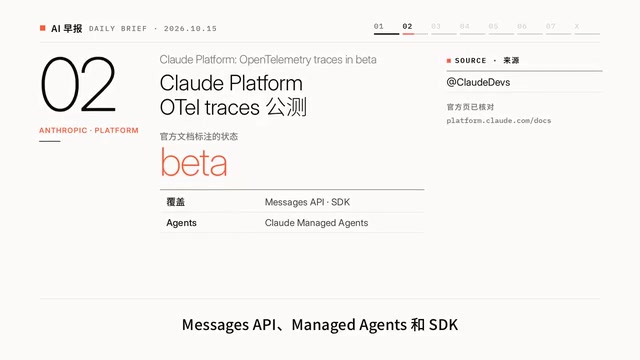
OpenTelemetry is an open-source observability framework under the CNCF that unifies the collection and export protocols for three types of telemetry data: Traces (call-chain tracing), Metrics, and Logs. In LLM applications, a Trace breaks a single request into layered Spans—for example, "user question → retrieval → tool call → model generation"—each with attributes such as latency, Token count, and model name. Compared with aggregated metrics alone, the value of Trace lies in locating bottlenecks in long chains: which tool call step slowed the overall response, or which retry round consumed extra Tokens. Claude Code exporting these fields by default means enterprises can plug the agent's execution process into existing backends such as Datadog, Grafana Tempo, and Jaeger without custom instrumentation, and correlate it with regular microservice monitoring data in the same view.
OpenAI's EU Sample: What Does Over Half Agent Usage Mean
OpenAI's published research gives a noteworthy ratio: in its EU enterprise sample, Codex and ChatGPT Work together account for more than half of Output Tokens. At the same time, for small and medium-sized enterprises with no more than 200 associated users, weekly active users have grown more than 8x since May.
Read together, these two data points show that enterprise-side AI consumption is shifting from "individual trial" to "workflow embedding." Output Tokens exceeding half means the content the model produces now mainly comes from office and coding tasks rather than scattered Q&A. The weekly active growth among SMEs shows that scale is no longer a barrier to AI adoption—organizations under 200 people are actually moving faster, likely because of shorter decision chains and lower pilot costs.
Output Tokens refers to the number of Tokens generated by the model, as opposed to Input Tokens on the input side. In API billing the two usually have different unit prices, with output often more expensive. Using "output share" as an observation metric is because it better reflects the model's actual workload: scattered Q&A has short output and a low share, while code generation, document writing, and multi-step agent execution produce large amounts of output. Thus, Output Tokens exceeding half can be roughly understood as the model's main capacity being used for substantive tasks rather than chit-chat. Note that this data comes from OpenAI's EU enterprise sample and has sample selection bias; it should not be directly extrapolated to global or industry-wide adoption levels, but it still has reference value as a directional signal.
Anthropic's Singapore Office: Fifth Asia-Pacific Stop and Government Cooperation
Anthropic opened an office in Singapore, its fifth location in the Asia-Pacific region, and signed a memorandum of cooperation with the Singapore government. Official figures disclosed: more than 1,500 GovTech staff use Claude Code, and Grab the Bricks says it saves about 40,000 hours per quarter.
A scale of 1,500 people is no longer pilot-level within a government technology department. Combined with this Claude Code desktop redesign toward multi-task dispatch, a consistent thread emerges: Anthropic is pushing "team-level, long-duration use" scenarios rather than a single-call API business. The signing of the memorandum also locks in this adoption relationship.
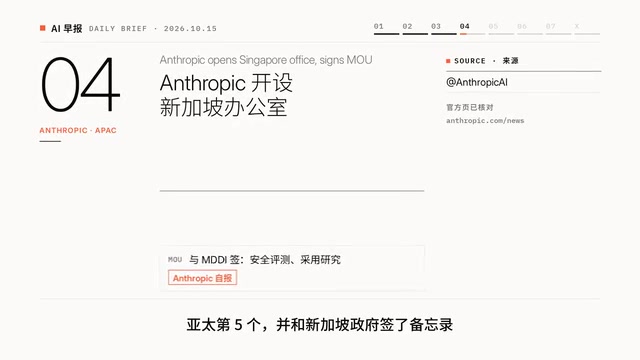
GovTech is the Government Technology Agency of Singapore, under the Prime Minister's Office, responsible for driving digitalization in the public sector and serving as the main executing agency for government technology procurement and pilots in Singapore. GovTech leading the introduction and promotion of Claude Code means the adoption is not an individual attempt by one department but an organization-level deployment backed by a unified technology governance body, which also explains how it quickly reached a scale of 1,500 people. Similar government technology agencies exist in other countries; they often serve as the first validation gate for new technologies entering the public sector, and their adoption decisions have a demonstration effect on local enterprises and surrounding markets.
On the Science Side: Argon Launch and DeepMind's Case Response
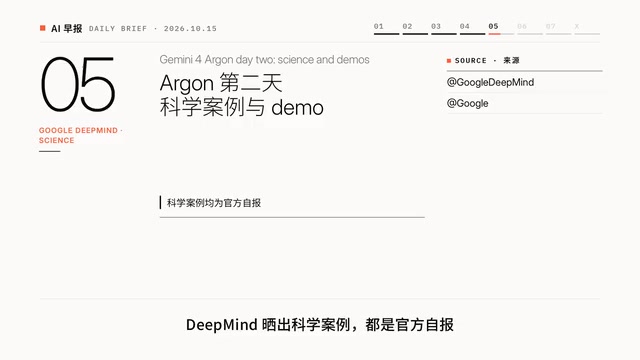
The day after Argon launched, DeepMind showcased a batch of scientific cases in response. At the same time, it officially announced that it would open the highest tier of Anti-Gravity to 10,000 scientists for free for six months.
This "launch-and-respond" rhythm is increasingly common in the recent science AI race. Opening the highest tier free to research users is, in the short term, about capturing usage habits, and in the long term, about accumulating cases and data in the field. For researchers, the barrier is indeed lowered, but they should also watch for migration costs after the free period ends.
Models and Tools at a Glance
JEV 1.14 listed on Open Router: $0.042 per million input Tokens, output free. The positioning is clear—it only answers structured questions, suitable for routing classification and gating tool calls. Such small models do not pursue general capability but use extremely low prices to handle high-frequency judgment-type requests.
Perplexity opens UltraFast Testing Catalog for Max subscribers: According to Testing Catalog, Grok Voice latency is reduced by about 40%. Note that this is a third-party paraphrase, not verified with xAI, so the figure is for reference only.
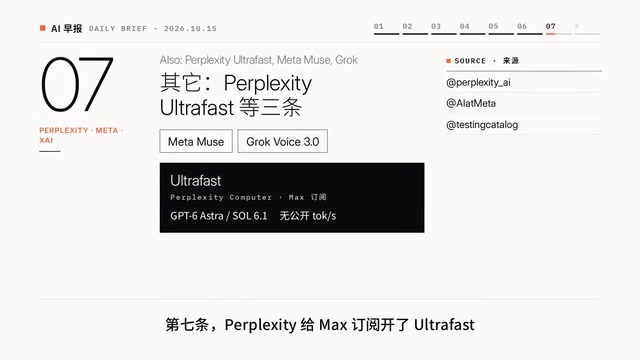
Other developments: Pi API opens Beta, slightly earlier than this window; Jensen Huang announces investment in UK companies in London; Open Router lists Assembly AI's speech-to-text model.
A Few Observations
What is most noteworthy in this batch of updates is not any single feature but two parallel trends. First, the product form of agent tools is changing—from "you ask, it answers" to "you dispatch, it runs." Claude Code's multi-session navigation and OpenTelemetry integration both serve this form. Second, enterprise adoption data is changing—agent usage exceeding half in OpenAI's EU sample and thousands of government users at Anthropic both point in the same direction: AI is becoming part of the workflow rather than an auxiliary tool.
Price-side signals are also worth noting. JEV 1.14 offers free output, and Anti-Gravity is free for six months, showing that in niche scenarios the price war continues, targeting two precise cuts: "tiny models for specific purposes" and "research users."
One-line Summary
Claude Code redesigns into a multi-session task console as enterprise agent adoption data rises in tandem
Paragraph Summary
This round of updates presents two parallel threads. On the product side, Claude Code's desktop main screen changes from a single chat window to a multi-session navigation hub, with tasks arranged as chess pieces and showing real-time status, plus a new BTW side-question entry; OpenTelemetry Traces enters public beta, with the Messages API, Managed Agents, and SDK all able to connect to self-hosted observability platforms, collecting duration, Tokens, model name, and tool name by default. On the adoption side, OpenAI discloses that in its EU enterprise sample, Codex and ChatGPT Work together account for more than half of Output Tokens, and SMEs under 200 people have seen weekly active users grow more than 8x since May; Anthropic opens its fifth Asia-Pacific office in Singapore, with over 1,500 GovTech staff using Claude Code. On the science side, there is Argon's launch and DeepMind's case response, opening the highest tier of Anti-Gravity free to 10,000 scientists for six months.
Related articles

Java Engineers Transitioning to Agent Development: A Complete Four-Week Learning Roadmap
A roadmap for Java engineers transitioning to AI Agent development: a four-week learning plan from core theory, the ReAct paradigm, and multi-agent collaboration to hands-on projects, analyzing the strengths, gaps, and job-market realities of a career change.

LangGraph Multi-Agent in Practice: Key Takeaways from a Bilibili Tutorial
A breakdown of a Bilibili LangGraph multi-agent tutorial covering architecture choices, core LangGraph components, and three hands-on projects: a code assistant, a prompt generation assistant, and a WebRTC digital human.

Backend to AI Agent Engineer: What Are P7 Interviewers Really Testing?
Based on a popular Bilibili AI Agent course, this analyzes backend developers' real path to Agent engineer: P7 interviews test engineering stability like strong validation, fallback degradation, and Semantic Cache—not Prompt tricks.