LangGraph Multi-Agent in Practice: Key Takeaways from a Bilibili Tutorial

A Bilibili tutorial systematically covers LangGraph multi-agent architectures, core components, and three progressive hands-on projects.
Based on a Bilibili tutorial, this article explains why multi-agent architectures are needed and the central role of the LangGraph framework. It notes that multi-agent architectures decouple complex logic through division of labor, with common patterns including hierarchical, collaborative, and competitive. Since version 0.2, LangGraph has integrated LangChain's agent and memory features, becoming the officially recommended agent runtime with core components such as graphs, nodes, edges, state, and checkpoints. The tutorial designs three progressive hands-on projects: a code assistant, a prompt generation assistant, and a large digital human multi-agent system combined with WebRTC. The article highlights that a practice-oriented learning path helps quickly build engineering experience and improve job competitiveness.
Why Do We Need a Multi-Agent Architecture?
When building complex AI applications, a single agent often struggles with multi-task, multi-role scenarios. A multi-agent architecture enables division of labor and collaboration, letting each agent focus on a specific domain, thereby improving the flexibility and maintainability of the overall system. The Bilibili tutorial states at the outset: the core reason for choosing a multi-agent architecture is to decouple complex logic and to leverage communication mechanisms between agents for more fine-grained control.
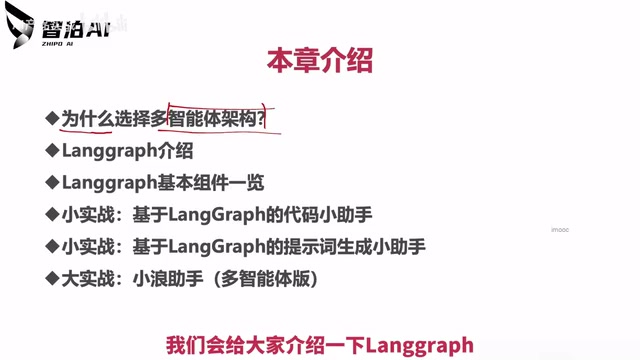
Common multi-agent architectures include hierarchical, collaborative, and competitive patterns. The tutorial emphasizes that different architectures suit different scenarios—for example, hierarchical is good for task decomposition, while collaborative is good for parallel processing. Understanding these patterns is the foundation for designing efficient systems.
Agent in the AI context typically refers to an autonomous software entity with perception, decision-making, and action capabilities. Its core capabilities are often built on large language models (LLMs) and can be extended through tool invocation, memory storage, and planning modules. A single agent's capabilities are limited by its context window and role definition; when facing tasks that require cross-domain knowledge or long multi-step collaboration, it can easily run into instruction conflicts or performance bottlenecks. A multi-agent architecture alleviates this by decomposing complex tasks into subtasks and assigning them to specialized agents with independent roles and tool sets. Common inter-agent communication mechanisms include message-passing bus patterns, shared state pools, and blackboard-system-based collaboration; these mechanisms determine the efficiency of task allocation, result aggregation, and conflict resolution. Understanding agent autonomy and communication topologies helps determine the applicable boundaries of different multi-agent architecture patterns (hierarchical, collaborative, competitive).
LangGraph: A Powerful Agent Development Tool in the LangChain Ecosystem
As an important part of the LangChain ecosystem, LangGraph is the officially recommended agent development framework. Starting from version 0.2, the official team extracted agent-related functionality (including the memory module) from LangChain and integrated it into LangGraph, making it more focused and powerful.
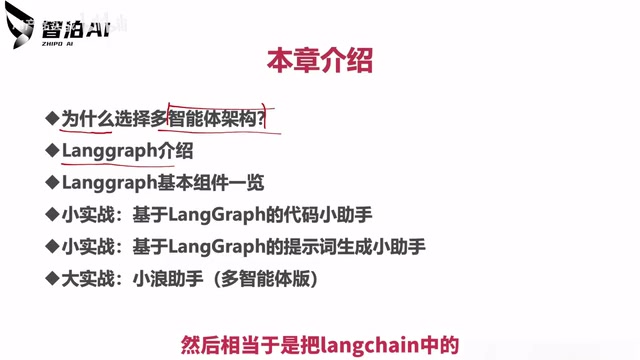
This adjustment means LangGraph is no longer just a simple graph-structure tool; it has evolved into a complete agent runtime environment. Developers can use its built-in state management, loop control, and persistence capabilities to build multi-agent systems with long-term memory and complex decision-making abilities.
LangChain is an open-source framework for building LLM applications, providing foundational abstractions such as model invocation, prompt templates, document loading, and tool integration. As agent applications grew more complex, LangChain's original Chain structure became increasingly limited in expressing loops, branching, and state persistence, so the official team separated and refactored the agent runtime into LangGraph. LangGraph centers on directed graphs as its core abstraction: nodes represent computation steps (often encapsulating agents or tool calls), edges define control flow, and it natively supports conditional branching, loops, and interruption recovery. Its built-in Checkpointer mechanism persists state snapshots during graph execution to external storage (e.g., memory, SQLite, Postgres), enabling long-running execution, human intervention, and failure recovery. Compared with LangChain's earlier linear execution mode based on AgentExecutor, LangGraph is closer to a state machine or workflow engine, suitable for orchestrating complex interactions among multiple agents.
Core Components at a Glance
The tutorial systematically reviews LangGraph's basic components, including Graph, Node, Edge, State, and Checkpointer. Together these components form the skeleton of agent collaboration: the graph defines the workflow, nodes encapsulate agent behavior, edges control flow logic, state passes information between agents, and checkpoints ensure persistence and recovery.
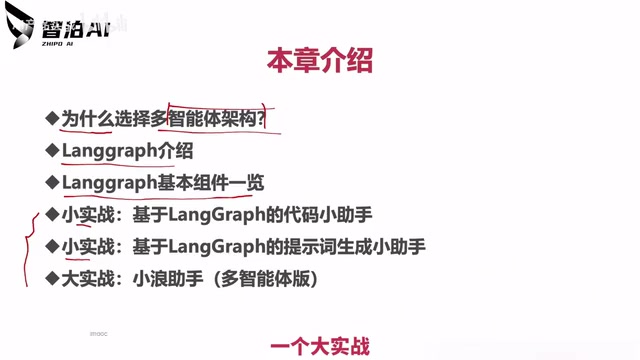
Mastering these components is a prerequisite for hands-on development. The tutorial uses diagrams and code snippets to show how to combine the components into a runnable multi-agent application.
State in LangGraph is usually a typed dictionary or data class that runs through the entire execution lifecycle of the graph; nodes share information by reading and updating state. State updates follow reducer rules: developers can specify whether a field is updated by overwrite or by append (e.g., accumulating a message list), which directly affects how information is aggregated during multi-agent collaboration. Checkpointer is the component that serializes and stores state at the end of each super-step, enabling the graph to resume execution from any historical node; it is the infrastructure for human-in-the-loop collaboration and fault-tolerant retries. Conditional Edge is a special form of edge that dynamically determines the next node based on a value in state, essentially routing logic within the graph. By combining these components, developers can build agent workflows with loop-based decision-making, dynamic branching, and persistent memory without managing complex control-flow code themselves.
Hands-On Cases: From a Code Assistant to a Digital Human
The tutorial designs three hands-on projects: two small projects (a code assistant and a prompt generation assistant) and one large project (a multi-agent digital human version combined with WebRTC). The code assistant demonstrates how to use LangGraph to coordinate multiple agents for code generation and review; the prompt generation assistant focuses on optimizing the prompt engineering workflow.
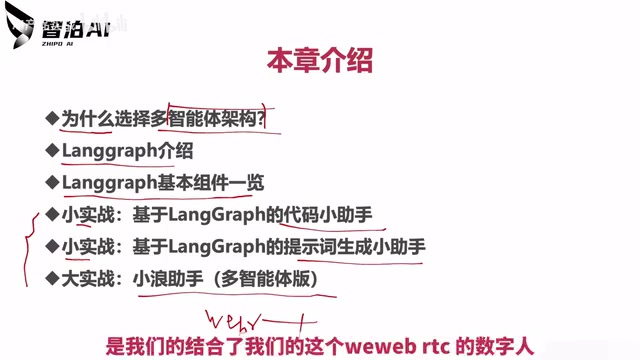
The large hands-on project integrates WebRTC real-time communication with multi-agent collaboration to build a digital human system with multi-component interaction capabilities. This case covers the full pipeline from architecture design to deployment, demonstrating LangGraph's practicality in complex scenarios.
WebRTC (Web Real-Time Communication) is a set of open standards that support real-time audio/video communication between browsers and mobile applications. Its core capabilities include audio/video capture, encoding/decoding, network traversal (ICE/STUN/TURN), and low-latency transmission. In digital human scenarios, WebRTC is responsible for transmitting the user's voice and video streams to the server in real time, and sending the digital human's synthesized voice, lip-sync animation, and facial expression video streams back to the user, forming a bidirectional interaction loop. When combining WebRTC with a multi-agent system, a real-time stream processing pipeline is usually required: a speech recognition agent transcribes audio into text, a dialogue management agent orchestrates multi-turn reasoning and tool calls based on LangGraph, and speech synthesis and animation-driving agents generate response content and push it back into the media stream. This architecture is latency-sensitive, so state passing and checkpoint strategies among agents need to balance persistence overhead against real-time requirements. A common practice is to keep short-term dialogue state in memory and only persist snapshots at key decision nodes.
Learning Path and Career Orientation
The tutorial emphasizes "all substance, no fluff," aiming to help learners quickly go from beginner to hands-on practice. Through three progressive projects, learners can not only understand the theory of multi-agent architectures but also accumulate reusable engineering experience. This practice-oriented content design directly helps job seekers who want to pursue AI application development.
As a learning platform, Bilibili's fine-grained explanations and code demonstrations provide developers with a low-barrier entry point. Combined with LangGraph's official ecosystem, learners can further explore more advanced features such as human-in-the-loop collaboration and dynamic routing.
Related articles

Anthropic Financials Leaked: Revenue Far Exceeds Compute Costs, Claude Inference Gross Margin Hits 68%
Leaked Anthropic financials show revenue roughly twice total compute costs, Claude inference gross margin at 68%, while frontier training burns $2.8B per quarter. This article breaks down the two accounts and analyzes shifts in AI company valuation logic.

JetBrains Open-Sources ThinkRail: A Visual AI Coding Workbench
JetBrains' open-source ThinkRail embeds an AI coding assistant into a visual dev environment with isolated workspaces, side-by-side chat and code diffs, and requirements docs alongside code.

JetBrains Open-Sources ThinkRail: A Hands-On Review of the Pi-Based Agentic IDE
ThinkRail is an open-source agentic IDE from a JetBrains Innovation Hub collaboration, built on Pi with spec-driven development and parallel multi-branch workspaces.