Claude Code Review's Three Modes Explained: How to Choose Between Quick, Standard, and Deep

Claude Code Review launches Quick, Standard, and Deep three-level review, centered on allocating review budget by risk.
Claude Code Review rolls out Quick, Standard, and Deep review levels. All three share the same underlying capability; the difference is how much inference budget they spend per line of code, creating a continuous trade-off among review depth, response speed, and cost. The article recommends Quick for immediate filtering on every push, Standard at the PR stage as the default, and Deep only for high-risk paths like authentication, encryption, and billing, or manually tagged PRs. Configuration should tier by repository risk profile rather than globally, making budgets predictable; before launch, use historical data to estimate each level's token consumption, feedback latency, and Deep's marginal hit rate over Standard. The article stresses that code review is shifting from on/off to budget-based, but risk classification standards still need to be defined by the team.
Claude Code Review recently rolled out three review levels—Quick, Standard, and Deep. This design turns what was originally a binary question (review or not) into a trade-off across a continuous spectrum: how to balance review depth, response speed, and cost. For teams already running code review in their CI pipelines, understanding the practical differences between these three levels matters more than rushing to enable Deep mode.
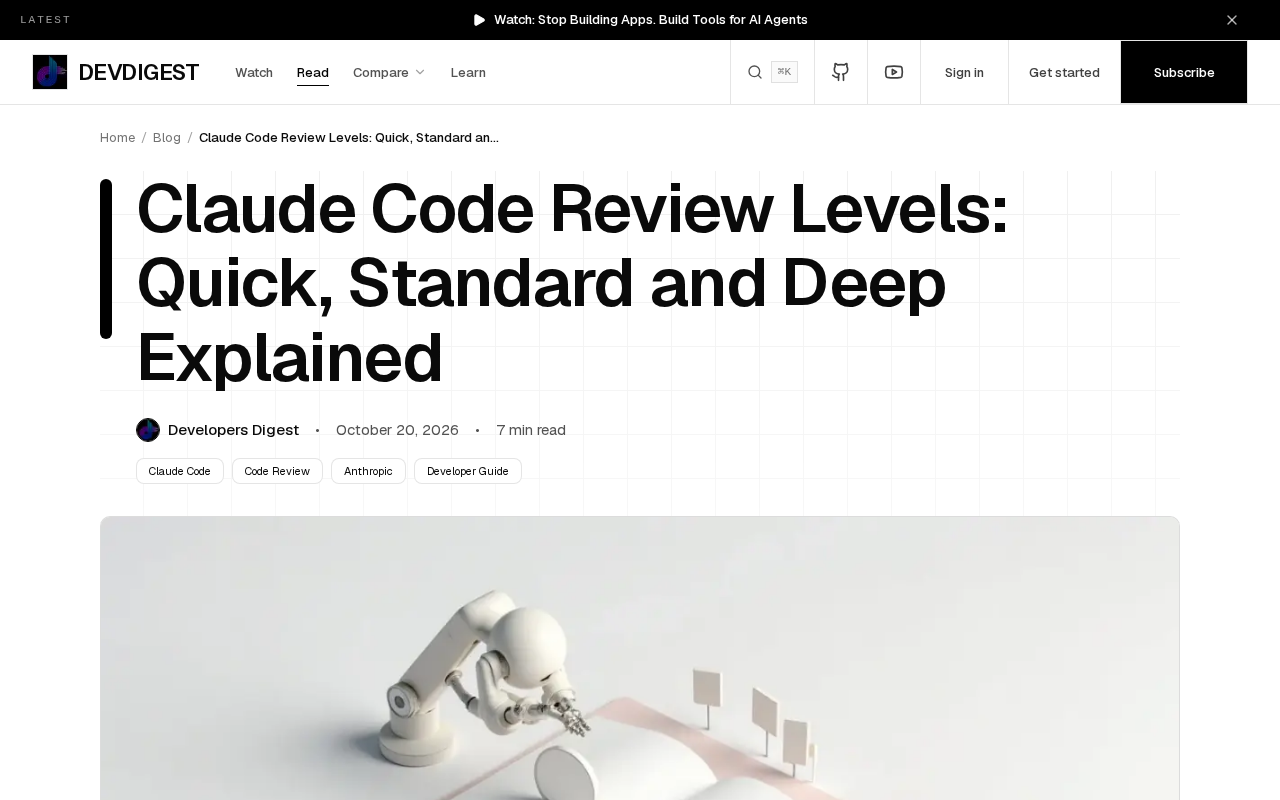
The core differences between the three review levels
All three levels share the same underlying review capability; the difference lies in how much inference budget they are willing to spend during review. Quick targets high-frequency, low-risk scenarios; Standard is the default level, balancing coverage and overhead; Deep maxes out the inference budget for changes where a missed detection is very costly.
In other words, choosing a level is fundamentally about "how many tokens you're willing to spend per line of code per unit of time." The deeper the review, the longer the call chains the model can trace and the more edge cases it can identify—but the time and cost per review rise accordingly.
Quick: lightweight review designed for high-frequency commits
Quick mode is suited to being triggered on every push. It tends to quickly identify obvious issues—clear null pointer risks, unhandled exception branches, suspicious hardcoded credentials—without repeatedly reasoning through complex control flow.
For repositories with high commit frequency, Quick's value lies in giving immediate feedback without blocking the development rhythm. The trade-off is that it is essentially powerless against implicit cross-file dependencies and issues that require understanding business semantics to judge. Treating Quick as a first-pass filter rather than the final line of defense is a more reasonable positioning.
Static analysis refers to techniques that discover potential defects by parsing source code's syntax trees, control flow graphs, and data flow graphs without executing the code. Common detections include null pointer dereferences, unreleased resources, and unreachable branches. It is fast and low-cost, but limited by its inability to know runtime state, it often cannot handle issues that depend on external input or business semantics.
Implicit dependencies refer to relationships between two code units that have no explicit import or function call but are indirectly coupled through global state, shared database tables, configuration files, environment variables, or message queues. Such dependencies do not appear in a single-file static view and must be traced across files or even repositories, so lightweight review modes typically struggle to cover them.
Standard: the balance point of the default level
Standard is the level most repositories should start with. It performs a certain degree of correlation analysis beyond single-file context, has decent recall for common logic errors and API misuse, while maintaining acceptable processing latency.
In pipeline design, Standard is better suited to the PR stage rather than every commit. This way it can catch issues before merging without triggering a costly review on every local push. The common practice for most teams is to leave Quick for push and Standard for PR, forming a two-stage funnel.
Deep: high cost in exchange for high coverage
Deep mode's positioning is clear: for high-risk changes. It is willing to spend more inference budget tracing the complete flow of data, checking race conditions in concurrent scenarios, and uncovering defects that only surface under specific input combinations.
But be clear-headed that Deep's marginal returns diminish. Applying it indiscriminately to all repositories and all PRs will quickly spiral costs out of control, while most everyday commits don't need this level of review at all. A more pragmatic approach is to enable it only on protected directories, core modules, or PRs tagged as high-risk.
Race conditions refer to situations where multiple threads or processes access shared resources in an unpredictable order, causing program results to depend on execution timing. A typical scenario is two threads simultaneously performing "read-modify-write-back" without lock protection, ultimately losing one of the updates. Such defects often don't appear in single-threaded tests and only surface under specific concurrent timing, so review tools need to be able to reason through multiple concurrent execution paths—requiring significantly more inference budget than ordinary checks.
Diminishing marginal returns is an economic concept meaning that, with other inputs unchanged, continuously increasing the input of one factor yields progressively smaller output increments per additional unit of input. Applied to review levels, the number of additional defects found when upgrading from Standard to Deep is usually far smaller than the increment from Quick to Standard. To judge whether an upgrade is worthwhile, look at the number of new findings rather than the total findings.
How to configure at the repository level
The key to configuration is binding levels to a repository's "risk profile" rather than applying a one-size-fits-all global setting. An actionable approach:
- Infrastructure and security-related repositories: Standard by default at the PR stage, with Deep coverage for paths involving authentication, encryption, and billing
- Business application repositories: Quick triggered on push, Standard on PR, with Deep triggered by manual tagging
- Experimental repositories and prototypes: Keep only Quick to avoid review costs slowing down iteration
The benefit of per-repository configuration is predictable budgets. Each repository's review overhead roughly equals its commit frequency multiplied by the level's unit price—a number you can estimate before rollout.
How to budget costs before launch
Before rolling out across the board, it's advisable to first run a small-scale calculation using historical data: pick a representative repository, count commits and PRs over a period, run one round at each of the three levels, and record the actual token consumption and latency per review.
This calculation can answer two key questions: first, whether the price difference between Quick and Standard is worth it; second, how high Deep's hit rate is (the proportion of cases where it actually finds issues that Standard missed). If Deep produces almost no new findings in the sample, then its return on investment on the current codebase doesn't hold up.
Another easily overlooked cost is waiting time. The higher the review level, the longer developers wait for feedback—and the impact of this delay on iteration rhythm is often more direct than token costs. Your budget table should look at "average feedback latency" and "cost" together.
Recall in the context of defect detection refers to the proportion of all real defects that a tool correctly identifies—measuring "did it miss anything it should have caught?"; the counterpart, precision, refers to the proportion of reported issues that are real defects—measuring "are the reported issues reliable?" When evaluating review levels, these two metrics must be considered together: chasing only high recall pushes a flood of false positives to developers, which actually increases manual review burden.
The engineering thinking behind tiered review
The three-level model reflects a broader trend: code review is moving from "on/off" to "budget-based." Teams no longer ask "should we use AI review?" but "how much review budget are we willing to spend on this code?" This shift lets review intensity adapt to code risk and makes costs measurable and allocatable.
For toolchains, tiering also makes integration more flexible—CI systems can dynamically select review intensity by branch, directory, or tag without maintaining a fixed review configuration for the entire repository.
What teams really need to figure out in advance is the risk classification standard itself. Levels are a capability the tool provides, but which repositories and paths count as high-risk still needs to be defined by people. If this classification is defined crudely, even the most granular review levels will just waste budget in the wrong places.
One-line Summary
Claude Code Review introduces Quick, Standard, and Deep three-level review, with the core idea of allocating review budget by risk.
Paragraph Summary
Claude Code Review has launched Quick, Standard, and Deep three-level review modes. All three share the same underlying capability; the difference lies in how much inference budget they are willing to spend per line of code, forming a continuous trade-off among review depth, response speed, and cost. The article recommends Quick for immediate filtering on every push, Standard at the PR stage as the default level, and Deep limited to high-risk paths such as authentication, encryption, and billing, or manually tagged PRs. Configuration should tier by repository risk profile rather than a global one-size-fits-all approach, making budgets predictable; before launch, use historical data to estimate each level's token consumption, feedback latency, and Deep's marginal hit rate relative to Standard. The article emphasizes that code review is moving from on/off to budget-based, but the risk classification standard still needs to be defined by the team itself.
Related articles

Automate Job Search with AI Agents and Residential Proxies for Precise Matching
Build an AI Agent with MCP and residential proxies to bypass recruitment site anti-scraping and geo-restrictions, scrape thousands of DevOps jobs, then have Claude score and rank each against your resume. Includes proxy comparison experiments, project structure, and cost analysis—filtering only, no auto-submission.

The AI Task Assistant That Knows When to Back Off: A Cure for Activation Struggles
One Small Step is an AI assistant for task initiation struggles, using agentic decisions for guilt-free reminders, timely retreat, and cross-platform task management. The developer shares real test results on 13 tasks and architectural trade-offs.

FastAPI: A High-Performance Python Framework and a Production-Ready API Development Powerhouse
FastAPI is a high-performance web framework based on Python type hints, supporting async and automatic OpenAPI docs. With over 100k GitHub stars, this article analyzes its core strengths, production readiness, and selection advice.