Claude Code's Most Powerful SEO Skill Pack: 26 Sub-Skills + 19 Subagents
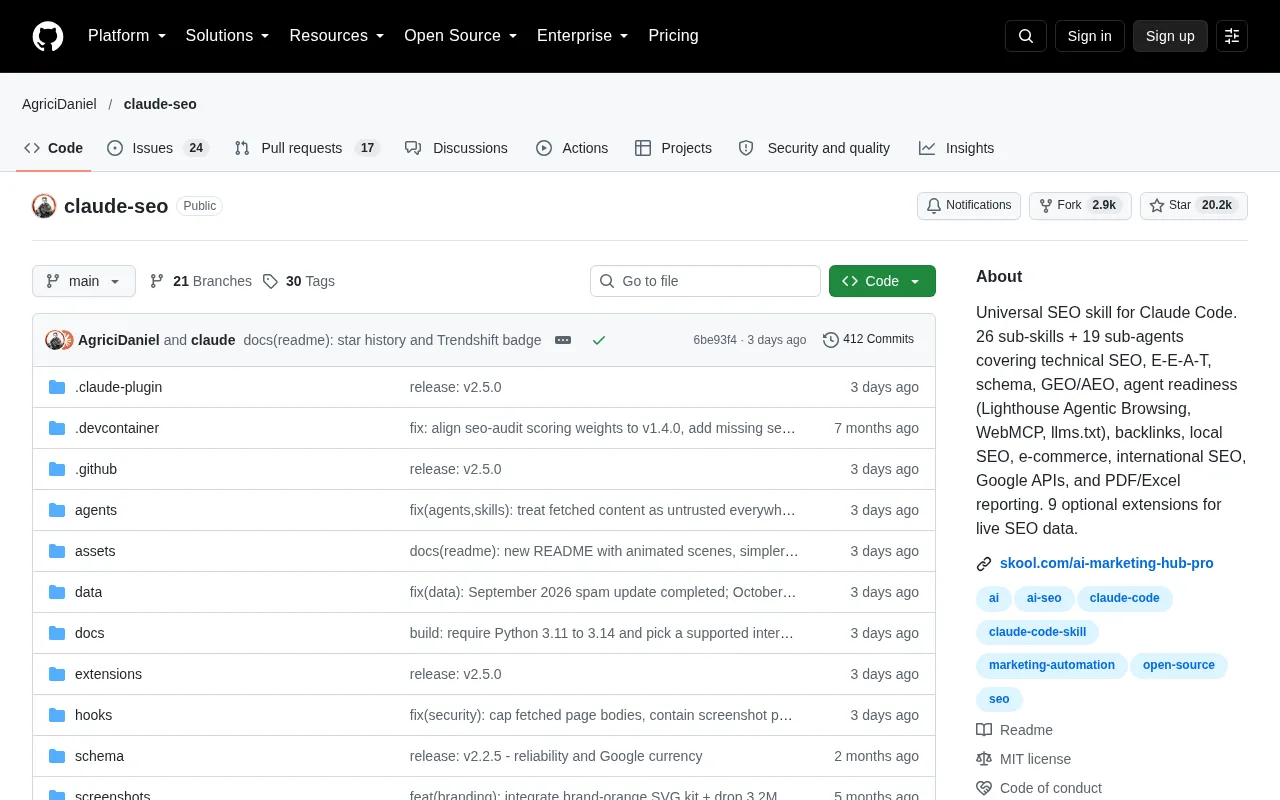
Open-source project claude-seo packages SEO workflows into 26 sub-skills and 19 subagents for Claude Code, covering emerging areas like GEO/AEO.
claude-seo is a popular open-source project on GitHub that breaks down a complete SEO methodology into 26 sub-skills and 19 subagents for Claude Code to invoke precisely based on task context. It covers technical SEO, E-E-A-T content evaluation, Schema, GEO/AEO, Agent Readiness (Lighthouse Agentic Browsing, WebMCP, llms.txt), backlinks, local and e-commerce SEO, and supports PDF/Excel report output, Google API integration, and 9 real-time data extensions. Written in Python, it has gained about 20,000 stars and 2,900+ forks, with 179 new stars in a single day. The article argues it reflects three trends: skill-based packaging becoming the mainstream path for AI tools, SEO boundaries expanding toward AI discoverability, and open-source solutions competing with commercial SEO platforms.
Claude Code's Most Powerful SEO Skill Pack: 26 Sub-Skills + 19 Subagents
As large language models begin to take over code writing and content generation, the workflows of SEO practitioners are being redefined. An open-source project called AgriciDaniel/claude-seo has quietly gained traction on GitHub, packaging a complete SEO methodology into skill modules that Claude Code can directly invoke.
What Problem Does This Project Solve
Claude Code itself is a powerful programming assistant, but when it comes to SEO—a composite discipline spanning technology, content, data analysis, and report output—general capabilities often fall short. The approach of claude-seo is to break SEO work down into atomic sub-skills, allowing Claude Code to invoke them precisely when needed.
The project includes 26 sub-skills and 19 subagents, covering everything from technical SEO and E-E-A-T content quality assessment to structured data (Schema), GEO/AEO (Generative Engine Optimization and Answer Engine Optimization), backlink analysis, local SEO, e-commerce SEO, and international SEO.
The key value of this design lies in "composability": users don't need to load all capabilities at once; instead, Claude Code selects the appropriate capability modules based on task context.
Claude Code is a command-line programming assistant launched by Anthropic, supporting capability expansion through "Skills" and "Subagents" mechanisms. Skills are typically instruction packages encapsulating domain-specific knowledge and workflows, loaded on demand when the model identifies relevant tasks; subagents are independent execution units that can be invoked by the main agent. The significance of this architecture is that it avoids stuffing all domain knowledge into a single context, instead dynamically composing by task—saving tokens and improving accuracy. claude-seo leverages this mechanism to break SEO methodology into fine-grained modules, giving a general-purpose programming assistant expert-level performance in vertical scenarios. Understanding this is key to seeing why the number of "sub-skills + subagents" becomes a metric for measuring such projects' coverage.
Coverage Far Beyond Traditional SEO Tools
If it only covered traditional keywords and backlinks, this project would be unremarkable. Its differentiation lies in coverage of emerging optimization domains.
GEO and AEO: Optimization for AI Search
GEO (Generative Engine Optimization) and AEO (Answer Engine Optimization) are concepts that have emerged over the past two years alongside the rise of AI search. By incorporating these two into its skill system, claude-seo attempts to help content gain visibility in answers from generative engines like ChatGPT and Perplexity.
GEO (Generative Engine Optimization) and AEO (Answer Engine Optimization) are often used interchangeably, but they emphasize different things. AEO focuses on making content directly extractable as "answer summaries," typically like featured snippets or voice assistant responses; the core is clear Q&A structure, explicit entities, and semantic compactness. GEO targets engines that generate synthesized answers via large models (such as ChatGPT Search, Perplexity, Google AI Overviews), focusing on whether content is retrieved, cited, and attributed. The common premise of both is that AI search no longer returns just a list of links—it first understands, then synthesizes, then cites. Therefore, content needs parseable structure (such as clear heading hierarchies, FAQ blocks, structured data), verifiable authority signals (author, source, update time), and machine-readable semantic markup. Compared with traditional SEO, GEO/AEO emphasizes "being cited" rather than "being clicked," and metrics shift from rankings to citation rate, answer share, and brand mentions.
Agent Readiness: Preparing Websites for Intelligent Agents
The project also includes Agent Readiness-related capabilities, specifically involving LighthouseAd Agentic Browsing, WebMCP, and llms.txt. This points to an emerging trend: websites must not only be readable by humans and search engine crawlers but also by AI agents. Conventions like llms.txt are becoming an entry point for websites to declare their content structure to large models.
Agent Readiness refers to the preparation a website makes for AI agents (rather than human users or traditional crawlers) to access, understand, and operate on it. It involves several layers: first, discoverability—declaring site structure, core content, and terms of use to large models through conventions like llms.txt, similar to robots.txt but aimed at LLMs; second, operability—WebMCP (the web-side extension of the Model Context Protocol) lets websites expose callable tools and interfaces to agents in a standardized way, enabling agents to perform actions like searching, ordering, and filling forms; third, observability—Lighthouse Agentic Browsing evaluates a page's accessibility and structural quality in agent browsing scenarios. The background for this concept's rise is that more and more traffic comes from AI agents rather than human clicks; if a website cannot be correctly parsed and invoked by agents, it will lose visibility in the "agent economy."
Report Output and API Integration
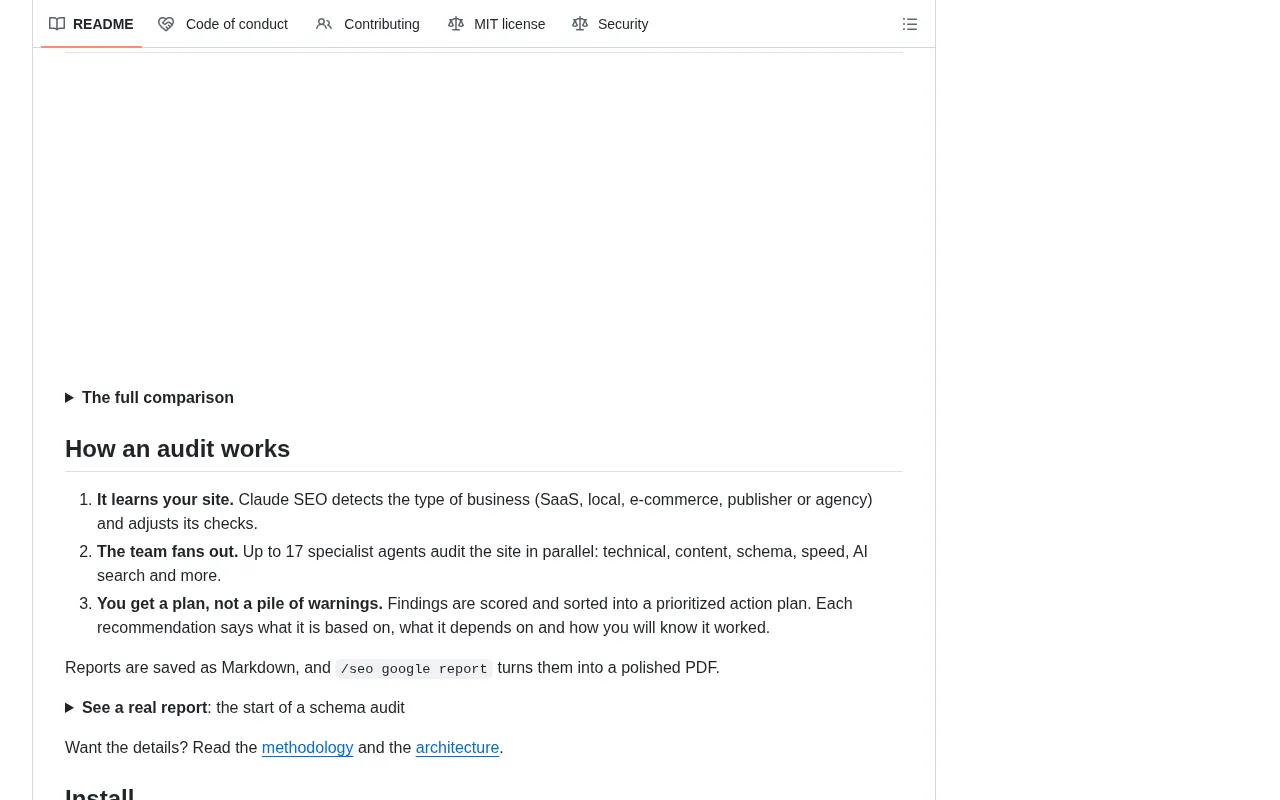
Beyond analysis capabilities, the project supports PDF and Excel report generation and integrates Google APIs. This means it doesn't just "give advice"—it produces deliverables that can be handed directly to clients or teams. It also offers 9 optional extensions for connecting to real-time SEO data.
Data Performance and Community Signals
Written in Python, the project currently has approximately 20,186 stars and 2,907 forks on GitHub, with 179 new stars added in a single day.
For a vertical-domain tool project, a star count in the twenty-thousands indicates it has hit a real need. SEO practitioners have always been willing to pay for automation tools, and embedding workflows into a developer-friendly environment like Claude Code lowers the barrier to entry.
Several Judgments Worth Noting
Skill-based packaging is the mainstream path for AI tools to land. No matter how powerful a general model is, vertical scenarios still require structured knowledge injection. claude-seo organizes SEO expertise through sub-skills and subagents, essentially turning domain experience into an executable instruction set for models.
The boundaries of SEO are expanding toward AI discoverability. From traditional crawler optimization to GEO/AEO, and then to llms.txt and WebMCP, the optimization target has shifted from "search engine rankings" to "being correctly understood and cited across various AI systems." The project's coverage of these directions reflects the migration of industry focus.
Competition between open-source tools and commercial SEO platforms will intensify. When an open-source project can cover technical audits, content evaluation, report generation, and data access, the value proposition of traditional SEO SaaS products needs to be re-examined. Of course, real-time data quality, crawler scale, and accuracy remain areas where open-source solutions will struggle to catch up in the short term.
Usage Recommendations
For developers or SEO teams already using Claude Code, this project is worth experimenting with as part of their workflow. It's recommended to start with well-defined tasks like technical SEO audits and Schema generation, then gradually expand to E-E-A-T evaluation and GEO-related capabilities. Note that the 9 extensions involve external data access, so the reliability and cost of data sources need to be evaluated.
Project address: github.com/AgriciDaniel/claude-seo
One-line Summary
Open-source project claude-seo packages SEO workflows into 26 sub-skills and 19 subagents for Claude Code, covering emerging domains like GEO/AEO.
Related articles

The Truth Behind Titanic's Sinking: Key Decisions and Communication Failures in the National Geographic Documentary
National Geographic's The Unsinkable Ship uses survivor testimony to reconstruct Titanic's fatal decisions—from the missing MSG telegram prefix and the broken boiler-room-to-bridge link to how 'unsinkable' thinking delayed damage control and evacuation.

74M-Parameter Open-Source Model Partially Outperforms Jev AI in Testing
Fastino AI's Glider 2.5 models, with just 74M–300M parameters, reportedly outperform Jev AI in some guardrail benchmarks per YouTube testing, run on consumer hardware, and even play Doom. We analyze small models' competitiveness and deployment value on specific tasks.

Gemini 4 Argon Hands-On: Aggressive Pricing, 3D Capabilities Need Coaching
Gemini 4 Argon hands-on: limited-time $2/$10 pricing, million-token output, strong 3D and reverse-engineering work, but weak front-end aesthetics and zero-shot ability need coaching.