Claude Code Setup and Practical Guide for Users in China: Bypassing Bans and Full MCP Integration Explained

A Bilibili creator shares a Claude Code learning path: from installation and built-in commands to MCP configuration.
Based on a Bilibili creator's livestream opening, the article discusses the rise of AI coding agents among developers in China and notes that hand-writing code has sharply declined in production. It compares Claude Code, Codex, Cursor, and Tree, relaying the creator's view that the first two are stronger at code and documentation generation. On account bans, the creator blames official bans and proposes skipping account registration; the author is cautious, calling this speculation without verifiable details. The article then outlines six course modules—installation, built-in commands, MCP configuration, SQL skills, Subject, and DRMD file—and stresses that MCP and built-in commands distinguish basic from skilled use. It concludes that the material is a roadmap, not a manual.
From "Old-School Coding" to AI Agents: Why Claude Code Is Worth Learning Seriously
At the start of a livestream class, a Bilibili creator opened with an observation: in his company's production environment, hand-writing code (what he calls "old-school coding") has become rare—most development now relies on web coding tools for assistance.
This judgment isn't an exaggeration. For programmers in China, the mainstream choices currently center on Claude Code, Codex, Cursor, and Tree. The creator stated outright that the two coding agents Claude Code and Codex perform better on code generation and documentation output than Cursor and Tree—though he added that this is just his personal feeling and that which tool to choose ultimately depends on one's own needs.
The problem is that many learners use Claude Code "unprofessionally," often stopping at chat-style conversation. This course attempts to cover exactly the details that are easily overlooked: installation and integration, full-line mode and built-in commands, MCP tool development and configuration, SQL skill usage, Subject, and Claude's DRMD file.
The Root Cause of Account Bans and the "Bypass Login" Approach
During the livestream, someone asked how to use Claude Code stably. The creator's explanation was: the root of account bans lies in accounts being banned by Claude's official website, and the official side has certain biases that make bans easy to trigger.
His proposed countermeasure is to bypass login—no account registration is needed at login, so the ban issue no longer arises. According to him, from the first day of installation to now, his own Claude Code has never been banned. During use, you can connect either foreign models or domestic models, configuring them yourself.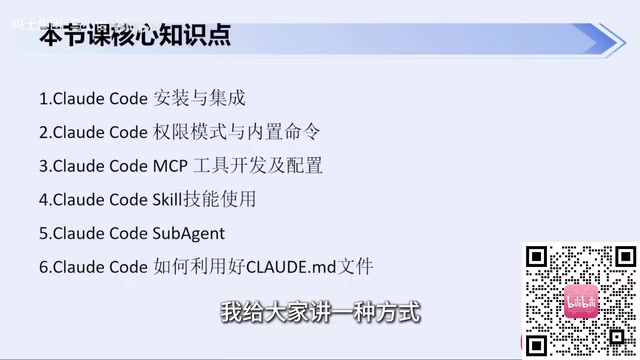
This content should be viewed objectively: the creator attributes bans to "political bias," which is more personal speculation than a verifiable technical conclusion; the specific mechanism of "bypassing login" is also not elaborated in the original material, and practical details are missing. For readers, a more prudent understanding is this—the stability of the account system is a prerequisite for long-term use of agent tools, and specific solutions need to be evaluated against official terms and the actual environment rather than copying claims from a single source.
The essential difference between coding agents and chat-style AI lies in their "action capabilities": reading and writing local files, executing shell commands, running tests, and invoking Git. As a result, their account and authentication systems are more sensitive than those of ordinary chat products. Claude Code officially supports logging in via a subscription account as well as using an API Key with pay-as-you-go billing; the former ties quota and risk control to an individual account, while the latter is associated with an organization-level API account. What is called "bypassing login" in practice usually means switching to an API Key or a third-party endpoint compatible with the OpenAI protocol, rather than truly evading official terms. It should be noted that using unofficial channels may involve service-terms risk, cross-border data transfer, and compliance issues; stability and security must be weighed by yourself, and it is not advisable to simply copy others' experience.
The Course's Knowledge Map: Six Modules
Judging from the outline, this course is designed to cover a complete path from beginner to advanced:
- Installation and integration: solves the question of whether the tool can run at all—the prerequisite for everything that follows.
- Full-line mode and built-in commands: most people only use the chat function, but built-in commands are where efficiency differences come from.
- Development and configuration of MCP tools: MCP is the key interface for extending Claude Code's capabilities; only with proper configuration can external toolchains be connected.
- Using SQL skills: brings database operations into the agent workflow, reducing manual switching.
- Subject: only the name is mentioned in the material, with no details.
- Claude's DRMD file: also appears only in the outline, with no explanation in the original material.
MCP (Model Context Protocol) is an open protocol proposed by Anthropic at the end of 2024 for connecting large-model applications to external data sources and tools in a standardized way. You can think of it as the "USB interface" of AI applications: the model itself can only process text within its context, while an MCP Server can package databases, file systems, third-party APIs, internal services, and other capabilities into tools in a unified format for agents to call as needed. The protocol uses a client–server architecture and defines three primitives—tools, resources, and prompts—so the same MCP Server can in theory be reused by multiple clients such as Claude Code and Claude Desktop. For developers, the value of MCP is that it turns "writing a separate integration for every tool" into "implement once according to the protocol and reuse it"—which is why the article emphasizes that "only with proper configuration can external toolchains be connected."
The DRMD file is very likely a mispronunciation or transcription error for a project-level instruction file such as CLAUDE.md. Such files are placed in the project root to persistently tell Claude Code about project structure, coding standards, common commands, prohibitions, and other contextual information. The agent automatically reads them at the start of each session, avoiding the need to repeatedly explain background in conversation. The difference from one-off prompts is that they are "persistent" and "versioned"—they can be committed, reviewed, and iterated along with the codebase, effectively distilling team conventions into machine-readable configuration. Only by understanding this can one understand why the article lists the "DRMD file" alongside MCP configuration as key steps from the "chat box" toward a "configurable development environment."
Practical Value for Learners
The truly valuable part of this course is not the act of "installation" itself—installation was never the hard part—but its attempt to restore Claude Code from a "chat box" to a configurable, extensible development environment. MCP configuration and built-in commands are precisely the divide between "knowing how to use it" and "using it well."
But a reminder is also in order: the material itself is a livestream opening, with limited information density. Several modules (Subject, DRMD file, SQL skills) have only names and no content, and "bypassing login" remains at the level of a conclusion. It is suitable as a learning roadmap, but not as a complete operations manual. For developers in China, the tool-selection judgment can be borrowed, but specific configurations still need to be verified against official documentation and your own environment.
One-line Summary
A Bilibili creator shares a Claude Code learning path: an advanced map from installation and built-in commands to MCP configuration.
Paragraph Summary
The article is based on the opening content of a Bilibili creator's livestream and discusses the spread of AI coding agents among developers in China, noting that hand-writing code ("old-school coding") has greatly decreased in production environments. The author compares tools such as Claude Code, Codex, Cursor, and Tree, relaying the creator's personal view that the first two are better at code and documentation generation. Regarding account bans, the creator attributes them to official account bans and proposes a login approach that skips account registration; the author remains cautious, noting that this is personal speculation lacking verifiable details. The article then outlines the course's six modules—installation and integration, built-in commands, MCP configuration, SQL skills, Subject, and DRMD file—and emphasizes that MCP and built-in commands are the key to distinguishing "knowing how to use" from "using it well." Finally, it reminds readers that the material's information density is limited and should be treated as a learning roadmap rather than an operations manual.
Related articles

Last Week Tonight Exposé: The Dangerous Ties Between Politicians and White Supremacy
Last Week Tonight investigates Georgia Senate candidate Mike Collins and Florida candidate Marshall Rawson, exposing their multiple ties to white supremacists and the Republican Party's silent response.
AI Buzz Weekly: GPT-6.5 Leak, New Claude Model, and MiniMax's Cost-Effectiveness
This week's AI buzz roundup: suspected GPT-6.5 leak, Microsoft configs showing GPT-6.1 Tera, Anthropic's new model that can identify entire classes of bugs, disappointing early Gemini 4 Carbon results, and MiniMax M3.1 Flash beating Claude Opus 5 and GPT-5.6 Sol in benchmarks at extremely low cost.

AI Briefing: Gemini 4 Carbon Released, Ant Open-Sources Ling-3.1
AI Briefing: Google releases Gemini 4 Carbon qubit model, claiming to surpass Opus 5.5 with half-price tokens; Ant open-sources Ling-3.1-1019 for real-task Personal Agents; domestic AI drug discovery succeeds in 18 of 19 projects, hitting all 6 GPCR targets; zero-revenue company valued at $20B raises another $1B; Sichuan convenience store robot sales fail.