Claude Code v2.1.286 Update Breakdown: Security Fixes and Multi-Session Experience Improvements

Claude Code v2.1.286 ships with security hardening, session reliability fixes, and subagent stability improvements.
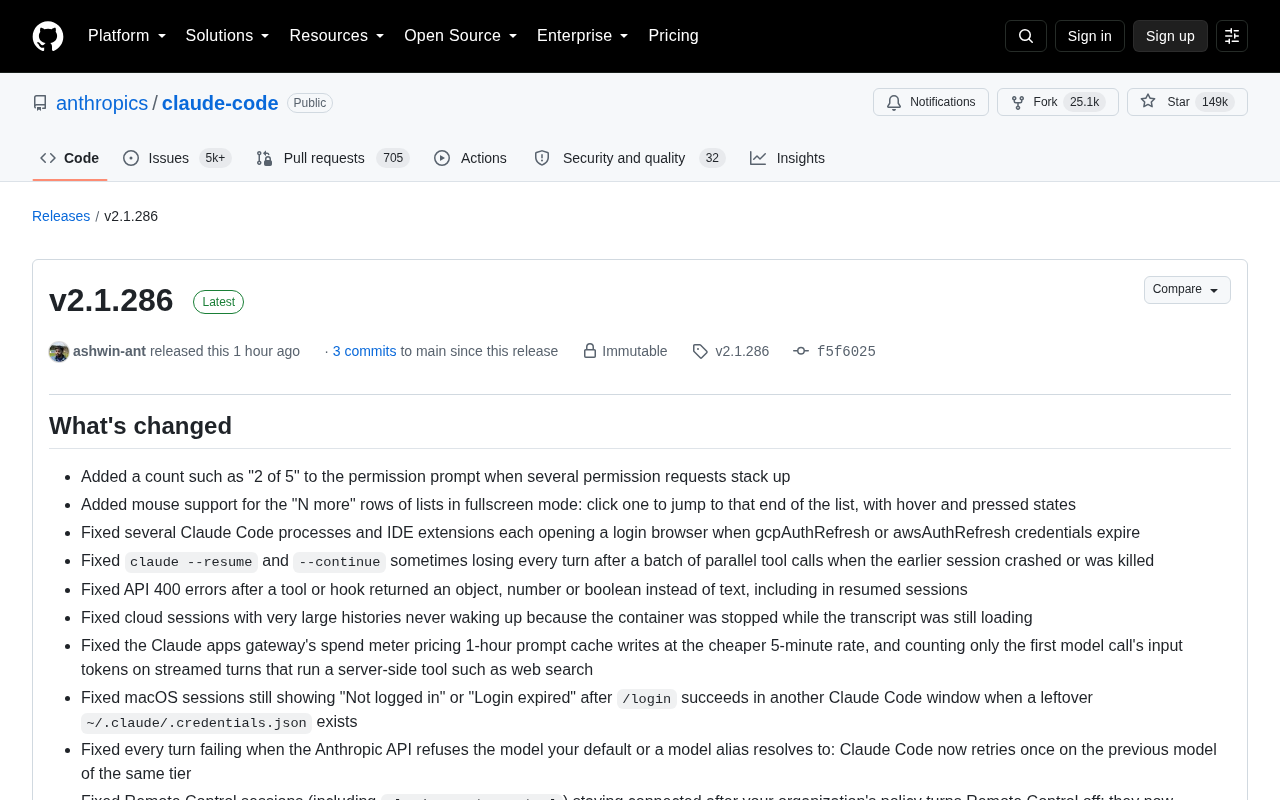
Anthropic released Claude Code v2.1.286, focusing on stability hardening and security reinforcement across credential redaction, session resumption, subagent collaboration, the VS Code extension, and retry logic. Security fixes systematically address credential leaks in logs and error messages, including partial masking of Bearer tokens and zero-width character bypass. Session reliability fixes resolve silent context loss on `--resume`/`--continue` after crashes and unrecoverable cloud sessions with large histories. Subagent fixes cover missing task-tracking tools, redundant worktree CLAUDE.md loading, and abnormal restarts after connection stalls. The VS Code extension gains a bookmark panel and Q&A history. API retry logic is refactored with graceful model degradation, and `--bare` mode behavior is redefined. Power users and enterprise teams should upgrade promptly.
Anthropic has shipped v2.1.286 for its command-line AI coding tool, Claude Code. This changelog is substantial, touching permission prompts, session resumption, credential redaction, subagents, and the VS Code extension. Rather than a feature leap, this is a dense round of stability hardening and security reinforcement — the kind of update that often delivers more real-world value to power users than shiny new features.
Security and Credential Redaction Are the Headliners
This update includes extensive, meticulous fixes around credential and key protection. It reads like Anthropic systematically tightening the risk of sensitive data leaking through logs and error messages.
Multiple fixes converge on a single goal: keeping secrets out of logs, transcripts, and error strings. Specifically: credential values are no longer exposed when Bearer or Basic appears before the key name in an error message; percent-encoded Bearer tokens that were only partially masked are now fully redacted; keys that previously slipped through when the key name contained zero-width or other invisible characters are now properly handled; and passwords containing punctuation like ), quotes, ], &, or a second @ in a URL are no longer partially leaked.
Additionally, a bug where session transcripts in the zip saved to disk by the /feedback command produced invalid JSON lines after key redaction has been fixed. Taken together, these changes reflect a systematic audit of cases where the redaction logic itself could fail — especially important for enterprise users running Claude Code on projects that involve secrets and API keys.
Session Resumption and Cloud Session Stability Fixes
For users who rely on claude --resume and --continue, several critical bugs have been resolved.
The most notable: when an earlier session crashed or was killed, --resume and --continue could silently drop every subsequent conversation turn following a batch of parallel tool calls. Silent context loss of this kind is catastrophic for long-running tasks. Also fixed: API 400 errors triggered when a tool or hook returned an object, number, or boolean instead of text — including in resumed session scenarios.
Cloud sessions received several improvements as well. Cloud sessions with very large histories could previously get stuck in an unrecoverable state if the container was stopped while the transcript was still loading — this is now fixed. Routines that ran against a cloud session that never actually started would incorrectly report "success"; they now correctly surface as "failed" — a meaningful fix for teams running automated pipelines who need accurate execution results.
Subagent and Permission Prompt UX Improvements
Subagent-related fixes make up a significant portion of the changelog, reflecting how central multi-agent workflows have become to how people use Claude Code.
Fixes include: foreground subagents sometimes missing TaskCreate/Get/Update/List, TodoWrite, and related tools in sessions where task tracking was enabled; subagents with worktree isolation redundantly reloading the project's CLAUDE.md and its imports from the worktree copy on the first file read; and Workflow tool subagents being restarted from the original prompt after a mid-response connection stall lasting several minutes. These are exactly the kinds of edge cases you hit when running multi-agent workloads in parallel.
Permission prompts are also clearer. When multiple permission requests are stacked, the prompt now shows a count like "2 of 5"; fetch, skill, file read, sandbox network, and Workflow script permission prompts have been unified to match the visual style of file edit prompts; Bash, PowerShell, and Monitor prompts now render command content inside a dashed border for improved readability.
What is a Subagent? In Claude Code's multi-agent architecture, a subagent is an independent execution unit dynamically spawned by the primary agent (orchestrator). Each subagent has its own context window and tool call permissions, and can handle tasks like code generation, file I/O, or external API calls in parallel, reporting results back to the orchestrator. Worktree isolation is a Git feature that allows multiple branches of the same repository to be checked out simultaneously in separate directories — subagents use this to work on isolated filesystem copies without interfering with each other. However, this also introduces boundary issues like redundant CLAUDE.md loading. CLAUDE.md is the project-level configuration file that Claude Code reads from the repository root to pass project-specific instructions to the model; if multiple subagents import it redundantly, it can cause context bloat or conflicting instructions. This fix targets exactly that class of multi-agent boundary condition.
VS Code Extension Gets Bookmarks and Q&A History
The VS Code extension received some genuine new features this release, not just fixes.
A new Bookmarks feature lets users save Claude's responses and pin them in the sidebar panel for quick reference. Q&A interactions are now written into the conversation: after you answer one of Claude's question cards, a Questions row appears recording each question and your selection. Question cards also gained option previews, showing a highlighted mockup or code snippet beside or below the relevant option.
Interaction behavior has also been adjusted: Stop and Escape now only end the current turn — background agents keep running and can be stopped individually from the agent map. The "✻ Claude Code" status bar item now appears in every window, even when no file is open, so you can always invoke Claude. These changes make managing multiple parallel tasks within VS Code feel more natural for developers.
Retry Logic and --bare Mode Behavior Changes
Beyond fixes, several default behaviors have changed — worth noting before you upgrade.
API request retry logic has been refactored: a single limit now covers the entire model call, and under default retry settings, a failing call will send at most 14 requests total, preventing runaway retries. --bare mode has been redefined — it now only connects to MCP servers explicitly specified on the command line, sends no system reminders to the model, and launches no background tasks. Under --bare, shell commands that reach their timeout are killed immediately rather than being moved to the background.
Additionally, when the resolved model for a default model or alias is rejected by the Anthropic API, Claude Code will now retry once on the previous model in the same tier, rather than letting every turn fail outright. This graceful degradation design minimizes the user impact of transient model availability issues.
What is MCP? MCP (Model Context Protocol) is an open protocol led by Anthropic that standardizes how AI models connect to external tools and data sources. MCP servers run as independent processes and expose tools, resources, and prompt templates to the model, enabling Claude to call databases, APIs, local filesystems, and other external capabilities. With
--baremode redefined, only MCP servers explicitly named on the command line are loaded — system-level background tasks and reminders are suppressed. This makes--barewell-suited for automation scripts or CI/CD integrations that require minimal interference and precise control over model behavior, providing a clean, predictable execution boundary.
Wrap-Up
v2.1.286 is a classic "deep polish" release: no headline features, but dozens of fixes across credential redaction, session reliability, subagent stability, and permission UX. For individual developers, the key protection and session resumption fixes reduce common pain points. For enterprise and team users, improvements to cloud sessions, routines, and Claude Tag (Slack integration) directly affect the reliability of automated pipelines. Heavy users should upgrade promptly.
Related articles

Chain of Thought Isn't Just for AI: How Humans Can Use CoT to Improve Thinking Quality
Chain of Thought isn't just a prompt trick for large models. Starting from a Hacker News discussion, this article analyzes why CoT works for human thinking too, breaks down actionable ways to transfer it, and highlights the key differences between human CoT and machine CoT.
Cloudflare Teams Up with OpenAI: Closi…
Cloudflare Teams Up with OpenAI: Closing the Loop from Vulnerability Discovery to Defense with AI
Cloudflare uses OpenAI Daybreak to investigate security vulnerabilities and generate reviewable remediation plans, while developers use Codex to boost coding efficiency and quality.

Orca Multi-Agent Orchestration in Practice: A Guide to Parallel Collaboration with Claude and Codex
Orca is Stable AI's free open-source agent workbench supporting 34 agents like Claude Code and Codex in parallel. Learn its Git worktree isolation, multi-model orchestration, and mobile management.