Claude Code v2.1.289 Update: Plugin Stability and Security Fixes Explained

Claude Code v2.1.289 delivers security hardening, plugin isolation fixes, and new agent.spawn capability.
Claude Code v2.1.289 is a maintenance release focused on production reliability. It patches multiple Bash deny/ask rule vulnerabilities — including environment variable prefix bypasses and symlink-based Read rule failures — that threatened enterprise security boundaries. The plugin and mod system has been extensively hardened to isolate component failures rather than crashing entire sessions, with numerous terminal rendering fixes included. A new agent.spawn capability lays groundwork for multi-agent workflows.
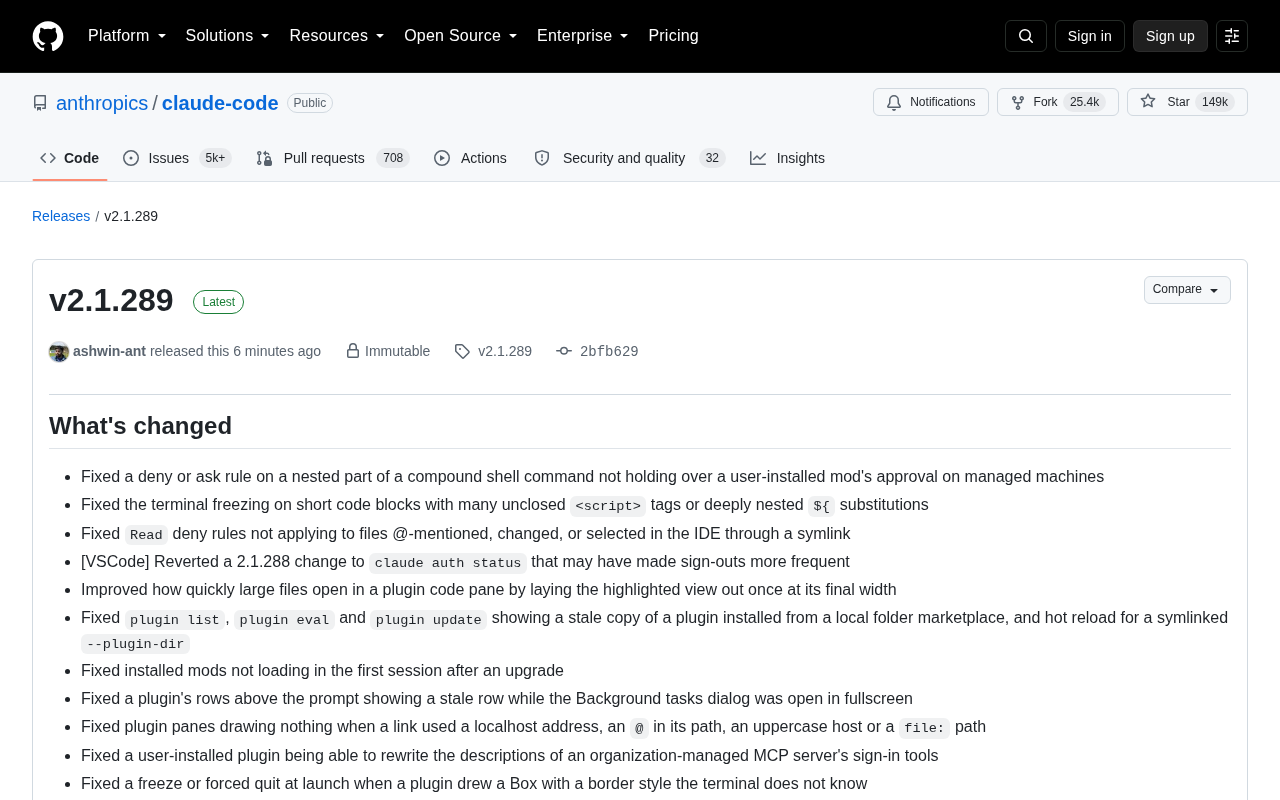
Anthropic has released version v2.1.289 of Claude Code, its command-line AI coding assistant. Published by team member ashwin-ant as an immutable release, this update focuses on plugin system stability, Shell command rule security, and terminal rendering fixes. While it doesn't introduce any flashy new features, it's a solid maintenance release for users who rely heavily on the plugin ecosystem and enterprise managed environments.
Security Rule Fixes: Closing Approval Gaps in Shell Commands
The most notable part of this update is a series of security hardening changes to Bash command deny/ask rules. In enterprise managed machine scenarios, there was a prior issue where deny or ask rules triggered by nested parts of compound Shell commands might fail to override approvals granted by user-installed mods. This meant users could potentially bypass organization-defined security boundaries — a gap that has now been closed.
More subtle was a bypass involving environment variables. Under sandbox auto-allow conditions, commands prefixed with environment variable assignments — such as TZ="$HOME" rm -rf build with already-expanded variable values — could previously skip deny or ask rules. Similarly, rules would be bypassed when a bare variable assignment appeared before a command. Neither scenario is uncommon in real development workflows, and once the attack surface exists, the consequences could range from accidental file deletion to execution of dangerous operations.
Additionally, Read deny rules previously failed to apply to files @ mentioned, modified, or selected via symlinks in the IDE — this has also been fixed. Another permission isolation fix worth noting for enterprise users: user-installed plugins could previously overwrite the descriptions of organization-managed MCP server login tools, and this kind of privilege escalation is now prohibited.
Managed Machines are devices in enterprise IT environments that are uniformly configured and controlled by the organization. Administrators can use policy files to pre-define which commands are allowed, which require secondary confirmation, and which are outright denied. Claude Code's deny/ask rules are the practical implementation of this system: deny rules block specific commands from executing, while ask rules require explicit user confirmation before running. In enterprise scenarios, the reliability of these rules directly determines whether an AI coding assistant can be incorporated into regulated development workflows. Sandbox auto-allow refers to a pre-trusted set of commands in a sandboxed environment, designed to reduce confirmation friction for low-risk operations. However, when commands prefixed with environment variable assignments (e.g., KEY=val cmd) bypass rule matching, this mechanism becomes a security blind spot — the way the Shell parses the combination of variable assignments and command bodies breaks string-prefix-based rule matching logic.
Plugin and Mod System: Isolated Failures, No More Session Crashes
The other major thread in this update is a large-scale hardening of the plugin and mod rendering system. The core design principle can be summed up in one sentence: let a single component's failure be isolated, rather than cascading into a full session crash.
Multiple fixes revolve around this principle. For example, when a value written by a mod's ui.render hook caused an exception while rendering a line, the session would previously terminate with an "unrecoverable interface error"; the engine will now draw its own line instead, allowing the session to continue. Similarly, when a mod's Client failed during drawing, it used to bring down everything the mod had rendered — now it fails alone and triggers ui.fault. When a plugin's screen handler threw an exception asynchronously, supervised and background sessions would previously terminate outright; this behavior has been corrected.
Rendering-layer fixes are quite dense, covering a variety of edge cases: short code blocks containing many unclosed <script> tags or deeply nested ${ substitutions causing terminal freezes; text with tabs, stray escape characters, and C1 control characters overwriting lines below; right-aligned content in mod panes rendering past closing markers; and more. These may seem minor in isolation, but they collectively determine whether the terminal interface remains stable under complex content.
Claude Code's plugins and mods represent two levels of extension mechanisms: plugins are typically feature packages distributed through a marketplace with full lifecycle management; mods are more lightweight, hooking directly into interface rendering (e.g., ui.render) to customize session appearance and behavior. The ui.render hook is called on every UI refresh, and mods use it to write custom content to the terminal. ui.fault is the error event triggered when a mod's Client fails to render; under the new mechanism, it serves as a notification outlet for local failures rather than pushing the entire session into an unrecoverable state. C1 control characters are a set of control codes in the extended ASCII set with byte values in the 0x80–0x9F range. Some terminal emulators interpret them as cursor movement or screen-clearing instructions. If text content accidentally contains these bytes, it can cause subsequent content to overwrite incorrect positions — the "overwriting lines below" issue mentioned in the article.
Improved Reliability for Plugin Management Commands
For developers using local folder marketplaces or symlinked plugin directories, plugin list, plugin eval, and plugin update previously showed stale copies of plugins, and hot reload had issues — both are now fixed. The claude plugin validate command also had two bugs corrected: one where it would skip plugin validation when a folder also contained a marketplace manifest, and another where it would incorrectly cause validation of plugins from Anthropic's own official marketplace to fail.
There was also a widely impactful issue: user-installed mods failed to load in the first session after an upgrade — this has been fixed. On the performance side, large files now open faster in plugin code panes, thanks to performing highlight view layout once at the final width, reducing redundant rendering passes.
New Capability: agent.spawn for Multi-Agent Collaboration
Among all the fixes, the standout new addition is agent.spawn, aimed at team collaboration. This update adds the agent.spawn capability for teammates, threads the same agent id through plugin hook events, and adds idle and waiting states to $.agent.list().
Though briefly described, this change signals Claude Code's continued investment in multi-agent orchestration. The ability to spawn new agents, uniformly track agent identity, and observe their runtime states is foundational infrastructure for building complex automated workflows. For developers looking to build multi-agent collaborative systems with Claude Code, this is a capability worth watching.
The core value of agent.spawn is that it allows a primary agent to dynamically create child agents at runtime, each with an independent execution context, enabling parallel processing of different subtasks — for example, simultaneously analyzing, testing, or refactoring multiple code modules. A unified agent id makes cross-plugin hook event tracking possible: whether it's a task start, intermediate state change, or completion callback, everything can be associated with the same agent entity, avoiding event orphans. The newly added idle and waiting states complete the observability of the agent lifecycle — idle indicates the agent has finished its task but hasn't yet been destroyed, while waiting typically means it's waiting for external input or for a dependent agent to complete. Both states are critical for the orchestration layer to make scheduling decisions. This aligns with the state machine design philosophy found in industry multi-agent frameworks like LangGraph and AutoGen.
Summary: A Maintenance Update Focused on Production Reliability
v2.1.289 doesn't feature the headline additions typical of a major release, but it reflects the stage Claude Code is currently in — the plugin ecosystem and enterprise deployment are becoming the product's center of gravity. The multiple security rule fixes directly concern the trust boundaries of enterprise managed environments, while the plugin rendering isolation mechanism determines whether third-party extensions can run reliably in production. Additionally, a frequent logout issue in VSCode caused by claude auth status (introduced in a 2.1.288 change) has been reverted and fixed.
For everyday users, upgrading should mean fewer terminal freezes and session interruptions. For enterprise administrators and plugin developers, the security and isolation details addressed in this update are where its real value lies.
Related articles

Random Pruning of the DPO Computation Graph: 1.4x Training Speedup and Lower Peak Memory
DPO training too slow and memory-hungry? This paper proposes a random pruning framework for the DPO computation graph, sampling independently across position, sequence, and branch dimensions; branch pruning achieves a 1.426x step-time speedup and cuts training time by about 30%, with in-depth attribution of memory and time gains.

Why Does JEPA Underperform MLM in Longitudinal EHR Representation Learning?
New study compares JEPA and MLM for longitudinal EHR representation learning on MIMIC-IV: three JEPA variants train stably without collapse but underperform MLM; target size, not heterogeneity, drives prediction error.

Transfer Learning + Visible Light Communication: A New Approach to Energy-Efficient Indoor Positioning
A study proposes a transfer learning-based visible light communication indoor positioning method, achieving 47% accuracy improvement on the BOSCH factory dataset, 67.5% model efficiency under high noise, and introducing the ME composite metric for energy-efficient positioning in energy-constrained industrial IoT scenarios.