Claude Code v2.1.291 Released: Fixes Session and Permission Regression Issues

Claude Code v2.1.291 patches two regressions: dropped cloud session permission prompts and lost trailing messages on exit.
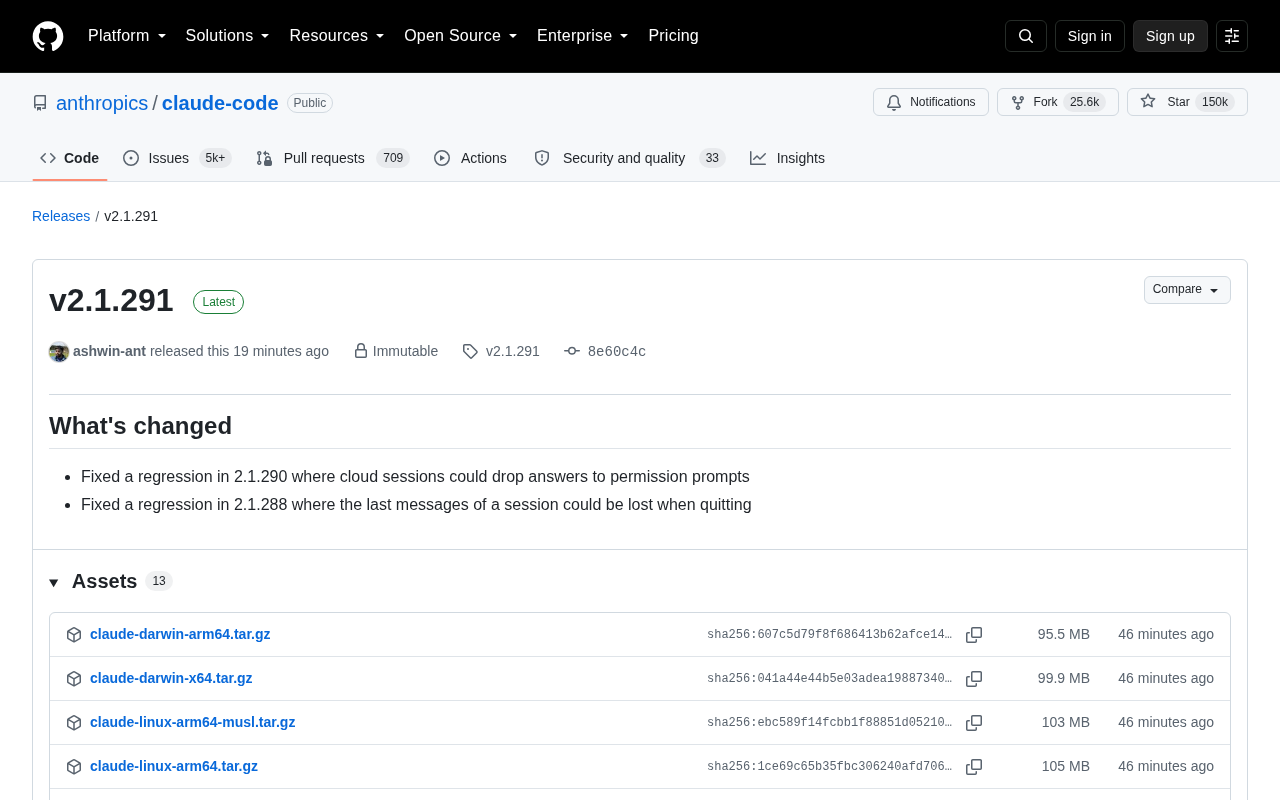
Anthropic's Claude Code has released v2.1.291, a maintenance update fixing two regressions from prior versions. In v2.1.290, user responses to permission prompts could be silently dropped in cloud sessions, disrupting sensitive operations like file writes and command execution. In v2.1.288, trailing messages were lost on session exit, breaking context in long coding sessions. The release contains no new features and is marked immutable. Users on affected versions should upgrade promptly.
Version Overview
Anthropic's terminal-based AI coding tool Claude Code has shipped a v2.1.291 update. This is a typical maintenance release, focused entirely on fixing regression bugs introduced in the two preceding versions rather than adding new features.
According to the project's GitHub release history, the repository has accumulated 150,000 stars and over 25,000 forks — a testament to its active developer community. While the changelog is brief, both issues addressed directly affect day-to-day stability, making this update meaningful for power users.
Two Key Fixes in This Release
Permission Prompts Dropped in Cloud Sessions
The first fix addresses a regression introduced in v2.1.290: in cloud session scenarios, user responses to permission prompts could be silently discarded.
Permission prompts are a critical part of Claude Code's security model — when the tool attempts sensitive operations such as writing files or running commands, it asks the user for confirmation. If these confirmations are dropped during a cloud session, it can at best cause operations to stall, and at worst disrupt workflow continuity and undermine security expectations. This fix restores the reliability of that interaction loop.
The key difference between cloud sessions and local sessions lies in where execution happens: in a local session, Claude Code runs directly on the user's machine and manages state locally; in a cloud session, some computation or state is hosted on remote servers, meaning user input and confirmations must travel over the network before taking effect. This architecture makes the "prompt → response" interaction chain more susceptible to information loss due to state synchronization issues. The permission prompt mechanism itself stems from the security design philosophy behind AI coding tools: enforcing manual confirmation for high-risk operations like file writes, shell command execution, and network access — striking a balance between automation convenience and operational safety. When a user's confirmation is silently discarded, the tool may get stuck in an infinite wait loop or abort the task entirely, causing unpredictable interruptions in long-running automated workflows.
Trailing Messages Lost on Exit
The second fix traces back to v2.1.288: when a user exits a session, the last few messages in that session could be lost.
For developers relying on Claude Code for extended coding sessions, those trailing messages often contain the latest code suggestions or critical conclusions. Losing them means a broken context. This fix ensures session content is fully preserved on exit.
What the Release Cadence Reveals About Product Strategy
The version number itself is worth noting — a high patch number like v2.1.291 reflects Claude Code's rapid, small-increment iteration approach. The tight sequence of consecutive versions (288, 290, 291), combined with this release specifically rolling back issues introduced in the prior two, signals that the team is pushing fast while staying sensitive to production quality.
This rhythm is common in the AI tooling space: ship features quickly, then stabilize through dense patch releases. For users, it means faster access to new capabilities — but it also demands staying current to avoid known regressions.
In software engineering, a "regression" specifically refers to a feature that previously worked correctly breaking again due to newly introduced code. It's a common byproduct of rapid iteration — changes for new features inadvertently break existing logic. High-frequency minor version releases (like the tight sequence of v2.1.288 → v2.1.290 → v2.1.291) can deliver value quickly but compress the testing window before each release, increasing regression risk. Mature engineering teams typically catch these issues through regression test suites in CI pipelines. However, for AI tools, scenarios like cloud session state synchronization and multi-user concurrency are often difficult to fully simulate in a test environment — which is why some regressions only surface in production and get addressed in follow-up patch releases.
What Users Should Do
If you're currently on v2.1.288 or v2.1.290, upgrading to v2.1.291 is recommended to avoid both the permission prompt loss and the trailing message loss issues. This release is marked as immutable — only the release title and notes may be modified — and official binary assets have been published alongside the version tag.
For teams that have integrated Claude Code into production workflows, monitoring the GitHub Releases page and maintaining a timely update process is a practical way to benefit from rapid iteration while keeping risk under control.
Related articles

Random Pruning of the DPO Computation Graph: 1.4x Training Speedup and Lower Peak Memory
DPO training too slow and memory-hungry? This paper proposes a random pruning framework for the DPO computation graph, sampling independently across position, sequence, and branch dimensions; branch pruning achieves a 1.426x step-time speedup and cuts training time by about 30%, with in-depth attribution of memory and time gains.

Why Does JEPA Underperform MLM in Longitudinal EHR Representation Learning?
New study compares JEPA and MLM for longitudinal EHR representation learning on MIMIC-IV: three JEPA variants train stably without collapse but underperform MLM; target size, not heterogeneity, drives prediction error.

Transfer Learning + Visible Light Communication: A New Approach to Energy-Efficient Indoor Positioning
A study proposes a transfer learning-based visible light communication indoor positioning method, achieving 47% accuracy improvement on the BOSCH factory dataset, 67.5% model efficiency under high noise, and introducing the ME composite metric for energy-efficient positioning in energy-constrained industrial IoT scenarios.