Claude Code v2.1.306 Update: Fixes Cloud Session Login and MCP Tool Errors

Claude Code v2.1.306 fixes cloud session login false alarms and MCP tool overload error misdiagnosis.
Claude Code released patch v2.1.306 with two bug fixes only. Running `claude -p` in cloud sessions without session env vars no longer falsely reports 'Not logged in', improving script/CI reliability. Sessions with many MCP tools no longer replace real API errors with 'prompt is too long' or trigger unnecessary compaction. No new features; production users are advised to upgrade.
Claude Code has released version v2.1.306, a pure bug-fix minor release. Although the changelog contains only two lines, both fixes address scenarios developers commonly stumble into during daily use: loss of login state in cloud sessions, and misdiagnosis of API errors caused by a large number of MCP tools.
What the Two Fixes Mean
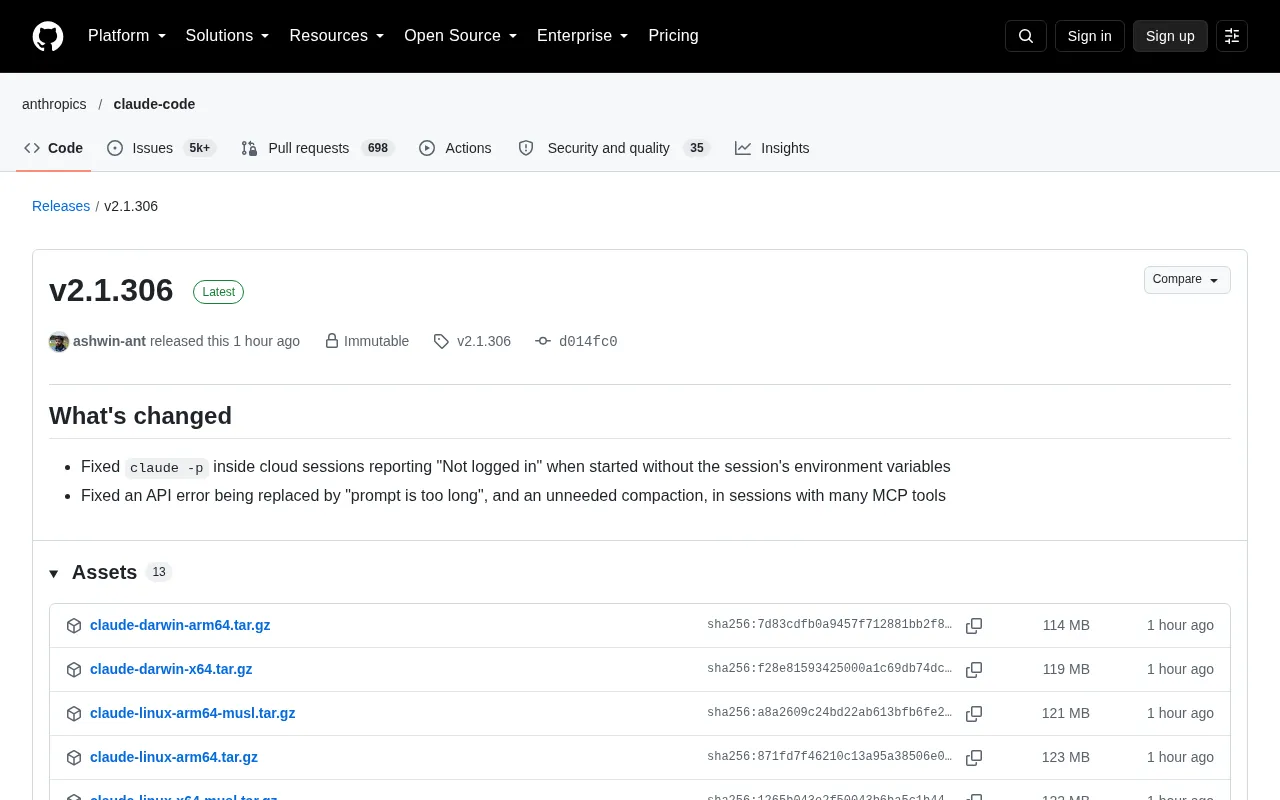
According to the official changelog, this update focuses on two bugs:
Login Issue with claude -p in Cloud Sessions
The first fix targets a problem where running the claude -p command in cloud sessions without the session's environment variables would incorrectly report "Not logged in". claude -p is Claude Code's non-interactive invocation mode, commonly used in scripts, CI pipelines, and automation tasks. In cloud environments, authentication information often relies on injected environment variables; if the process isn't started the right way, the CLI misjudges the state as not logged in and blocks execution outright. This fix makes authentication detection more reliable in that scenario.
What is claude -p? -p is short for --print. This mode lets Claude Code accept a one-shot prompt, output the result directly, and exit without entering the interactive REPL. It fits naturally with pipes, shell scripts, and CI configurations—for example, cat error.log | claude -p "analyze this log". Precisely because it is often embedded in unattended workflows, any misjudgment at the authentication layer directly causes pipeline failures with no chance for human intervention to correct course—which is why this bug has a relatively large impact.
Cloud session authentication mechanism. Claude Code supports running in cloud sandboxes or remote execution environments (such as containerized CI or hosted development environments). These environments typically don't retain credential files on disk; instead, authentication information is injected at startup via environment variables (such as API keys or session tokens). If the process fails to properly inherit these variables at startup, the CLI cannot distinguish between "genuinely not logged in" and "login information not yet ready", resulting in misleading error messages.
Error Misreporting Caused by Too Many MCP Tools
The second fix is more technically involved: in sessions configured with a large number of MCP tools, API-returned errors would be replaced with "prompt is too long", and an unnecessary context compaction would be triggered. MCP (Model Context Protocol) tools expose their tool definitions to the model; the more tools there are, the more context they consume. When a real error occurred, the system incorrectly attributed it to an overly long prompt and then performed compaction—both masking the original error information and wasting a round of context reorganization overhead. After the fix, error messages and compaction behavior return to normal.
MCP and context consumed by tool definitions. MCP (Model Context Protocol) is an open protocol proposed by Anthropic for exposing external tools and data sources to models through a standard interface. Every tool declared by an MCP server is injected into the request's system/tools fields as a JSON Schema (name, description, parameter structure). These definitions are re-sent on every request round and counted against the token budget, so after mounting a dozen tool servers, tool descriptions alone can consume thousands or even tens of thousands of tokens, significantly shrinking the actually usable conversation space.
Context compaction. When conversation history approaches the model's context window limit, Claude Code automatically performs compaction: summarizing or truncating earlier conversation to free up space to continue working. This mechanism should only trigger when genuinely approaching the limit, but because the error classification logic attributed any API error to "prompt is too long", compaction was executed prematurely and unnecessarily—losing historical detail and preventing developers from seeing the real cause of failure.
Practical Impact on Developers
These two fixes correspond to two types of users. Teams using cloud sessions for automated invocation can escape intermittent login false alarms; developers who heavily rely on the MCP ecosystem and mount multiple tools simultaneously will no longer be led astray in troubleshooting by misleading "prompt is too long" messages. The latter deserves particular attention—the relationship between the number of MCP tools and context consumption is an easily underestimated engineering problem in today's agent toolchains.
Release Cadence Observations
v2.1.306 is a patch-level release that introduces no new features. Judging from the release cadence, Claude Code has recently favored high-frequency, small-step fixes, which aligns with its positioning as a developer tool: stability over feature stacking. For production users, such fix releases are generally worth following, especially changes involving authentication and error handling.
Immutable release. This is a setting provided by GitHub Releases: once enabled, the tag, title, and description of a published release are locked and can only be modified after a repository administrator unlocks them, and associated build artifacts cannot be replaced. For teams relying on fixed version numbers for auditing, SBOM records, or supply chain verification, immutable releases ensure that the identifier "v2.1.306" always points to the same binary, avoiding build irreproducibility caused by upstream quietly changing content.
Upgrade Recommendation
Simply update to the latest version. If you invoke claude -p via scripts in cloud environments, or have configured a relatively large number of MCP tools, this update falls into the recommended-upgrade category. The release page also marks this version as an Immutable release—meaning content beyond the release title and description cannot be modified—ensuring traceability of release artifacts.
One-line Summary
Claude Code v2.1.306 fixes false login reports in cloud sessions and error misdiagnosis caused by too many MCP tools.
Paragraph Summary
Claude Code has released patch version v2.1.306, with a changelog of only two lines, both bug fixes. First, when running claude -p in cloud sessions, if started without the session's environment variables, the CLI would falsely report "Not logged in", blocking script and CI automation calls; after the fix, authentication detection is more reliable. Second, in sessions configured with many MCP tools, real API errors would be replaced with "prompt is too long" and trigger an unnecessary context compaction—masking the original error and wasting overhead; after the fix, error messages and compaction behavior return to normal. The article notes that this version has no new features and reflects Claude Code's high-frequency, small-step iteration cadence with stability first; patches involving authentication and error handling are recommended for production users to follow.
Related articles

AI Game Dev Acceptance Lesson: Using GUT Tests and Agent Self-Checks to Make Bugs Impossible to Hide
Lesson 12 of AI game development: use GUT automated tests, Agent self-check loops, browser smoke acceptance, and external playtesting to turn "AI says done" into verifiable evidence.

DoorDash Reveals Only Hundreds of Orders from AI Agents, Open Collaboration Seen as Key
DoorDash reveals only hundreds of orders from AI agents and says it is open to working with third-party agent developers. This article analyzes the early state of agentic commerce, platform openness, and transaction trust bottlenecks.

Kimi K3.1 Pro Pricing and Benchmarks: Open-Weight Promises and the True Cost
Kimi K3.1 Pro costs $2 per million input tokens and $10 per million output tokens, scores 65.7% on Terminal-Bench 4.0 (vendor-reported), and promises open weights by November 4. This article breaks down its pricing structure, benchmark credibility, and real cost per task.