Claude Code v2.1.332 Update: MCP Skills, Stability Fixes, and Model Routing Improvements
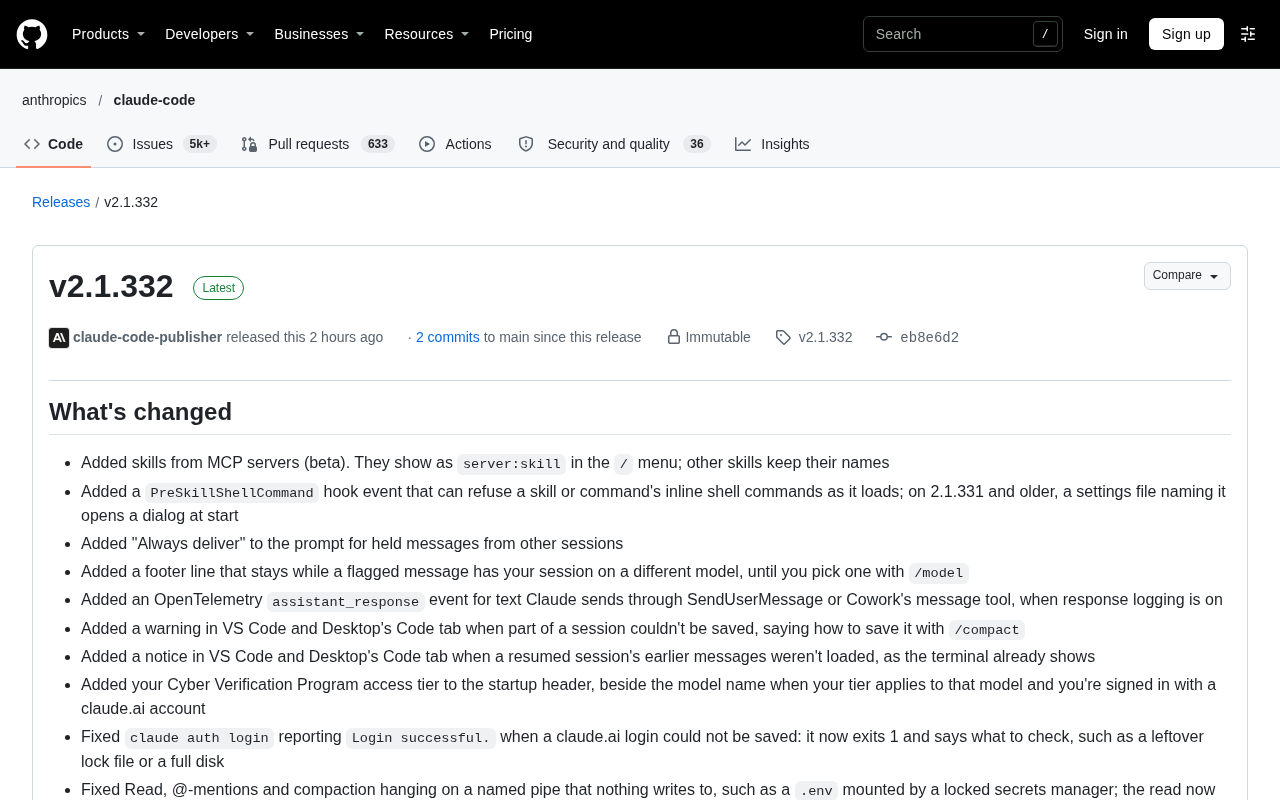
Claude Code v2.1.332 focuses on stability fixes and introduces MCP server skills beta and multi-cloud model alias adjustments.
Claude Code v2.1.332 is an update focused primarily on stability fixes and polish. New features include MCP server skills (beta), with skills from MCP servers appearing in the `/` menu as `server:skill`, plus a new `PreSkillShellCommand` hook for load-time interception; OpenTelemetry gains an `assistant_response` event. On stability, it addresses numerous freezes, runaway memory, and hangs, covering MCP stdout floods, unlimited hook output and oversized logs (truncated beyond ~50,000 characters), named pipe reads (20-second timeout), SSE server reconnection after endpoint changes, and multi-wildcard permission rule checks. On model routing, Google Cloud Agent Platform and Foundry `sonnet` aliases point to Sonnet 5.5 while Bedrock stays at 4.5, Bedrock Mantle is corrected from a misresolved Haiku 4.5 to Sonnet 5, and fallback logic is enhanced. Several Code Mode and Windows/Linux platform experience issues are also fixed.
Claude Code has released version v2.1.332, an update focused primarily on stability fixes and polish, while also introducing new features such as MCP server skills (beta). For developers who rely on Claude Code for daily development, this version resolves a number of long-standing issues with freezes, memory leaks, and model switching.
MCP Skills and Hook Mechanism Expansion
The most notable new feature in this update is MCP server skills (beta). Skills from MCP servers are displayed in the / menu as server:skill, while other skills keep their original names. This means developers can expose capabilities provided by external MCP services directly as invocable skill entry points, further connecting Claude Code with the external tool ecosystem.
A corresponding PreSkillShellCommand hook event has been added, which allows intercepting and rejecting inline shell commands when skills or commands are loaded. Note that in versions 2.1.331 and earlier, if a settings file named this hook, a dialog would appear at startup.
Other interaction-level improvements include: an "Always deliver" option for pending messages from other sessions; a new footer hint line that persists when a flagged message causes the session to use a different model, until the user selects a model via /model. On the OpenTelemetry side, a new assistant_response event records text that Claude sends via the SendUserMessage or Cowork message tools.
MCP (Model Context Protocol) is an open protocol proposed by Anthropic that lets models like Claude connect to external tools and data sources in a unified way. An MCP server is an independent process that exposes three types of capabilities to clients over transports such as standard input/output (stdio) or HTTP/SSE: "tools," "resources," and "prompts." As an MCP client, Claude Code discovers these capabilities and registers them into its own invocation system.
The "MCP server skills" introduced in this release add a new layer of abstraction on top of existing tools: a server can declare a set of documented "skills," which Claude Code attaches to the / menu under the server:skill namespace, so users or the model can trigger them like built-in slash commands. This upgrades MCP service capabilities from "functions the model calls on demand" to "user-visible, composable workflow entry points," which also explains why the PreSkillShellCommand hook is needed for interception and governance at load time.
Stability Fixes: Centralized Handling of Freezes and Memory Issues
This version fixes a large number of scenarios that caused freezes, covering everything from MCP servers to hook output.
When a local MCP server produced a large amount of standard output, the terminal previously froze and ignored Ctrl+C; this is now fixed. Freezes and runaway memory caused by hooks printing unlimited output have been resolved in most cases. Freezes and context overflow caused by hooks blocking or failing mid-turn, or by oversized logs after /compact, have also been fixed—text exceeding roughly 50,000 characters is now truncated.
Reading named pipes (such as a .env mounted by a locked key manager) previously caused Read, @-mentions, and compaction to hang indefinitely; reads now fail after 20 seconds. In addition, an issue where SSE MCP servers would hang or reject all tool calls until a manual reconnect after the event stream was cut and resumed with a new endpoint has been resolved.
Also worth noting: freezes when permission rules or hook conditions contain multiple wildcards and are checked against long commands, long freezes when opening rollback points after rewriting large trace files, and freezes when @ is followed by an extremely long unbroken string (such as minified CSS with embedded fonts) have all been fixed.
SSE (Server-Sent Events) is a transport commonly used by remote MCP servers: the client establishes a long-lived connection, and the server continuously pushes events in text/event-stream format. Unlike ordinary request-response, this stream may break due to network interruptions, proxy timeouts, or server restarts, after which the server provides a new endpoint for the client to reconnect to. If the client does not correctly handle the combination of "stream cut + endpoint change," it remains in the old connection state, manifesting as all tool calls hanging or being rejected until the user manually reconnects. This fix completes that reconnection state machine.
Similarly, a named pipe (FIFO) is a special filesystem object where a read operation blocks until a writer is ready. When a key manager mounts .env as a pipe, ordinary file-read semantics no longer apply, so a timeout (20 seconds in this case) is needed to avoid indefinite hangs.
Model Routing and Cloud Platform Adaptations
Several adjustments were made to model selection logic for multi-cloud environments. On Google Cloud's Agent Platform and Microsoft Foundry, the sonnet model alias now points to Sonnet 5.5, and Foundry's opus alias points to Opus 5.5; on Amazon Bedrock, sonnet remains Sonnet 4.5. Foundry's default model has also changed to Sonnet 5.5, and users need to deploy claude-sonnet-5-5 or set ANTHROPIC_DEFAULT_SONNET_MODEL to point to a deployed model.
On Bedrock Mantle, the sonnet alias previously resolved incorrectly to Haiku 4.5; it is now corrected to Sonnet 5 (not Sonnet 5.5). Accounts without Sonnet 5 will receive an error and need to enable it first.
Model fallback logic has also been enhanced: when the cloud rejects the default model and the availableModels list does not force a specific one, --model default and the Default option now fall back to older models instead of erroring out. In auto mode, fallback only occurs to models accepted by auto mode. On Microsoft Foundry, Claude Sonnet 4, Opus 4, and Opus 4.1 are now considered retired, and fallback will not stop at these versions.
Model aliases refer to stable identifiers like sonnet and opus that each cloud platform maps to specific model versions. The same alias may point to different snapshots on different platforms: Amazon Bedrock, Google Cloud Agent Platform (formerly Vertex AI), and Microsoft Foundry each maintain independent model catalogs and deployment processes, so alias resolution must be configured per platform. This is why sonnet on Bedrock remains at Sonnet 4.5 while Agent Platform and Foundry now point to Sonnet 5.5.
Model fallback is another layer of mechanism: when the requested model is unavailable in that account or region, the client falls back to older or more widely available versions in a preset order instead of throwing an error. The availableModels list restricts the allowed candidate set, and in auto mode fallback only goes to models accepted by auto routing. Note that Sonnet 4, Opus 4, and Opus 4.1 on Foundry have been marked as retired, and the fallback chain will not stop at these versions. You can use the ANTHROPIC_DEFAULT_SONNET_MODEL environment variable to explicitly specify the deployed model to use.
Developer Experience and Code Mode Improvements
Code Mode fixes several issues affecting workflows. When tool input contained a list of more than 4,096 items, Code Mode previously skipped that tool call silently; input with oversized typed arrays is now rejected instead of freezing. Typing a message during command execution and pressing Esc before Claude replies previously left the message unanswered; now the message starts a new turn, and pressing Esc again stops it.
When resuming a Code Mode session, Claude is now informed upfront that previous script variables have been lost. In the Agent SDK and claude -p, an issue where the last reply was lost when resuming a session that was stopped while a script was running has also been fixed.
Other experience improvements include: /context output is shorter in full screen, reducing cases where the total scrolls off-screen in short windows; /usage has improved peak memory and speed on machines with many recent sessions; /permissions rejects rules that would be skipped at the next startup (such as rm -rf without a tool name) and displays the reason.
On Windows, claude plugin marketplace add now waits and retries when antivirus software briefly holds the downloaded file; stability issues where Claude Code on some corporate computers exited with no output after startup have been improved. On Linux, when images cannot be read from the clipboard, the Ctrl+V hint now indicates which package to install (wl-clipboard or xclip).
Code Mode is an execution paradigm in Claude Code: instead of making individual tool calls directly, the model writes a script that orchestrates tool calls in batch within a sandbox and handles intermediate results. This approach reduces round trips and supports loops and conditional logic, but it also introduces new boundary issues—for example, serialization and validation overhead when input parameters are too large. Among the fixes in this release, "lists with more than 4,096 items were silently skipped" and "oversized typed arrays caused freezes" are essentially both cases of Code Mode handling parameters whose scale exceeds expectations incorrectly: the former should explicitly error rather than silently discard, and the latter should be rejected at the entry point rather than attempting to process.
Another class of issues relates to session resumption: Code Mode script variables exist in runtime memory and cannot be restored after a session interruption, so on resume the model must be informed upfront that "previous script variables have been lost"; otherwise the model will continue writing scripts based on incorrect assumptions.
Conclusion
v2.1.332 is a typical "big fix" release, with more than half of the changes focused on handling freezes, memory, and hang issues. At the same time, through MCP skills (beta) and corrections to multi-cloud model routing, it lays the groundwork for future capability expansion. For teams using Claude Code on Bedrock, Google Cloud Agent Platform, or Foundry, we recommend paying attention to the impact of the model alias changes.
Related articles
Google Stitch Skills: Connecting Coding Agents to the Design Workflow
Google Stitch Skills is an Agent Skills library following the open standard, adding a design-to-code workflow to the Stitch MCP Server. This article breaks down its three skill groups, SKILL.md directory structure, installation paths, and dependency pitfalls.

40.5-Inch Color E-Paper Art Frame: An Art Display You Charge Once a Year
The Ink Poster Tella 40.5-inch color e-paper art frame uses the E Ink Spectra 6 full-color solution: A1 format, no backlight, no noise, about one charge a year, 2,000+ licensed artworks built in, and automatic adaptation of phone photos.

Jingle Jam Memories: RT's Awkward First Encounter with Lewis
RT shares his awkward first Jingle Jam experience: unexpectedly pushed into the studio, meeting Lewis and Yogg's cast, and Toddy appearing in armor.