Claude Code vs. Codex: A Practical Guide to Enterprise-Grade AI Programming

A guide to moving beyond Vibe Coding to enterprise-grade AI programming with Claude Code and Codex.
This article explores the limitations of Vibe Coding and presents a three-tier progressive model for enterprise AI programming using Claude Code and Codex. It covers the HARIS engineering system, backend LLM selection strategies, the SuperPower plugin for spec-driven development, environment setup, and the business value of AI model aggregation platforms like OpenRouter.
From Vibe Coding to Enterprise Development: The Right Way to Approach AI Programming
As AI programming tools become increasingly mainstream, many people harbor unrealistic expectations about "Vibe Coding" — the idea that you can simply describe your requirements to an AI and it will replace programmers in building enterprise-grade products. The reality, however, is that Vibe Coding can only produce demo-level projects. True enterprise development demands a systematic, engineering-oriented approach to AI programming. Based on a practical course by Teacher Zhuge on Bilibili, this article provides a comprehensive overview of how to use Claude Code and Codex for enterprise-grade project development.
Choosing and Positioning AI Programming Tools
The Two Most Powerful AI Programming Tools Today
The two most capable AI programming tools in the world right now are Claude Code and Codex. While domestic tools like CodeBuddy, Zhijie CodeTree, and Cursor also perform well, the core competitive advantage in AI programming lies in the capability of the underlying model.
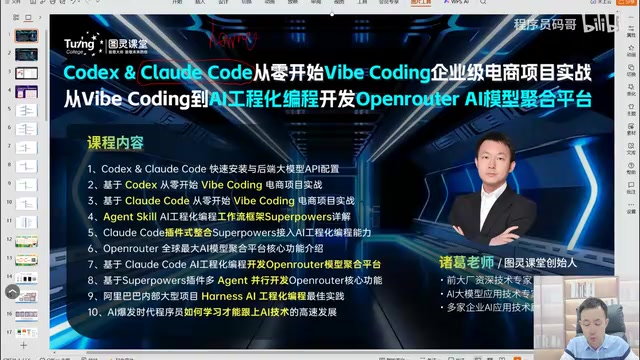
The reason Claude Code is widely adopted by professional programmers is that it incorporates a complete HARIS AI Engineering Programming System, with extensive optimizations for professional-grade coding. The core philosophy of the HARIS system is to deeply integrate classical software engineering methodologies with AI code generation capabilities. Traditional software engineering emphasizes requirements specifications, architecture design documents, code reviews, and continuous integration. The HARIS system transforms these stages into standardized workflows that AI can understand and execute. Specifically, it uses preset system prompts, context management strategies, and multi-turn dialogue orchestration to ensure that AI-generated code automatically adheres to engineering standards — rather than producing arbitrary output like casual chat-based programming. This is why code generated through Claude Code is far superior in quality to code requested directly in a chat window, even though both use the same Claude model. The difference isn't in the model itself, but in the engineering orchestration layer. Examining Claude Code's source code reveals that it is essentially the implementation of this entire engineering system.
Codex previously lagged significantly behind Claude Code, but with the release of GPT's latest version and ongoing internal optimizations, its capabilities have grown considerably. Combined with the increased account risk caused by Anthropic (Claude's parent company) CEO's account banning policies, more and more developers are shifting to Codex.
Strategies for Choosing Backend LLMs
Among domestic large language models, based on actual usage experience, the ranking is:
- Tier 1: GAM (Qwen) — strongest overall capability
- Tier 2: MINIMAX, Kimi, DeepSeekAd
- Best Value: DeepSeek — solid capability at extremely low prices
All of these models can be accessed through OpenRouter for use with Claude Code, avoiding the risk of account bans from using the Claude API directly. OpenRouter is an AI model API aggregation gateway that provides a unified API interface, allowing developers to access dozens of different large language models (including Claude, GPT, Gemini, Llama, Mistral, etc.) through a single endpoint. From a technical architecture perspective, OpenRouter is essentially an API proxy layer that handles authentication, billing, load balancing, and model routing. Developers don't need to register separate accounts with each model provider or adapt to different API formats — they simply integrate with OpenRouter's standardized interface.
Analyzing the Limitations of Vibe Coding
What Is Vibe Coding?
Vibe Coding is exactly what it sounds like — programming by vibes. The core idea is: just clearly describe the requirements in your head to an AI programming tool, and it will generate the code for you. While this sounds appealing for product managers or non-technical users, it has a serious ceiling.
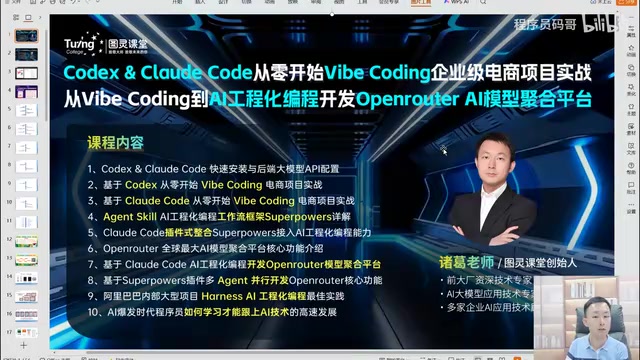
Three Core Problems with Vibe Coding
- Poor code quality: The generated code is often "dead-on-arrival code" — difficult to maintain and extend
- Difficult bug fixing: Non-technical users cannot effectively direct AI to fix production bugs, easily falling into infinite loops
- Limited project scale: Only suitable for simple small tools and websites — incapable of handling high concurrency, distributed systems, or microservices architecture
It's worth explaining why these three technical characteristics form the dividing line between enterprise systems and demo projects. High Concurrency refers to a system's ability to handle a large number of simultaneous user requests — typical scenarios include flash sales on e-commerce platforms or ticket-grabbing during peak travel seasons, involving thread pool management, asynchronous processing, caching strategies, and database connection pool optimization. Distributed Systems involve deploying applications across multiple servers working in coordination, requiring solutions for data consistency (CAP theorem), network partition tolerance, and distributed transactions. Microservices Architecture breaks a monolithic application into multiple independently deployable small services, each responsible for a single business function, communicating through API gateways and message queues. The combination of these three forms the technical foundation of modern enterprise systems, while Vibe Coding typically generates code in a monolithic architecture, single-machine deployment, synchronous processing pattern that simply cannot handle these complex scenarios.
Many early AI influencers claimed that Vibe Coding had "killed programmers," but a closer look at their projects reveals nothing more than simple cross-border e-commerce sites, ring light tools, and other minimalist applications. Real enterprise projects involve complex business logic and technical architecture that Vibe Coding simply cannot handle.
The Three-Tier Progressive Model for Enterprise AI Programming
Tier 1: Vibe Coding for Rapid Prototyping
Suitable for validating ideas — you can scaffold the basic framework of an e-commerce project in minutes. The approach is straightforward: give the AI a requirements description and let it generate code directly.
Tier 2: Plan Mode
Both Claude Code and Codex support plan mode. In this mode, the AI first analyzes requirements, creates a development plan, and then executes step by step. Compared to pure Vibe Coding, the code structure is more reasonable, but it's still not enterprise-grade.
Tier 3: SuperPower Engineering Programming
This is the truly enterprise-grade development approach. Claude Code has a plugin called SuperPower that includes a series of AI engineering programming Agent Skills (ranging from a dozen to several dozen), covering the entire workflow from requirements analysis, architecture design, coding, testing, to deployment.
This workflow is similar to the earlier Spec-Driven Development (SDD) methodology, but more intelligent. SDD is a software development methodology driven by formal specification documents. Its core principle is: before writing any code, produce detailed technical specification documents, including API contracts (such as OpenAPI/Swagger specs), data model definitions, interface behavior descriptions, error handling specifications, and more. The development team strictly implements code according to the specs, the testing team writes test cases based on the specs, achieving the ideal state of "documentation as code." This methodology is particularly important in microservices architecture and front-end/back-end separation projects, as it ensures interface consistency when multiple teams develop in parallel. In the context of AI programming, SDD's value is further amplified — when AI models have clear specification constraints, the quality and consistency of generated code far exceeds what's produced from natural language descriptions alone. Specification documents essentially serve as a "precise instruction set" for AI. Many small and medium-sized companies are already using this system in production projects.
Development Environment Setup Guide
Recommended Development Environment Configuration
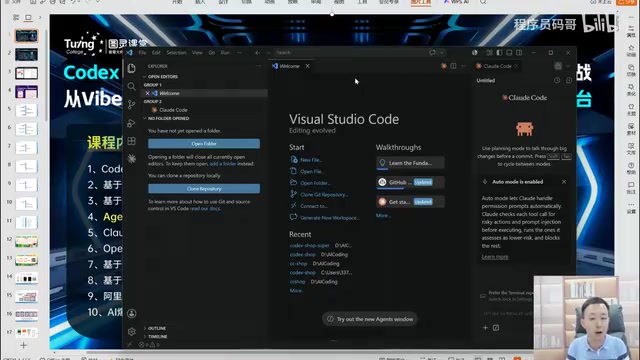
- Editor: VS Code (Cursor works too — it's essentially a fork of VS Code)
- AI Plugins: Claude Code plugin + SuperPower plugin
- Command-line Tools: Claude Code CLI + Codex CLI
- Desktop Client: Codex desktop app
The relationship between Cursor and VS Code deserves a deeper look. Cursor is an AI-native code editor built on top of VS Code's open-source codebase (specifically Microsoft's Code OSS project). VS Code itself is built with the Electron framework, and its core editor engine Monaco Editor and extension system are both open source, enabling third-party teams to build customized products on top of it. Cursor deeply integrates AI code completion, multi-file editing, and codebase-level context understanding on top of VS Code. Its differentiating advantage lies in the native integration of AI interaction experiences. However, this also means Cursor inherits VS Code's entire plugin ecosystem, allowing users to seamlessly use the vast majority of VS Code extensions. It's worth noting that Microsoft itself is also pushing deep GitHub Copilot integration within VS Code, creating direct competitive pressure on Cursor from upstream.
One detail worth mentioning: traditional IDEs like IntelliJ IDEA are starting to look outdated in the AI era. If JetBrains doesn't make significant changes, they could see massive user attrition within the next 2-3 years.
Practical Project Planning
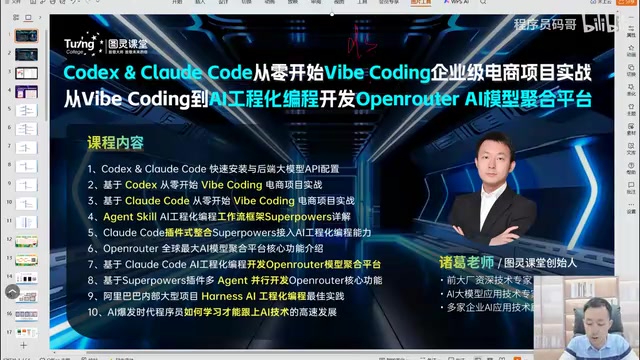
The course demonstrates the development of two enterprise-grade projects:
- E-commerce project — progressively upgraded from a Vibe Coding version to an enterprise-grade version
- AI model aggregation platform (similar to OpenRouter) — a wrapper site that integrates multiple large language models
OpenRouter and the Business Value of AI Model Aggregation Platforms
The Most Profitable Directions in AI Right Now
Here's an industry insight worth noting: the most profitable segment in AI today isn't consumer-facing AI applications (Doubao, Tencent Yuanbao, etc. are all losing money). Instead, it's these three directions:
- Selling compute power: Chips, semiconductors, memory, and other hardware
- Selling tokens: LLM API services
- Wrapper aggregation platforms: Model aggregation sites like OpenRouter
In the commercial ecosystem of large language models, a Token is the basic unit of billing. One token corresponds to roughly 3/4 of an English word or 1-2 Chinese characters, and every request processed by a model consumes both input tokens and output tokens. Token pricing varies dramatically across models: as of mid-2025, Claude Sonnet 4's input token price is approximately $3 per million tokens, while DeepSeek V3's price is less than one-tenth of that. This price differential creates enormous arbitrage opportunities — aggregation platforms can reduce overall costs through bulk purchasing and intelligent routing (assigning simple tasks to cheaper models and complex tasks to premium models), then offer services at intermediate prices. Additionally, the token economy involves the concept of a context window — the maximum number of tokens a model can process in a single request — which directly impacts an AI programming tool's ability to handle large codebases.
According to insider information, there are domestic startup teams of just a dozen people running AI model wrapper aggregation sites that generate annual revenue of 100-200 million RMB. The core value of these platforms lies in acquiring tokens at low cost and offering them to users at reasonable prices.
Enterprise AI Programming Practices at Major Tech Companies
Alibaba has already established a complete AI engineering programming system internally, forming a "self-contained evolutionary" development model. This system is being adopted across major tech companies and represents the future direction of enterprise AI programming.
For individual developers, the key is to leap from the "toy stage" of Vibe Coding to the "enterprise stage" of AI engineering programming. Mastering systematic methodologies like requirements analysis, architecture design, and spec-driven development is essential to staying competitive in the AI era.
Key Takeaways
Related articles
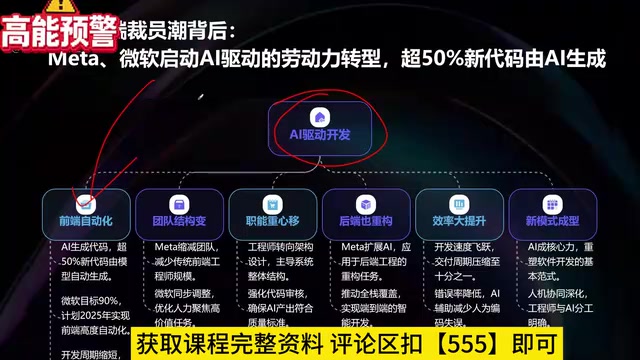
What Is Vibe Coding? The AI Programming Skill Every Developer Needs
What is Vibe Coding? Learn how AI programming is reshaping dev teams, why traditional programmers face displacement, and why Cursor & Claude Code matter.
Making Rocks Think: A Philosophical Exploration of Generative AI and Information Compression
From a viral Reddit post to deep AI theory: why compression equals understanding, the Library of Babel thought experiment, semantic compression, and the Hutter Prize.
Irregular Warns: Four AI Lab Security Breaches Traced to the Same Root Cause
Irregular reveals four AI lab security breaches share a single root cause, exposing systemic risks from technology stack homogeneity across the AI industry.