Claude Code Web Launch: Parallel Programming and Haiku 4.5 Multi-Model Collaboration in Practice

Anthropic launches Claude Code Web and Haiku 4.5, redefining the AI programming workflow.
Anthropic has released Claude Code Web, enabling coding task initiation from browsers and mobile devices with parallel processing, sandbox isolation, and seamless cloud-to-local handoff. The simultaneously launched Haiku 4.5 model achieves near-flagship coding performance at one-third the cost, scoring 73.3% on SWE-bench. Combined with multi-model collaboration and smart follow-up features, it creates a complete AI programming ecosystem from requirements clarification to code delivery, driving the developer role shift from coder to AI programming director.
Anthropic has officially launched the web version of Claude Code, extending the AI programming assistant from terminals and IDEs to browsers and mobile devices. Released alongside it, the Haiku 4.5 model delivers near-flagship coding capabilities at extremely low cost. Together, these updates are redefining the daily workflow of developers.
Cloud-Based Programming: Delegating Coding Tasks Directly from the Browser
Claude Code Web brings a fundamental change—developers no longer need to open a terminal or IDE to initiate coding tasks. The workflow is remarkably simple: connect your GitHub account, select a repository, describe your requirements in natural language, and let Claude handle the rest on cloud infrastructure.
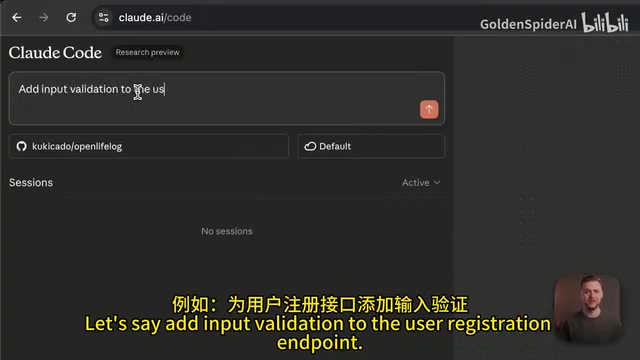
More importantly, it offers parallel task processing capabilities. Developers can launch multiple sessions across different repositories simultaneously—whether tackling a backlog of bugs, performing routine fixes, or implementing entirely new features, Claude can handle them in parallel. This means a single developer's output can multiply several times over—instead of queuing tasks one by one, you operate like a tech manager dispatching multiple "AI developers" at once.
Claude runs in an isolated sandbox environment with full Git access, and developers can observe progress in real time. A sandbox is a security isolation mechanism that creates a restricted execution environment for programs, preventing them from accessing other resources on the host system. In cloud programming scenarios, sandboxes ensure each coding task runs in an independent container, avoiding interference between different tasks and preventing AI from accidentally modifying unrelated system files. Within the sandbox, Claude can perform a full suite of version control operations—cloning repositories, creating branches, committing code, and opening Pull Requests—but all operations are confined within predefined security boundaries. This design ensures both security isolation and sufficient transparency.
Haiku 4.5: Flagship-Level Coding at One-Third the Cost
The Haiku 4.5 model, released alongside Claude Code Web, is another major announcement in this update. Five months ago, Sonnet 4 was the industry's most advanced coding model; now, Haiku 4.5 delivers comparable programming performance at one-third the cost and more than twice the speed, even surpassing Sonnet 4 on certain tasks (such as Computer Use).
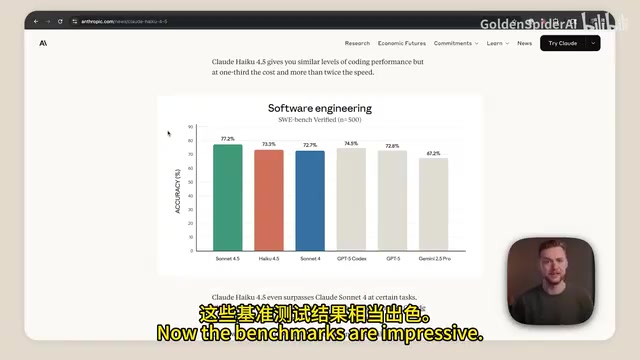
The specific benchmark data is impressive:
- SWE-bench Verified: 73.3%
- Terminal Bench: 41%
- Reaches 90% of Sonnet 4.5's performance in Agentic Coding evaluations
SWE-bench is a software engineering benchmark introduced by a Princeton University research team in 2023, specifically designed to evaluate AI models' ability to solve real GitHub issues. The test set contains real bug-fix tasks collected from 12 popular Python open-source projects (such as Django, scikit-learn, sympy, etc.). SWE-bench Verified is a human-verified subset that excludes poorly described or insufficiently tested samples, making it a more reliable evaluation standard. A score of 73.3% means Haiku 4.5 can autonomously solve nearly three-quarters of real software engineering problems—a level that was unimaginable just a year ago, when the best models scored below 20% on this benchmark in early 2024.
On pricing, Haiku 4.5 costs only $1/million input tokens and $5/million output tokens, dramatically reducing the cost of large-scale AI programming assistant usage. Tokens are the basic units that large language models use to process text, roughly equivalent to three-quarters of an English word or one Chinese character. AI API pricing typically charges separately for input and output tokens, with output tokens being more expensive because generating text requires more computational resources than understanding it. For comparison, OpenAI's GPT-4o is priced at $2.5/million input tokens and $10/million output tokens, while Claude Sonnet 4 costs $3/million input tokens and $15/million output tokens. This means for enterprise scenarios requiring heavy AI coding API calls, using Haiku 4.5 can reduce API costs by 60%-80%.
Multi-Model Collaboration: The Sonnet Plans + Haiku Executes Division of Labor
An increasingly popular multi-agent workflow is emerging within the Anthropic community: Sonnet 4.5 handles high-level problem decomposition and architectural planning, while Haiku 4.5 handles actual code implementation and writing.
Multi-Agent architecture is an important paradigm in AI system design. Its core idea is to decompose complex tasks among multiple specialized AI agents working collaboratively, rather than relying on a single model to handle everything. In software engineering, this pattern borrows from microservices architecture—each Agent focuses on its area of expertise. Sonnet 4.5, as the "architect Agent," with its larger parameter count and stronger reasoning capabilities, excels at understanding the global structure of complex systems, identifying dependencies, and formulating refactoring strategies. Haiku 4.5, as the "execution Agent," with its faster inference speed and lower cost, is well-suited for handling large volumes of concrete code writing, test generation, and formatting tasks.
This division of labor is particularly effective for large-scale code refactoring or technical debt reduction scenarios. It essentially maps the "architect + developer" collaboration model from software engineering onto the AI model layer—using more powerful (and more expensive) models for decision-making, and faster (and cheaper) models for execution, achieving an optimal balance between quality and cost. This layered collaboration pattern is especially effective when dealing with large-scale refactoring involving dozens of files.
From Cloud to Local: Open in CLI for Seamless Context Continuity
One of the most practical features of Claude Code Web is the "Open in CLI" button. When a cloud task is complete, developers simply click this button, copy the generated command and paste it into their local terminal to continue working in their local development environment—with all context and progress fully preserved.
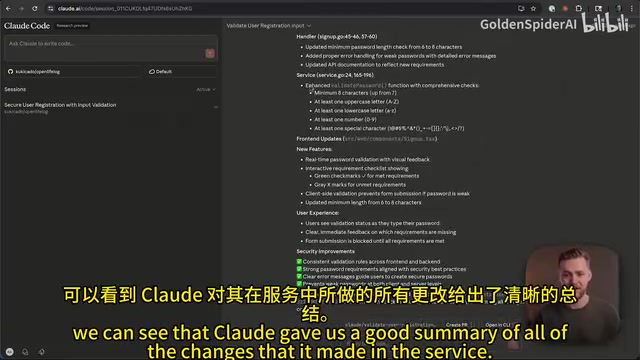
CLI (Command Line Interface) is the text-based interface through which developers interact with operating systems, and is extremely widely used in professional development. The "Open in CLI" feature relies on session state serialization technology—the complete context of a cloud task (including conversation history, list of modified files, branch state, unfinished plans, etc.) is encoded as a transferable state snapshot. After the developer executes the generated command in their local terminal, the Claude Code CLI client downloads this state snapshot and restores it in the local environment while pulling the Git branch created in the cloud to the local machine. This design eliminates the tedious process of manually syncing code and re-explaining context to the AI.
A typical usage scenario looks like this:
- Start a coding task on Claude mobile while commuting
- After arriving at the office, sync progress to local VS Code via CLI
- Review all modified files and examine code changes
- Continue iterating and debugging in the local environment
This seamless connection between cloud and local truly realizes the vision of "develop anywhere, anytime." Development is no longer tied to a workstation, and fragmented time can be effectively utilized.
Smart Follow-up Questions: From Vague Requirements to Precise Code Implementation
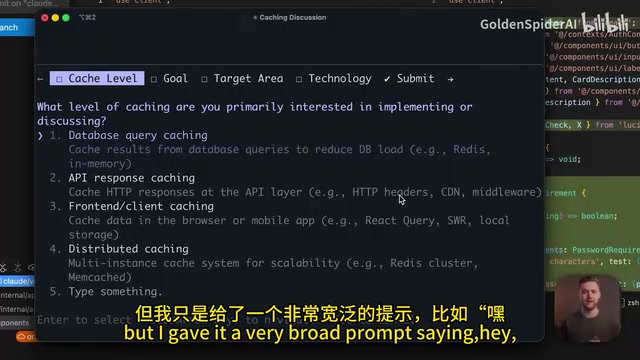
Claude Code also introduces a multi-question follow-up (Multi-question Support) feature. When a developer provides a vague requirement description, Claude doesn't blindly start coding—instead, it asks structured follow-up questions to ensure the implementation direction is correct.
The design philosophy behind this feature is closely related to Requirements Engineering in software development. Research shows that approximately 40%-60% of software defects can be traced back to issues in the requirements phase. Traditional requirements gathering relies on iterative communication between product managers and developers, while Claude Code's smart follow-up feature essentially automates the "Requirements Elicitation" techniques from requirements engineering. Its structured questioning strategy resembles the "5W1H analysis method" in software engineering—systematically confirming What (what to do), Why (why do it), Where (scope of impact), How (technical approach), and other dimensions to transform vague natural language requirements into executable technical specifications.
Taking "add caching to the application" as an example, Claude would ask in sequence:
- Cache level: Database query cache, API response cache, or something else?
- Goal: Improve performance, reduce database load, or both?
- Target scope: For user data, training data, or analytics data?
- Technology choice: Redis, in-memory cache, or Postgres built-in caching?
This interaction pattern simulates how a senior developer thinks when receiving a requirement—first clarify the requirement boundaries, then start implementing. It effectively avoids the common risk of "hallucinated implementation" in AI programming (where AI assumes unspecified requirement details and produces code that deviates from expectations), significantly improving first-delivery accuracy.
What Claude Code Web Means for Developers
Overall, this round of Anthropic updates has built a remarkably complete AI programming ecosystem:
- Web interface solves the problem of initiating tasks anywhere, anytime
- Parallel processing addresses efficiency bottlenecks
- Haiku 4.5 solves the cost problem
- Multi-model collaboration balances quality and cost
- CLI integration bridges the gap between cloud and local
- Smart follow-ups prevent rework caused by vague requirements
Claude Code Web is currently available to Pro and Max users. As AI programming tools evolve from "coding assistance" to "autonomous development," the developer's role is shifting from "the person who writes code" to "the person who guides AI to write code." This isn't just a tool upgrade—it's a fundamental paradigm shift in development.
Related articles
 Tech Frontiers
A Rare Quiet Day in AI: Recursive Self-Improvement Stirs Beneath the Surface
A rare quiet day in AI sees multiple sources go silent simultaneously. Behind the calm, Recursive Self-Improvement (RSI) research continues. What this means for the industry.
 Tech Frontiers
Reve 2 vs. Ideogram 4: A Deep Dive into Layout Control in AI Image Generation
A deep comparison of Reve 2 and Ideogram 4's layout control capabilities, covering technical approaches, real-world use cases, and industry trends for designers and creators.
 Tech Frontiers
In the Weights: Check Your Influence Score in the AI World
In the Weights is an AI influence search engine that quantifies your presence in the AI world with a score. Explore how it evaluates practitioners and what it means for digital identity.