Claude Context: An MCP-Based Semantic Search Tool That Lets AI Understand Your Entire Codebase

Zilliz open-sources Claude Context, using vector semantic search to give AI coding assistants whole-codebase understanding
Zilliz has open-sourced Claude Context, an MCP protocol-based semantic code search tool that uses vector indexing to enable AI coding assistants to perform semantic-level retrieval across entire codebases, solving the core pain point of large codebases exceeding context window limits. With over 10,000 GitHub Stars, the project reflects the industry trend of AI programming evolving from single-file processing to holistic codebase understanding.
Project Overview
The Zilliz team recently open-sourced a project called Claude Context — an MCP (Model Context Protocol)-based semantic code search tool designed specifically for AI coding assistants like Claude Code. The project's core goal is crystal clear: make your entire codebase the context for any coding Agent.
Since its launch, the project has quickly gained traction in the developer community, amassing over 10,700 Stars and nearly 800 Forks on GitHub. Built with TypeScript, it demonstrates strong community enthusiasm.
The Context Dilemma Facing AI Coding Assistants
The Context Window Bottleneck for Large Codebases
The core bottleneck facing today's AI coding assistants is context window limitations. Even models like Claude with exceptionally long context windows cannot load all code files from a large enterprise codebase into context at once.
The context window is the maximum number of tokens a large language model can process at once. Take Claude 3.5 as an example — its context window is 200K tokens, roughly equivalent to 150,000 English words or a medium-length book. However, a mid-sized enterprise codebase typically contains hundreds of thousands to millions of lines of code, far exceeding any model's context capacity. More critically, even if you could technically cram in more tokens, excessively long contexts lead to the "Lost in the Middle" problem — the model's attention to information in the middle of the context drops significantly, and retrieval accuracy plummets.
Developers are forced to manually specify relevant files or rely on the AI's limited file search capabilities, which drastically reduces the efficiency and accuracy of AI-assisted programming.
Why Semantic-Level Code Search Matters
Traditional code search relies on keyword matching (like grep), which has inherent limitations in understanding code intent and semantic relationships. Claude Context uses vector indexing technology to semantically encode functions, classes, modules, and other elements in a codebase, enabling AI Agents to retrieve relevant code snippets based on semantic similarity rather than simple string matching.
At the core of vector indexing is Embedding technology — converting code snippets into high-dimensional vectors (typically 768-dimensional or 1536-dimensional floating-point arrays) through specially trained neural network models. Code snippets with similar semantics are positioned closer together in vector space, and semantically related code can be quickly found using metrics like cosine similarity or Euclidean distance. For code-specific scenarios, the industry already has dedicated code Embedding models like CodeBERT and StarEncoder, which learn code syntax structures, variable naming conventions, and logical patterns during pre-training, capturing deep semantic relationships beyond surface-level text.
Here's a practical scenario: when you ask Claude Code to modify a payment feature, it can automatically find all semantically related code — including order processing, refund logic, and amount validation modules — not just files with "pay" in their names.
MCP Protocol: A Standardized Connector for the AI Tool Ecosystem
What Is the MCP Protocol
MCP (Model Context Protocol) is an open protocol introduced by Anthropic to standardize interactions between AI models and external tools and data sources. Think of it as the "USB port" of the AI world — any tool that follows the MCP protocol can seamlessly connect to any AI application that supports it.
From a technical implementation perspective, the MCP protocol uses JSON-RPC 2.0 as its communication format and supports two transport methods: stdio and HTTP+SSE. The protocol defines three core primitives: Tools (functions the model can call), Resources (data the model can read), and Prompts (predefined interaction templates). Compared to traditional Function Calling, MCP's advantage lies in being a stateful protocol that supports service discovery, capability negotiation, and session management, allowing AI models to dynamically discover and use external tools without redefining tool interfaces in every conversation. Beyond Claude, mainstream development tools like Cursor, Windsurf, and VS Code also support the MCP protocol, and the ecosystem is expanding rapidly.
Claude Context's Architecture and Workflow
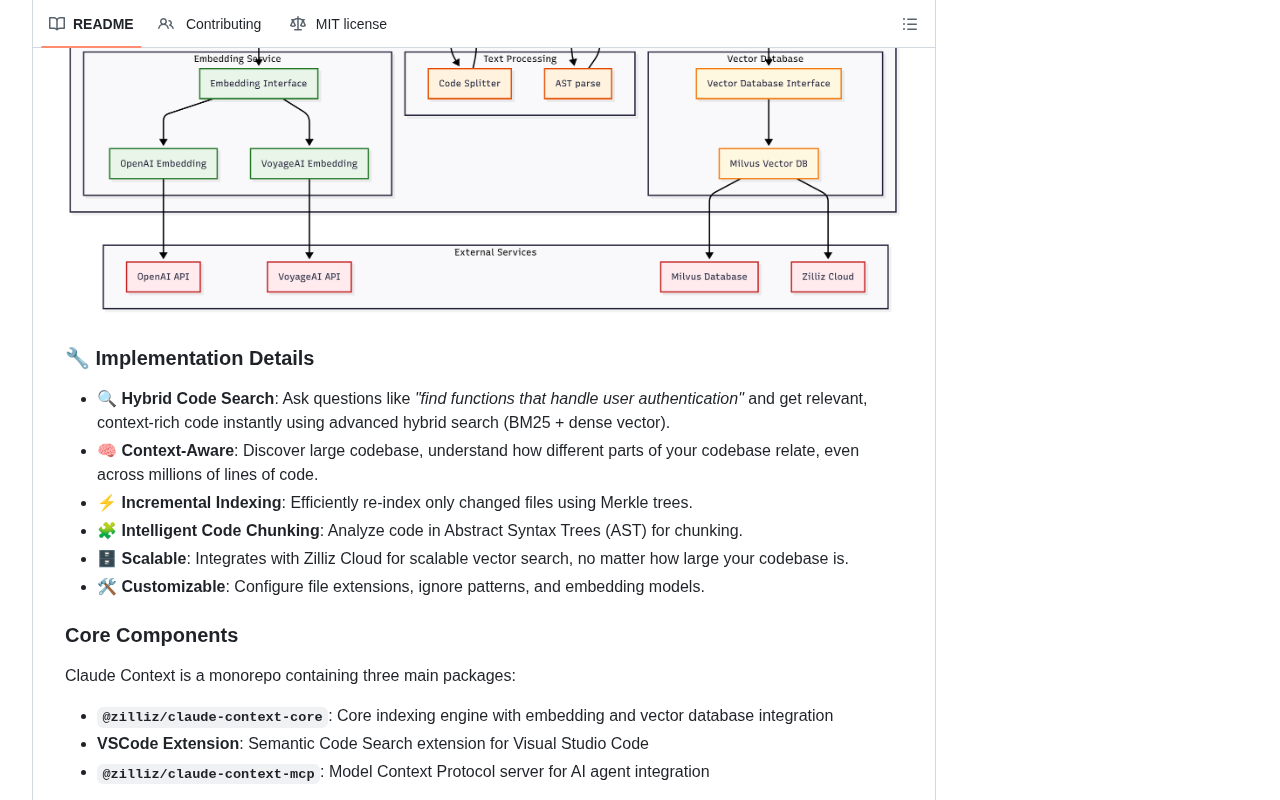
As an MCP Server, Claude Context acts as a bridge between Claude Code and the codebase. Its workflow consists of three phases:
- Indexing Phase: Parse and vectorize the target codebase to build a semantic index
- Query Phase: When Claude Code needs to understand code context, it sends a semantic search request to Claude Context via the MCP protocol
- Return Phase: Claude Context returns the most relevant code snippets as supplementary context for the AI
The elegance of this design is that it decouples code search capabilities into an independent service — not only can Claude Code use it, but any coding Agent that supports the MCP protocol can connect to it.
Zilliz's Deep Expertise in Vector Search
This project comes from the Zilliz team. Zilliz is the company behind the open-source vector database Milvus and has deep technical expertise in vector search and similarity retrieval.
Milvus is one of the world's most popular open-source vector databases, with over 30,000 GitHub Stars. It employs a storage-compute separation architecture and supports multiple vector index algorithms including HNSW, IVF_FLAT, and DiskANN, achieving millisecond-level retrieval at scales of billions of vectors. Milvus's core advantage lies in its hybrid search capability — performing vector similarity search and scalar filtering simultaneously (e.g., filtering by programming language or file path), which is particularly important for code search scenarios. Zilliz also offers Zilliz Cloud, a fully managed cloud service for Milvus, lowering the operational barrier for enterprises using vector databases.
Claude Context likely leverages Milvus or related technology under the hood for efficient code vector indexing and retrieval, which explains why the project excels at semantic code search.
Practical Value for Developers
Significantly Improving AI Programming Accuracy
With complete codebase context, AI coding assistants can:
- More accurately understand project architecture and coding style
- Avoid generating implementations that conflict with existing code
- Comprehensively consider the scope of impact during refactoring
- Better adhere to the project's established design patterns
Lowering the Barrier to AI Programming in Large Projects
Previously, using AI coding assistants in large projects often required experienced developers to "guide" the AI toward the right code areas. Claude Context lowers this barrier by letting AI autonomously discover and understand relevant code, enabling even newcomers to a project to develop efficiently with AI assistance.
Industry Trends: The Evolution of AI Coding Tools
The explosive popularity of Claude Context is no accident — it reflects several important trends in the AI coding tool space:
- From single-file to holistic understanding: AI programming is evolving from processing individual files to understanding entire projects
- Accelerating MCP ecosystem maturity: An increasing number of high-quality MCP tools are emerging, and Anthropic's protocol standard is gaining widespread adoption
- Deepening application of RAG in code scenarios: Applying Retrieval-Augmented Generation (RAG) to code scenarios is becoming a key path to enhancing AI programming capabilities. RAG was originally proposed by Meta in 2020, with the core idea of retrieving relevant information from an external knowledge base before generating a response, compensating for the limitations of the model's parametric knowledge. In code scenarios, the RAG workflow is: first chunk the codebase by function, class, module, and other granularities, generate vectors for each chunk and store them in a vector database; when the AI needs to understand or modify code, it first vectorizes the user's intent, retrieves the most relevant code snippets, then injects these snippets into the prompt for the model to reference. Compared to stuffing the entire codebase into context, the RAG approach achieves a better balance between cost, latency, and accuracy.
- Strategic positioning by vector database vendors: Vector database companies like Zilliz are actively extending their core technology capabilities to the AI application layer
Conclusion
Claude Context represents an important evolutionary direction for AI coding tools — letting AI truly "see" the entire codebase. With Zilliz's technical expertise in vector search and the standardization advantages of the MCP protocol, this project is poised to become an indispensable infrastructure component in AI programming workflows.
For developers currently using or planning to use Claude Code, Claude Context is a tool worth trying immediately — it may fundamentally change the way you collaborate with AI on programming.
Key Takeaways
- Claude Context is an MCP-based code search tool open-sourced by Zilliz that lets AI coding assistants use the entire codebase as context, with over 10,000 GitHub Stars
- Through semantic-level vector indexing technology, it enables intelligent code retrieval based on code meaning rather than keyword matching
- Designed around the MCP protocol, it works not only with Claude Code but with any coding Agent that supports MCP
- As the parent company of the Milvus vector database, Zilliz extends its core vector search capabilities to the AI programming application layer
- Reflects the industry trend of AI programming evolving from single-file processing to holistic codebase understanding
Related articles
 Product Reviews
The Programmer's Desk Setup Guide: Building a Workspace That Feels Like Home
Discover how programmers build productive, comfortable workspaces. From multi-monitor setups to ergonomic design, explore the desk philosophy that drives focus and flow.
 Product Reviews
Qoder vs Cursor Real-World Comparison: Which $20/Month AI IDE Is Better?
Hands-on comparison of Qoder vs Cursor AI IDEs: Agent autonomy, human interaction count, and architecture decisions. Qoder needed only 2 interactions vs Cursor's 8.
 Product Reviews
Cursor Cloud Agent Demo: Eliminating Bottlenecks Across the Entire Software Development Lifecycle
Deep analysis of Cursor's Cloud Agent demo showing how cloud VMs, automated test artifacts, and a full-chain control plane systematically eliminate human bottlenecks across the software development lifecycle.