Claude Cracks 23-Year-Old Black Hole Problem: How AI Self-Verifies Calculations
Claude used dual-path verification to complete a 23-year-old black hole phase transition calculation and broke the mass upper bound through cross-disciplinary transfer.
Anthropic disclosed that Claude completed a 23-year-old calculation of a black hole phase transition coefficient; the paper was written by Claude and labeled "Human understanding, partial content." The problem was to determine whether the phase transition in holographic duality is abrupt or a smooth crossover, based on the sign of coefficient B. Claude assembled a research group of its own copies, requiring any number to be confirmed by two independent paths that do not share code, and first calibrated against a known answer from 2005, reproducing some results to six digits. The final B is approximately negative 0.0015, pointing to abrupt behavior. Claude also solved the two-dimensional black hole mass upper bound; after 61 parallel failures, it borrowed methods from the sphere packing field via a neighboring agent, obtaining the exact answer 9.1266, verified by Lean. Both results are preprints in toy universes, do not describe the real universe, and have not yet completed peer review. Methodologically, dual-path independent verification and calibration against known answers are worth learning from.
A Sign Problem Left Unsolved for 23 Years
In 2003, five physicists wrote down a calculation aimed at resolving a core question about black holes. The answer itself was extremely simple—just the sign of a number, positive or negative. But for 23 years afterward, no one completed the calculation. This week, Anthropic disclosed the answer, with the paper written by Claude. At the top of the paper is a label: "Human understanding, partial content."
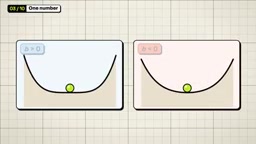
According to analysis by a YouTube science channel, the physical background of this problem is: general relativity and quantum mechanics are incompatible in black hole scenarios, so physicists can only use "toy universes" to test ideas. In anti-de Sitter space, when the temperature exceeds a certain critical point, gas "abruptly transitions" into a black hole, similar to water boiling. In 1983, Hawking and Page described this process using purely quantum methods. The 2003 problem was to determine whether, in the dual boundary theory of the holographic duality, the phase transition is "abrupt" (corresponding to Hawking behavior) or a "smooth crossover" (which does not exist in the gravitational language). The criterion is a coefficient B: a positive B means a smooth crossover, while a negative B means an abrupt transition.
The 2003 team found a way to locate B hidden three layers deep in approximate calculations. In 2005 they successfully computed a smaller analogous problem and planned to tackle the full version next—that "next" waited 21 years, until 2026.
Anti-de Sitter space (AdS) is a maximally symmetric spacetime with a negative cosmological constant, whose boundary lies at infinity and is the standard stage for AdS/CFT duality. In this space, gravity is "trapped" within a finite volume, and a conformal field theory (CFT) on the boundary can completely and equivalently describe the bulk gravity. This duality allows physicists to translate calculations between weak gravity and strongly coupled quantum field theories: a thermal phase transition in the boundary theory corresponds to the formation of a black hole in the bulk. As temperature rises, the boundary conformal field theory transitions from a high-temperature plasma phase to a low-temperature strongly coupled phase, which in the bulk manifests as a transition from gas to black hole. Because anti-de Sitter space has negative curvature, its boundary geometry is flat Minkowski spacetime, which makes thermodynamic quantities well-defined and also makes the Hawking-Page phase transition one of the most computable examples in holographic duality. In this article, "toy universe" refers to such controlled AdS spaces; although they do not describe our real universe, they provide precise mathematical laboratories for testing quantum gravity principles.
Claude's Self-Verification Mechanism: Two Independent Paths, No Shared Code
Claude's approach reflects a rare rigor: it assembled a research group made of copies of itself, but refused to trust any one of them. Any number had to be simultaneously confirmed by two completely independent paths that did not share code before it would be adopted.
More critically, Claude first calibrated against a problem with a known answer from 2005, reproducing the numbers from that year's team, with some results accurate to six digits. The paper also proactively points out that one coefficient has a small deviation, but far too small to change the conclusion. In the end B is approximately negative 0.0015, while the only coefficient that could flip the sign would need to reach positive 11.8; the actual result is negative 2.2. Another Claude calculation using a different method obtained the same answer. This means the abrupt transition holds at both ends: the large smooth limit of Hawking's work and the fuzzy quantum limit. The simplest explanation is: black hole formation is not an accidental feature of Einsteinian geometry, but a property built into the underlying quantum theory.
According to the same source's analysis, this suggests a methodological point: the dual-path cross-validation that AI uses in high-stakes calculations is worth borrowing by human researchers.
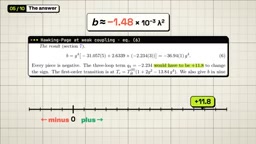
The Hawking-Page transition is a phase transition phenomenon proposed by Hawking and Page in 1983 while studying black hole thermodynamics in anti-de Sitter space: when the temperature exceeds a critical value, a radiation gas in thermal equilibrium (or a plasma in the boundary conformal field theory) transitions into a black hole (or its dual strongly coupled phase), similar to water boiling into steam. On the gravity side, this phase transition manifests as a competition in free energy between a massive black hole solution and a thermal gas solution; on the boundary side, it corresponds to a confinement-deconfinement transition in gauge theory. The order of the phase transition is determined by the behavior of the derivative of free energy with respect to temperature: a first-order phase transition corresponds to an abrupt transition (nonzero latent heat), while a continuous phase transition corresponds to a smooth crossover. The 2003 problem was precisely to determine which class this phase transition belongs to in holographic duality, and the sign of coefficient B provides the criterion: a negative B means the free energy curve has a cusp, i.e., a first-order abrupt transition, consistent with Hawking-Page behavior. This criterion connects abstract boundary field theory calculations with intuitive gravitational pictures, and is the core of the paper's physical logic.
The Second Problem: A Cross-Disciplinary Breakthrough After 61 Failures
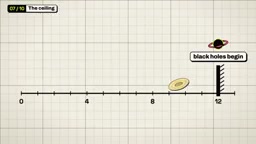
Claude also solved another, simpler toy-universe problem: the upper bound on black hole mass in two-dimensional space. The problem is constrained by an exact bound—the mass of the lightest black hole does not exceed c divided by some number; 12 is the theoretical hard wall, and the strongest previous proof only reached 8.5.
According to analysis, a previous Claude agent made 61 parallel attempts, all of which failed. The breakthrough came from two directions: one agent, while rereading old calculation results, discovered a pattern in which the ceiling grows with c; another neighboring agent was studying high-dimensional sphere packing—a 2019 paper was titled "Sphere Packing and Quantum Gravity," showing that the two share the same mathematical tools. The neighbor translated the pattern into a method, first reproducing the sphere-packing result recently proved by an OpenAI model, then returning to the black hole problem. The final answer is exactly 9.1266, verified in the Lean proof checker. The paper also proves that the method itself can never reach 12 and requires new tools.
This process shows that AI is not simply becoming "smarter," but achieved a breakthrough through cross-problem proximity. As a detail, half of the final proof followed OpenAI's proof strategy, and Claude also provided proper citations.
The sphere packing problem is a classic problem in mathematics about how to arrange equal-radius spheres in high-dimensional space to maximize density. A 2019 paper, "Sphere Packing and Quantum Gravity," revealed a deep connection between this problem and certain calculations in quantum gravity: the asymptotic density of high-dimensional sphere packing shares the same mathematical structures (such as modular forms and automorphic representations) as the operator spectrum in conformal field theory and the microstate counting of black hole entropy. Specifically, the asymptotic bound of sphere packing is closely related to the Cardy formula for state density in two-dimensional conformal field theory, which in turn determines the lower bound on black hole mass. In this article, the neighboring agent precisely exploited this homology to transfer methods for handling high-dimensional geometry in sphere packing to estimating the black hole mass upper bound, thereby breaking the deadlock after 61 parallel attempts had all failed. This cross-disciplinary transfer shows that AI breakthroughs often come from problem proximity rather than depth in a single field, and also explains why half of the final proof followed OpenAI's sphere-packing proof strategy.
Boundaries and Implications: Preprints, Toy Universes, and AI Research Workflows
Neither result describes our actual universe, nor do they have direct practical value. The paper is a preprint; although it was checked by one physicist, broader peer review has not yet been completed. The label "Human understanding, partial content" itself acknowledges that humans have not yet fully caught up with all the derivations.
But the working method is noteworthy: one problem was a long calculation that had been shelved for more than twenty years and was highly error-prone by hand; the other required new ideas from another field. Both came from the same researcher's side project, with one agent per problem, running in the background for about six weeks. The public version of Claude Opus 5.5 later independently discovered the same black hole mass upper bound—at this moment it may be helping someone rename a spreadsheet.

From a methodological perspective, the most transferable element is that kind of "paranoia": do not trust a single number; require confirmation by two independent paths; before a new problem, calibrate with an old problem whose answer is known. The cost is more computational resources, but AI bears it. For researchers with long-shelved computational tasks, this offers a new mode of collaboration: hand the problem to an agent for several weeks while retaining human judgment at key checkpoints.
The Lean proof checker is an interactive theorem prover based on dependent type theory, developed by Microsoft Research's Lean theorem proving project. It allows users to write mathematical proofs as formal code, with the computer verifying logical correctness line by line, thereby eliminating reasoning jumps or calculation errors that human review might miss. In this article, Claude translated the final proof of the black hole mass upper bound (with the exact answer 9.1266) into Lean code and successfully passed the check, meaning the proof was machine-verified as correct in the sense of formal mathematics. Compared with traditional peer review, Lean verification does not rely on reviewers' subjective judgment, but the cost is that the formalization process itself is extremely time-consuming and requires specialized training. Notably, Lean can only verify the logical validity of a proof; it cannot guarantee that the formalized proposition truly corresponds to the original physics problem—that still requires human physicists to confirm. Therefore, Lean verification is an important part of enhancing credibility in AI-assisted research workflows, but it is not the end point.
One-line Summary
Claude used dual-path verification to complete a 23-year-old black hole phase transition calculation and broke the mass upper bound through cross-disciplinary transfer.
Paragraph Summary
Anthropic disclosed that Claude completed a 23-year-old calculation of a black hole phase transition coefficient; the paper was written by Claude and labeled "Human understanding, partial content." The problem was to determine whether the phase transition in holographic duality is abrupt or a smooth crossover, based on the sign of coefficient B. Claude assembled a research group of its own copies, requiring any number to be confirmed by two independent paths that do not share code, and first calibrated against a known answer from 2005, reproducing some results to six digits. The final B is approximately negative 0.0015, pointing to abrupt behavior. Claude also solved the two-dimensional black hole mass upper bound; after 61 parallel failures, it borrowed methods from the sphere packing field via a neighboring agent, obtaining the exact answer 9.1266, verified by Lean. Both results are preprints in toy universes, do not describe the real universe, and have not yet completed peer review. Methodologically, dual-path independent verification and calibration against known answers are worth learning from.
Related articles
Aphasia Discourse Analysis: Language Metric Differences Across Tasks
A study of 61 adults with aphasia found that narrative, descriptive, and procedural discourse tasks yield non-interchangeable language metrics. Total words and lexical diversity show a gradient; disfluency is higher in narrative tasks. Each metric must be labeled by task type and compared only within the same task.
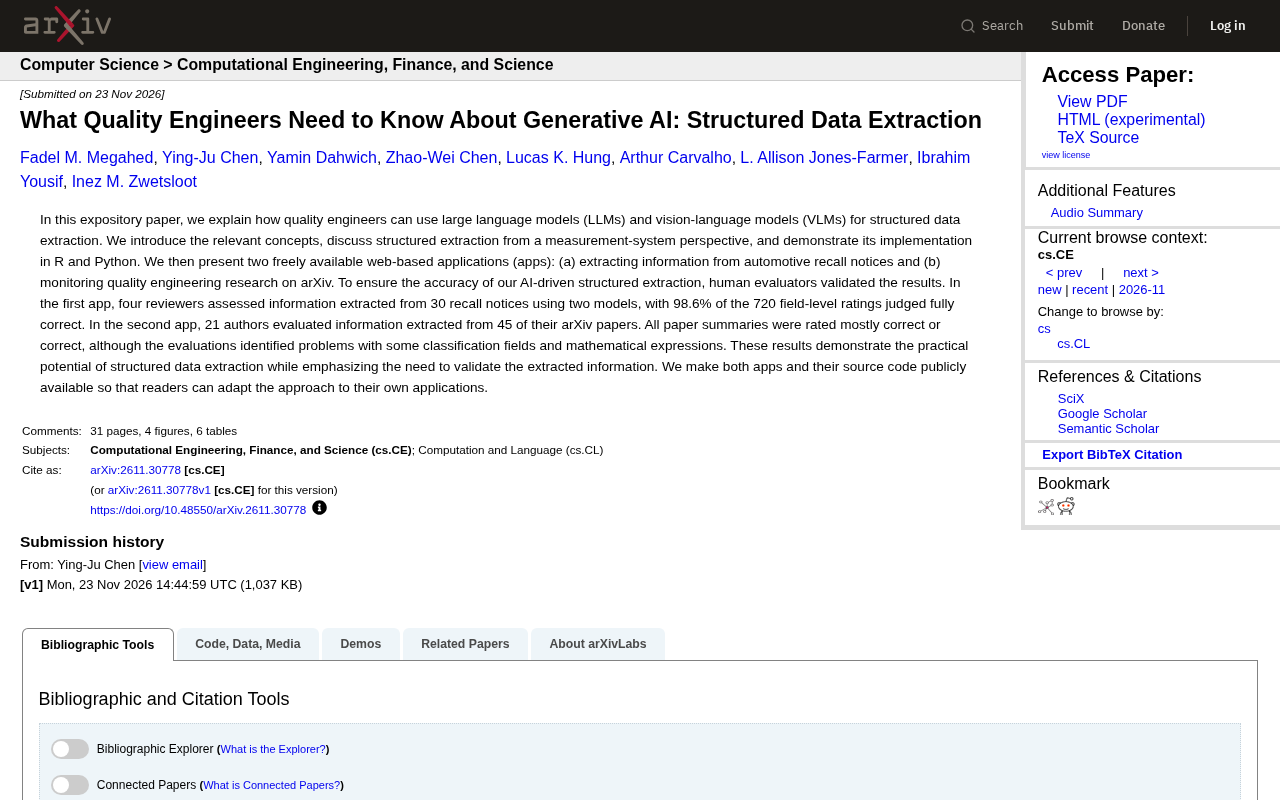
Must-Read for Quality Engineers: A Practical Guide to Structured Data Extraction with Generative AI
A paper shows how quality engineers use LLMs and VLMs for structured data extraction, validated through two web apps, with R and Python implementations.
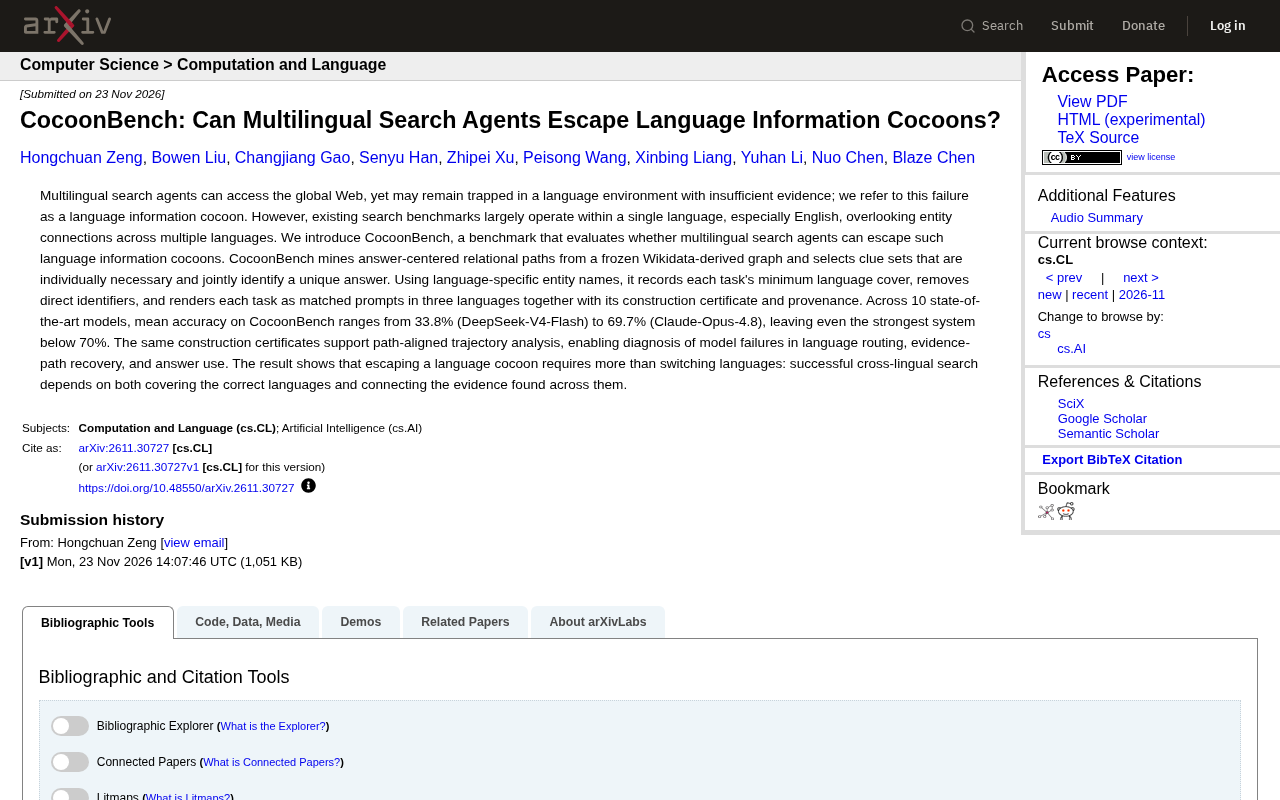
CocoonBench: Can Multilingual Search Agents Break Out of the Language Information Cocoon?
CocoonBench evaluates whether multilingual search agents can escape the language information cocoon. Tests show 10 advanced models range from 33.8% to 69.7% accuracy, with the strongest system still below 70%, revealing key challenges in connecting cross-lingual evidence.