Claude Designs Protein Binders to Neutralize Scorpion Neurotoxins

Anthropic's Claude was used to design protein binders for scorpion neurotoxins, showcasing the potential of large models in molecular design.
The article reports a case shared by the Hacker News community: Anthropic's Claude model successfully designed protein binders targeting scorpion neurotoxins. Scorpion venom neurotoxins cause disease by blocking ion channels. Traditional antivenom serums rely on animal immunization and have drawbacks such as batch variability, inconvenient storage, and allergy risks, while protein binders can specifically bind toxins and block their interaction with targets. The article analyzes the technical approach of this case, suggesting it involves sequence generation and structural compatibility assessment. AI-assisted design is expected to shorten R&D cycles, reduce animal experiments, and support customized development. It also notes that practical application of protein binders still requires experimental validation of affinity, stability, and safety. The significance of this case lies more in its demonstrative effect—large models are moving from text generation toward scientific hypotheses and molecular design, and future attention should be paid to validation results and reproducibility.
AI takes another step forward in biomedicine. According to a Hacker News community share, Anthropic's Claude model successfully designed protein binders targeting scorpion neurotoxins, offering a new approach to addressing the limitations of traditional antivenom serums.
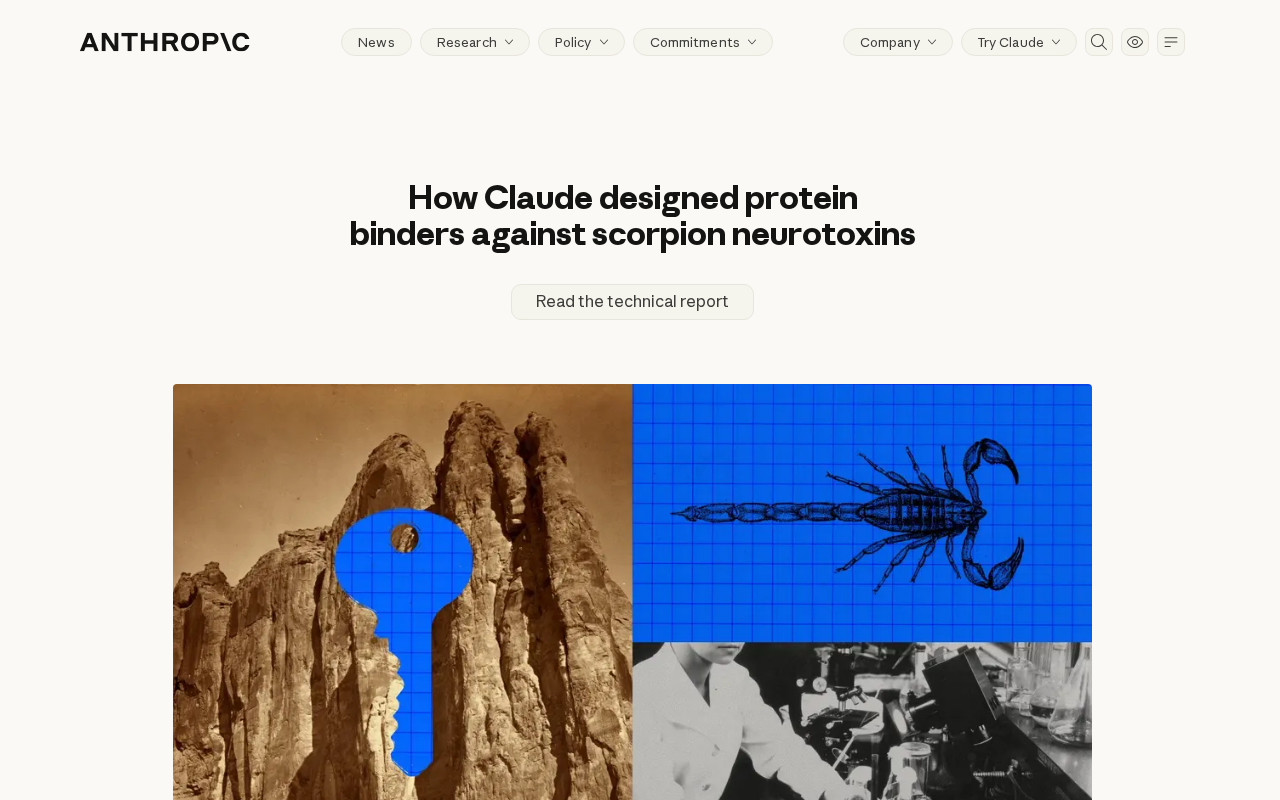
From Toxin Neutralization to AI Protein Design
Neurotoxins in scorpion venom cause severe physiological reactions by blocking ion channels. Traditional antivenom serums rely on animal immunization and suffer from batch variability, inconvenient storage, and allergy risks. Protein binders, as an alternative, can specifically bind toxins and prevent them from interacting with their targets. Claude's design attempt demonstrates the potential of language models in protein sequence generation and optimization.
Protein binders are a class of proteins capable of binding target molecules with high affinity and specificity. Typical examples include antibodies, antibody fragments (such as scFv, Fab), designed repeat proteins (such as DARPins, affibody), and the recently emerging de novo designed small proteins (de novo minibinders). Compared with antibodies, these low-molecular-weight binders are generally easier to express, more stable, can be lyophilized for storage, do not rely on animal immunization, and can be mass-produced using microbial systems. Their mechanism of action is not direct chemical neutralization of the toxin, but rather occupying the receptor-binding site on the toxin surface or providing steric hindrance to prevent the toxin from binding to ion channels. The key to de novo protein design lies in finding amino acid sequences that can fold into stable structures and whose surfaces are complementary to the target epitope—this is precisely where computational tools (such as RFdiffusion, ProteinMPNN) and language models can intervene.
Technical Approach and Potential Advantages
According to the original information, Claude participated in a protein binder design task targeting scorpion neurotoxins. Although the specific methods are not detailed in the source, it can be inferred that it involves sequence generation and structural compatibility assessment. Compared with traditional methods, AI-assisted design is expected to shorten R&D cycles, reduce reliance on animal experiments, and support customized development for specific toxins.
The core idea of using language models for protein sequence generation is to treat amino acid sequences as text composed of 20 "letters" and perform autoregressive or masked pretraining on large-scale protein sequence databases, thereby learning the grammar and evolutionary constraints of sequences. Such models (e.g., the ESM series, ProGen) can perform sequence completion, conditional generation, and fitness prediction, and are often used in combination with structure prediction tools (AlphaFold, ESMFold) and structure generation models: first, a structure model provides a backbone or binding interface; then a sequence model fills in compatible amino acids; finally, scoring functions are used for screening. It should be noted that there is currently no public evidence that general-purpose conversational models can independently complete end-to-end molecular design. The actual workflow is typically a closed-loop iteration in which the model generates candidates, computational tools filter them, and wet-lab experiments validate them.
Challenges and Industry Implications
The practical application of protein binders still requires experimental validation of their affinity, stability, and safety. The significance of this case lies in its demonstrative effect: large models are moving from text generation toward scientific hypothesis generation and molecular design. For the biotechnology industry, AI is no longer just an auxiliary tool but may become a participant in early-stage R&D. Future attention should be paid to experimental validation results and reproducibility.
Affinity and developability validation is the key threshold for protein binders to move from computation to application. In vitro evaluation typically includes the dissociation constant KD measured by surface plasmon resonance (SPR) or biolayer interferometry (BLI) (only sub-nanomolar levels have practical value), thermal stability (melting temperature Tm), soluble expression level, and whether there is a tendency to aggregate. At the in vivo level, half-life, immunogenicity, and tissue distribution also need to be evaluated. In addition, the reproducibility of the design-validation loop depends on publicly available sequences, structures, and experimental conditions. Currently, most AI protein design reports lack independent reproduction, which is one of the main reasons this field has been questioned.
One-line Summary
Anthropic's Claude was used to design protein binders for scorpion neurotoxins, demonstrating the potential of large models to participate in molecular design.
Paragraph Summary
The article reports a case shared by the Hacker News community: Anthropic's Claude model successfully designed protein binders targeting scorpion neurotoxins. Scorpion venom neurotoxins cause disease by blocking ion channels. Traditional antivenom serums rely on animal immunization and suffer from batch variability, inconvenient storage, and allergy risks, whereas protein binders can specifically bind toxins and block their interaction with targets. The article analyzes the technical approach of this case, suggesting that it involves sequence generation and structural compatibility assessment. AI-assisted design is expected to shorten R&D cycles, reduce animal experiments, and support customized development. At the same time, it points out that the practical application of protein binders still requires experimental validation of affinity, stability, and safety. The significance of this case lies more in its demonstrative effect—large models are moving from text generation toward scientific hypotheses and molecular design, and future attention should be paid to validation results and reproducibility.
Related articles

WorkBuddy Full Tutorial: Build an AI Office Automation Agent from Scratch
A complete WorkBuddy tutorial: installation, three working modes, multimodal picture book video practice, expert team agent building, and workflow configuration for low-cost AI office automation.

WorkBuddy Agent Complete Guide: From Beginner to Automation in 7 Days
Based on Bilibili's 256-episode WorkBuddy masterclass, this systematically breaks down Tencent's AI office workbench core capabilities: Agent principles, Skill encapsulation, cross-platform connectors, scheduled automation, knowledge bases, and zero-code development, with learning path recommendations.

8 AI Accounts, 7 Failed: An Honest Review of Using AI to Get Work Done
Only 1 of 8 AI-run Bilibili accounts succeeded. We break down the real difference between "performing AI" and "using AI to get work done."