Claude Detects Early Signs of Sepsis, Reddit User Says AI Saved Their Life

Reddit user saved after Claude promptly identified sepsis signs, sparking discussion on AI health warning value and boundaries.
A Reddit user experienced difficulty urinating, blood in urine, and confusion late at night. After describing symptoms to Claude, Claude assessed it as possible sepsis from a urinary tract infection and strongly urged immediate emergency care. Doctors confirmed that waiting until morning could have led to septic shock. The event shows LLMs' potential in pattern recognition and linking emergency symptoms, but also exposes limitations: no physical exams or tests, an element of luck in the assessment, and no substitute for professional diagnosis. The article discusses the auxiliary role of AI health assistants, the constraining effect of system prompts, and the principle that users should not delay medical care because of AI reminders.
A Reddit user posted that Claude's timely warning helped them avoid a potentially fatal septic shock. The post quickly went viral, prompting us to re-examine the potential value and boundaries of AI in emergency health scenarios.
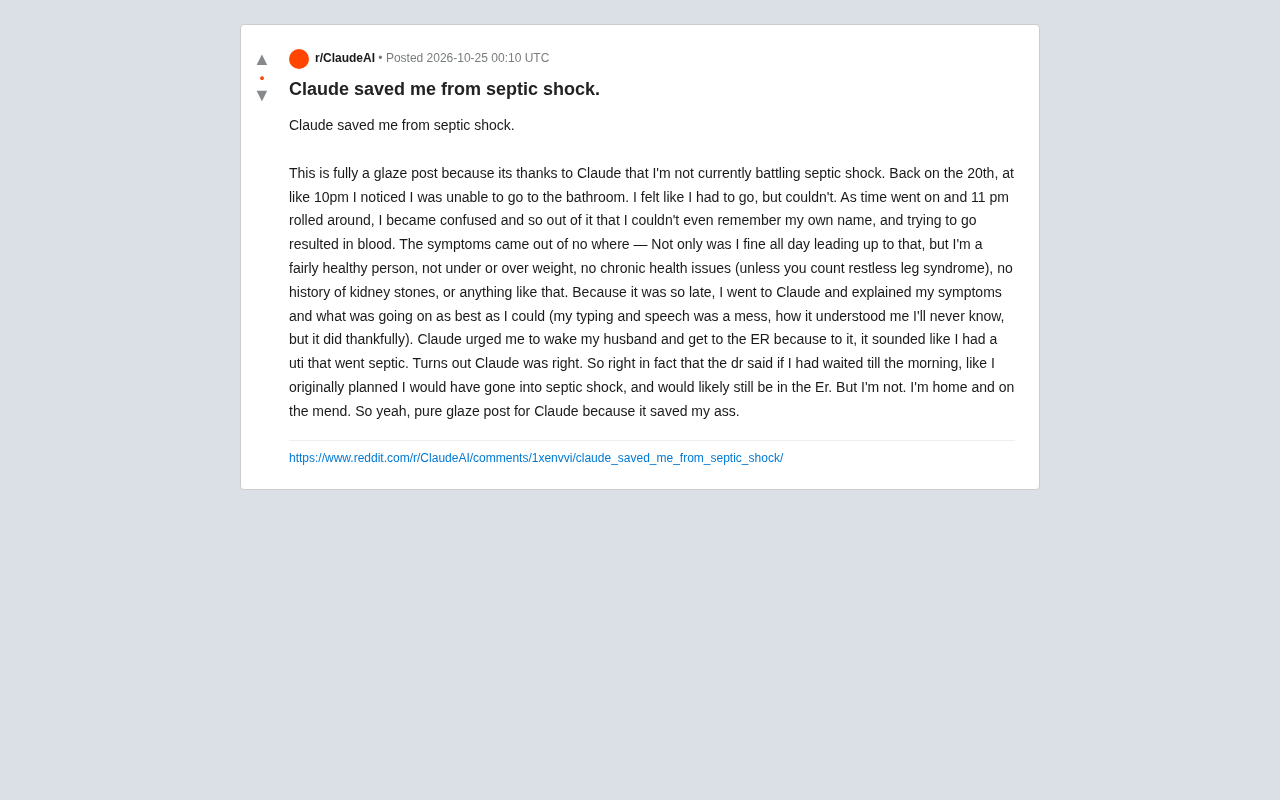
Event Recap: Sudden Symptoms Late at Night, AI Becomes the First Point of Contact
According to the Reddit user, around 10 PM that night, they found themselves unable to urinate despite a strong urge to go. As time passed, the symptoms rapidly worsened: by 11 PM, they became confused and couldn't even remember their own name, and noticed blood when trying to urinate. These symptoms came out of nowhere—they had been completely normal during the day, were generally healthy with no chronic conditions (aside from restless legs syndrome), and had no history of kidney stones.
Because it was so late, they chose to describe their symptoms to Claude. Even though their typing and expression were already muddled at that point, Claude still understood their situation and strongly urged them to wake their husband immediately and go to the emergency room, as Claude judged this could be sepsis caused by a urinary tract infection.
Medical Verification: Doctor Confirms AI's Assessment Was Accurate
The user followed Claude's advice and went to the emergency room. The doctor's diagnosis confirmed Claude's assessment: had they waited until morning to seek medical attention as originally planned, they would likely have developed septic shock and might still be in the ER fighting for their life. Now, they have returned home to recover and are getting better.
The post garnered significant attention on Reddit, with many users expressing surprise at Claude's accurate assessment. The original poster themselves said it was a "pure praise post" because Claude saved their life.
Sepsis and septic shock are key medical background for understanding the severity of this event. Sepsis refers to a dysregulated immune response to infection that leads to life-threatening organ dysfunction; when the circulatory system collapses and blood pressure drops sharply, it progresses to septic shock, which can have a mortality rate of 30%–40% or higher, with the risk of death rising significantly for every hour that antibiotic treatment is delayed. Urinary tract infections are a common trigger, especially when bacteria enter the bloodstream. Typical warning signs include altered mental status, difficulty urinating, blood in urine, rapid breathing, and elevated heart rate. In this case, "confusion and inability to remember one's own name" are signs of inadequate organ perfusion and systemic inflammatory response—a red alert requiring immediate emergency intervention, not a mild condition that can wait until the next day.
The Potential and Limitations of AI in Health Early Warning
This incident demonstrates the potential of large language models in identifying emergency medical conditions. Claude was able to extract key information from a confused description (difficulty urinating, blood in urine, confusion) and associate it with the typical symptoms of sepsis, reflecting AI's strengths in pattern recognition and knowledge integration.
However, this does not mean AI can replace professional medical diagnosis. First, the user's symptom combination itself was highly indicative, so AI's accurate assessment involved some element of luck. Second, AI cannot perform physical examinations or laboratory tests, and its advice should always be treated as reference rather than diagnosis. More importantly, in emergency situations, calling emergency services directly or going to the hospital remains the first choice.
The pattern recognition capabilities of large language models (LLMs) come from statistical learning over massive amounts of text, not from medical reasoning or sensing of physical signs. They can semantically match symptom combinations like "difficulty urinating + blood in urine + confusion" with descriptions of sepsis in their training corpus, thereby providing risk alerts; but they cannot measure body temperature, blood pressure, or blood oxygen, nor can they perform urinalysis or blood cultures. Therefore, the appropriate role of LLMs in health scenarios is that of a "triage prompter" rather than a "diagnostic tool": their value lies in shortening the time between symptom onset and seeking professional help, not in providing definitive conclusions. Understanding this distinction helps explain why the same model may give inconsistent advice for different symptom descriptions.
Industry Implications: AI Health Assistants Need More Rigorous Design
This case provides important reference for the design of AI health assistants. On one hand, AI needs the ability to recognize emergency symptoms and guide users to seek professional help; on the other hand, developers must clearly define AI's auxiliary role to prevent users from becoming overly dependent. Currently, mainstream models including Claude emphasize in their system prompts that they "cannot replace professional medical advice," but in practice, users often treat AI as their first point of consultation.
For ordinary users, this story reminds us: when something abnormal happens to your body, seeking medical attention promptly is always the first principle. AI can serve as an informational aid, but should not become a reason to delay medical care.
System prompts and safety alignment are the primary means by which current mainstream models constrain medical advice. Developers typically add instructions at the system level such as "do not provide diagnoses, do not replace doctors, call emergency services in emergencies," and use reinforcement learning with human feedback (RLHF) to reduce the probability of the model giving dangerous advice. However, such constraints are probabilistic and cannot guarantee that the model will trigger a medical referral reminder for every emergency phrasing. More rigorous design approaches include: forcibly inserting fixed safety templates when high-risk symptom keywords are detected, proactively asking about duration and accompanying symptoms during conversations, and clearly distinguishing "informational reference" from "medical advice" in interface prompts. For users, this means that a single correct judgment by the model should not be treated as a reproducible guarantee of reliability.
Conclusion
Claude played a key role in this incident, but its success was more about "timely warning" than "medical diagnosis." AI has broad prospects in health applications, but the boundaries of responsibility need to be clearly defined. For the tech industry, how to ensure user safety while improving AI capabilities will be an ongoing topic of discussion.
Related articles

Underdog Saluki 27B: A Practical Guide to Tool Calling Under 2-Bit Quantization
An in-depth look at Underdog Saluki 27B's GSQ-RCO-based 2-bit quantization, covering GGUF header structure, memory usage analysis, and BFCL tool-calling test points under native llama.cpp.

GPU-unlock: Unlocking the FP/BF16 Instruction Issue Rate of Nvidia 3000-Series GPUs
gpu-unlock explores the FP16/BF16 instruction issue rate limits of Nvidia 3000-series GPUs, covering measurement methods, unlocking approaches, community debates, and implications for GPU performance optimization.

Cognition Open-Sources Devin Vulnerability Fixes Plugin: AI Agent Automatically Patches Critical PHP/Node.js/GitLab RCE Flaws
Cognition open-sources Devin Vulnerability Fixes, with 3 MIT-licensed agent skills targeting critical RCE flaws in PHP, Node.js, and self-hosted GitLab—automating inventory, patching, testing, and one PR per repo.