GPU-unlock: Unlocking the FP/BF16 Instruction Issue Rate of Nvidia 3000-Series GPUs

gpu-unlock explores measuring and unlocking the FP16/BF16 instruction issue rate of Nvidia 3000-series GPUs, with the community skeptical of its practical gains.
gpu-unlock is a GitHub project aimed at measuring and potentially unlocking the FP16 and BF16 instruction issue rate potential of Nvidia 3000-series GPUs (Ampere architecture) through low-level techniques. The article explains the importance of instruction issue rate to actual GPU floating-point throughput, noting that official spec sheets typically ignore this metric and that vendors may differentiate professional and consumer cards through firmware or drivers. The project provides microbenchmarking methods and unlocking exploration, but these are high-risk operations that may cause system instability. Hacker News community discussions are divided: some believe the gains from unlocking may be offset by bottlenecks such as memory bandwidth, while others argue that reverse engineering itself has technical value. The article emphasizes that microbenchmark improvements may not translate into end-to-end speedup, and the project's main value lies in helping developers understand GPU microarchitectural constraints rather than providing production-grade solutions.
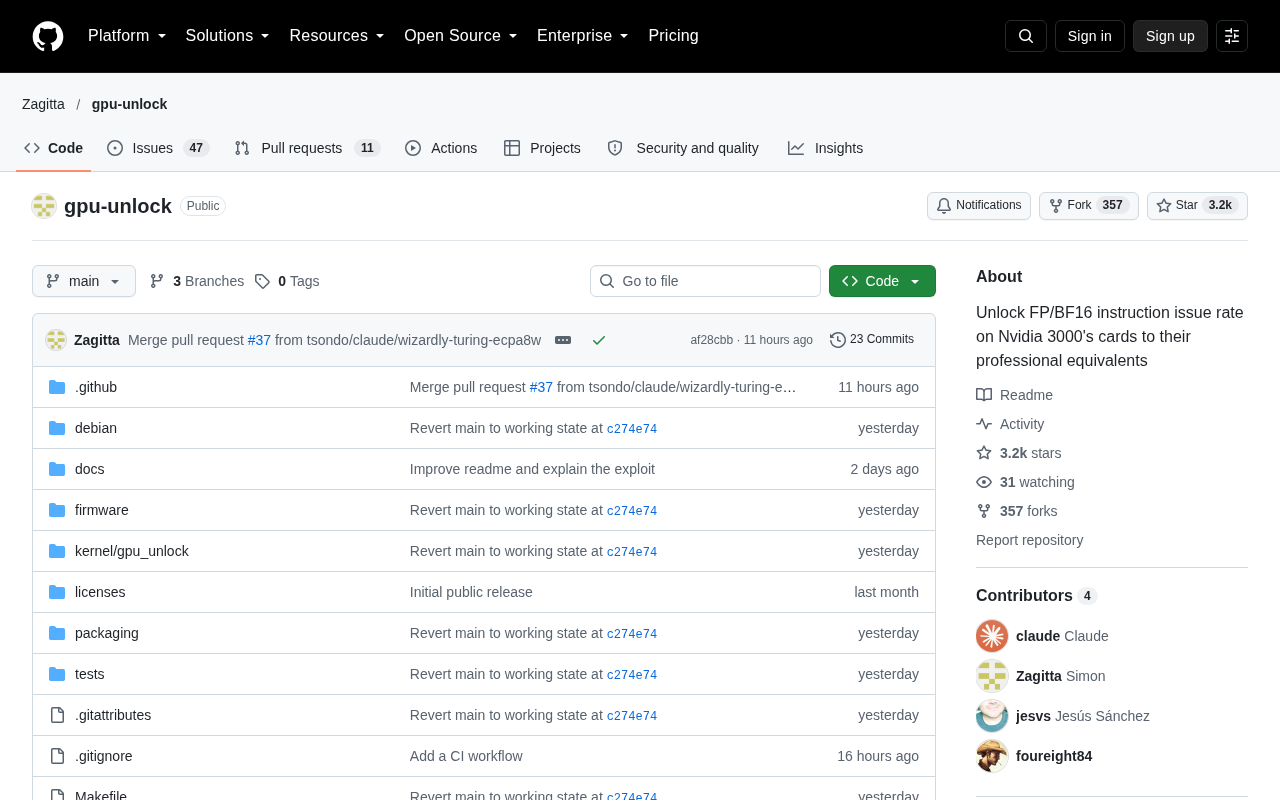
In Nvidia's GPU architectures, the instruction issue capabilities of different compute units are often overlooked in official spec sheets. Recently, a project called gpu-unlock appeared on GitHub, dedicated to exploring how low-level techniques can unleash the FP16 and BF16 instruction issue rate potential of Nvidia 3000-series GPUs (based on the Ampere architecture). This topic garnered 195 points and 61 comments on Hacker News, indicating that many developers are keenly interested in the hidden compute power of consumer-grade GPUs.
Why Instruction Issue Rate Matters
In the GPU execution model, the instruction issue rate determines how many instructions an SM (Streaming Multiprocessor) can dispatch to execution units per clock cycle. For dense computations like matrix multiply-add, the theoretical floating-point peak depends not only on the number of CUDA cores but is also limited by whether instructions can be continuously and sufficiently fed to the execution pipeline. Nvidia often differentiates professional and consumer cards through firmware or driver-level configurations, causing chips with similar specs to diverge in actual throughput.
FP16 and BF16 are the most commonly used data formats in deep learning inference and mixed-precision training. The Tensor Cores of 3000-series GPUs have hardware support for both formats, but whether consumer-market products are deliberately restricted at the instruction issue level has long been a gray area in community discussions. The gpu-unlock project approaches from this angle, attempting to quantify and possibly bypass such limitations through reverse engineering and experimentation.
SM (Streaming Multiprocessor) and Sub-partitions: In Nvidia's GPU architecture, the SM is the basic compute unit, and each SM contains multiple sub-partitions, each with its own instruction scheduler and execution units. Instruction issue rate is typically measured as the number of instructions each sub-partition can issue per clock cycle. Each SM in the Ampere architecture contains four sub-partitions, each with 32 FP32 cores, but instruction issue capability is not entirely proportional to core count. Understanding the internal structure of the SM helps analyze why certain instruction streams encounter issue bottlenecks.
FP16 and BF16 Formats: FP16 (half-precision floating point) uses 16-bit storage with 1 sign bit, 5 exponent bits, and 10 mantissa bits; it has a smaller dynamic range but adequate precision and is widely used for inference. BF16 (Brain Floating Point) is also 16-bit but uses 8 exponent bits and 7 mantissa bits, giving it the same dynamic range as FP32 and making it more suitable for training. Both have hardware support on Tensor Cores, but instruction issue strategies may differ by data format.
What the Project Does
The core work of the gpu-unlock repository revolves around two aspects: measurement and unlocking. On the measurement side, the project provides microbenchmarking methods to observe the issue behavior of specific SM sub-partitions under continuous FP16/BF16 instruction streams, thereby determining whether an artificial rate bottleneck exists. On the unlocking side, the project explores the feasibility of altering issue strategies by modifying device configurations, adjusting driver parameters, or leveraging undocumented register interfaces.
It must be emphasized that such operations are typical low-level tinkering, with both risks and rewards. Modifying firmware or driver behavior can lead to system instability, unreliable computation results, and even affect warranties. The project itself is more of a research record and tool collection than a one-click solution. Readers hoping to reproduce results are advised to test in an isolated environment first.
Microbenchmark: A small program specifically designed to measure specific hardware behavior, typically by looping through a large number of identical or similar instructions to observe metrics such as throughput and latency. On GPUs, microbenchmarks can precisely control instruction streams, thread block sizes, and memory access patterns, thereby isolating microarchitectural characteristics such as instruction issue rate. The measurement scripts in the gpu-unlock project likely employ this technique, inferring the existence of artificial limits by comparing instruction throughput under different configurations.
Community Reaction and Controversies
The Hacker News discussion reveals two typical attitudes. Some commenters believe that restrictions on instruction issue rate in consumer-grade GPUs are a standard means of market segmentation by vendors, and unlocking them amounts to wandering in a gray area, with actual gains possibly offset by memory bandwidth and cache hierarchy. Others, from a purely technical perspective, argue that understanding the true capabilities of hardware is itself a valuable reverse-engineering practice, even if it ultimately cannot be stably used in production.
From existing discussions, the community has not reached a consensus on whether unlocking can translate into considerable performance gains in real workloads. Whether differences in microbenchmarks manifest in high-level frameworks like PyTorch or cuBLAS depends on multiple factors such as kernel scheduling, occupancy, and data locality. This is also a common limitation of such projects: improvement in low-level metrics does not equal end-to-end speedup.
Impact of Memory Bandwidth and Cache Hierarchy: Even if instruction issue rate improves, GPU performance may be limited by memory bandwidth or cache hit rates. The GA102 chip in the Ampere architecture has a large L2 cache, but consumer-grade GPUs typically have lower memory bandwidth than professional cards. In dense computations, if data supply cannot keep up, even a higher instruction issue rate cannot translate into actual performance. Therefore, the community's skepticism that the actual gains of unlocking are offset by other bottlenecks is reasonable.
Significance for Developers and Researchers
Even without intending to actually modify anything, gpu-unlock offers a window into understanding GPU microarchitecture. It reminds us that the TFLOPS numbers in official spec sheets are idealized upper bounds; real performance is jointly determined by a series of micro-mechanisms such as instruction issue, register pressure, and shared memory bank conflicts. For developers engaged in high-performance computing and deep learning system optimization, understanding these low-level constraints helps write kernels that better fit the hardware.
Another noteworthy signal is that as open-source inference frameworks mature in their support for low-precision formats, the actual throughput of BF16 on consumer-grade hardware will receive increasing attention. If the community can systematically quantify the differences in instruction issue rates across GPU models, it can provide more reliable basis for user selection and kernel tuning.
The Gap Between TFLOPS and Real Performance: TFLOPS (trillions of floating-point operations per second) is a theoretical peak calculated based on core count and clock frequency, assuming all execution units are always fully utilized. However, in real applications, factors such as instruction dependencies, branch divergence, and memory latency cause utilization to be far below 100%. Instruction issue rate is one of the key factors affecting utilization; official spec sheets typically do not disclose this detail, resulting in a significant gap between theoretical peak and actual performance.
Practical Advice
If you are interested in such low-level experiments, a reasonable path is to first read the measurement scripts in the repository, understand which level of metrics they observe, and then reproduce baseline data in a controlled environment. Do not directly apply any unverified modifications on production machines. At the same time, it is recommended to compare microbenchmark results with end-to-end data from real model inference to avoid being misled by local metrics. The value of low-level tinkering lies in deepening understanding, not in chasing paper numbers.
One-line Summary
gpu-unlock explores measuring and unlocking the FP16/BF16 instruction issue rate of Nvidia 3000-series GPUs, with the community skeptical of its practical gains.
Paragraph Summary
gpu-unlock is a GitHub project aimed at measuring and potentially unlocking the FP16 and BF16 instruction issue rate potential of Nvidia 3000-series GPUs (Ampere architecture) through low-level techniques. The article explains the importance of instruction issue rate to actual GPU floating-point throughput, noting that official spec sheets typically ignore this metric and that vendors may differentiate professional and consumer cards through firmware or drivers. The project provides microbenchmarking methods and unlocking exploration, but these are high-risk operations that may cause system instability. Hacker News community discussions are divided: some believe the gains from unlocking may be offset by bottlenecks such as memory bandwidth, while others argue that reverse engineering itself has technical value. The article emphasizes that microbenchmark improvements may not translate into end-to-end speedup, and the project's main value lies in helping developers understand GPU microarchitectural constraints rather than providing production-grade solutions.
Related articles

Underdog Saluki 27B: A Practical Guide to Tool Calling Under 2-Bit Quantization
An in-depth look at Underdog Saluki 27B's GSQ-RCO-based 2-bit quantization, covering GGUF header structure, memory usage analysis, and BFCL tool-calling test points under native llama.cpp.

Cognition Open-Sources Devin Vulnerability Fixes Plugin: AI Agent Automatically Patches Critical PHP/Node.js/GitLab RCE Flaws
Cognition open-sources Devin Vulnerability Fixes, with 3 MIT-licensed agent skills targeting critical RCE flaws in PHP, Node.js, and self-hosted GitLab—automating inventory, patching, testing, and one PR per repo.

OpenAI and Anthropic Restrict Smart TV Reverse Engineering, Sparking AI Ethics Debate
OpenAI and Anthropic restrict the smart TV reverse engineering project REA, sparking debate over AI safety and open research. This article analyzes the background, privacy risks, AI companies' usage policies, and the path to balance.