Claude Diagnoses Hardware Fault in Old iPhone, Solving Hours-Long Problem in 20 Minutes
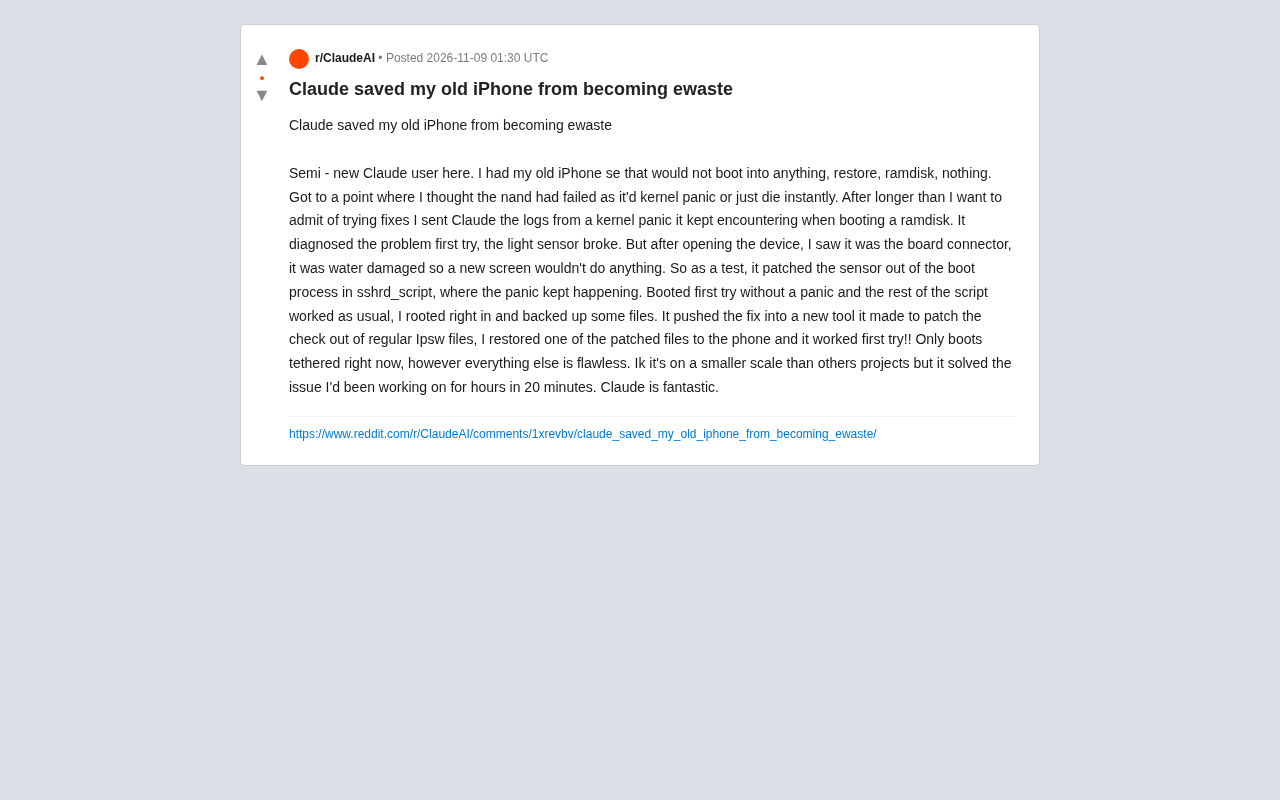
Claude diagnosed an old iPhone's ambient light sensor fault by analyzing kernel logs and generated a patching tool to boot it successfully.
A Reddit user shared how they revived an unbootable old iPhone SE using Claude. The phone frequently experienced kernel panics; after submitting the logs to Claude, it diagnosed the ambient light sensor fault on the first attempt. Teardown confirmed the motherboard connector was damaged by water. Claude then helped modify sshrd_script to bypass the sensor check, and the device booted successfully; it also extended the fix into a tool that removes the check logic from IPSW firmware, with the patched firmware succeeding on the first try. The device currently only supports tethered boot, but other functions work normally, and the user successfully rooted it and backed up files. This case demonstrates AI's practical value in hardware debugging, log parsing, and firmware patching, but also shows such solutions still depend on users having technical skills such as disassembly and flashing.
A Reddit user shared their experience of using Claude to revive an old iPhone SE that wouldn't boot. After trying recovery mode, ramdisk, and various other methods, the phone still failed to start, frequently experiencing kernel panics or instant power-offs. The user initially suspected NAND flash corruption, but after sending the kernel panic logs to Claude, Claude diagnosed the problem on its first attempt: a faulty ambient light sensor. This case demonstrates the practical value of AI in hardware debugging and reverse engineering.
From Kernel Logs to Precise Diagnosis: Claude's Troubleshooting Process
The user submitted the kernel panic logs that repeatedly appeared during ramdisk boot to Claude, and Claude quickly determined the problem was the ambient light sensor. After opening the device, the user found that the motherboard connector had been damaged by water, meaning even replacing the screen wouldn't help. This diagnosis aligned closely with the actual hardware condition, showing that Claude has considerable capability in parsing low-level system logs.
A notable detail: Claude didn't stop at diagnosis. After the user confirmed the hardware issue, it helped modify sshrd_script to bypass the sensor during the boot process—specifically, by patching the checkpoint in the boot process that was triggering the panic. After the patch was applied, the device booted successfully on the first attempt with no kernel panic, and the rest of the script ran normally. The user was able to successfully root the device and back up some files.
Kernel Panic is a protection mechanism that the operating system kernel triggers when it detects an unrecoverable critical error. On iOS devices, kernel panics are usually caused by hardware faults, driver anomalies, or out-of-bounds memory access; the device force-restarts and generates a log containing a backtrace and error information. These logs often present hexadecimal addresses and driver function names, which are difficult for ordinary users to interpret, but experienced developers can use them to pinpoint the specific failing hardware component. In this case, Claude narrowed the fault down to the ambient light sensor and its related connector by analyzing the repeatedly appearing driver identifiers and error patterns in the logs, demonstrating the potential of large language models in parsing unstructured system logs.
Automated Patching Tool: From Script to IPSW File
Claude then extended this fix approach into a new tool capable of removing the corresponding check logic from standard IPSW firmware files. The user restored the patched firmware to the phone, and it succeeded on the first try again. Currently the device only supports tethered boot, but all other functions work normally.
In this case, Claude's role extended from log analysis to code patching and tool generation, demonstrating the continuity of AI in solving specific technical problems. The user said that a problem they had spent hours unable to solve was given a viable solution by Claude in 20 minutes.
IPSW (iPhone Software Update) is the official iOS firmware package provided by Apple, essentially a ZIP archive containing the system image, bootloader, baseband firmware, and recovery mode. The jailbreaking and reverse engineering community often unpacks IPSWs, modifies specific files within them (such as iBSS, iBEC, or the device tree), and repackages them to achieve custom boot processes. The tool Claude generated can locate and remove the check logic that triggers kernel panics, meaning it understood the internal structure of IPSW and the dependencies among components in the boot chain. Tethered boot means the device requires a USB connection to a computer and an external tool to re-inject the bootloader each time it restarts before it can enter the system—this is because the patch modified a critical verification step in the boot chain, preventing the device from completing boot independently.
The Potential and Limits of AI-Assisted Hardware Debugging
Judging from community feedback, such applications are gradually increasing. Claude's capabilities in code generation and log parsing make it a practical assistant for hardware enthusiasts repairing old devices. However, this approach still depends on users having certain hands-on skills (such as disassembling devices and flashing firmware), and patched devices may have functional limitations (such as tethered boot only).
For ordinary users, directly diagnosing hardware faults through AI still has barriers; but for developers and tech enthusiasts, this offers a new approach to reducing electronic waste and extending device lifespan. The case also sparked discussion: can AI assist firmware reverse engineering and system-level debugging on a broader scale? Currently, the answer leans toward yes, but it requires combination with specific scenarios and manual verification.
sshrd_script is a well-known open-source scripting tool in the iOS jailbreaking community, used to boot devices into a temporary ramdisk environment (i.e., a recovery environment accessible via SSH) through BootROM exploits such as checkm8. In this environment, users can mount the file system, back up data, or execute low-level debugging commands without fully booting iOS. In this case, what Claude modified was precisely the part of the script responsible for loading sensor drivers and initialization checks; by bypassing the checkpoint that triggers the panic, the device could run stably in the ramdisk environment. Such tools typically require users to be familiar with command-line operations and the iOS boot process, so while AI assistance lowers the diagnostic barrier, actual operation still requires a certain technical background.
Key Takeaways
- By analyzing kernel panic logs, Claude diagnosed the ambient light sensor fault in an old iPhone on its first attempt;
- The user found the motherboard connector was damaged by water; Claude helped modify sshrd_script to bypass the sensor check, and the device booted successfully;
- Claude further generated a tool that can remove the check logic from standard IPSW files; after restoring the patched firmware, it succeeded on the first try;
- The device currently only supports tethered boot, but other functions work normally; the user successfully rooted it and backed up files;
- This case demonstrates the practical potential of AI in hardware debugging and firmware patching, but requires a certain technical threshold.
Related articles
Seven Years of Evolution: How Far Has the Foldable Come From the First Generation?
From the first foldable to today's latest models, what has seven years changed? Shallower creases, higher brightness, thinner bodies, and smoother software migration—has the foldable crossed the chasm from enthusiasts to ordinary users? This article discusses the question based on a video comparison.

When Did Humans Start Eating Salt? A 10,000-Year History of Salt
When did humans start eating salt? From salt use at the dawn of agriculture 11,000 years ago to ancient seawater evaporation and rock salt mining, and on to the salt trade, salt taxes, and Gandhi's Salt March, this article traces salt's key role in human civilization.
Microsoft Paza Research: How African Language Speech Recognition Breaks Through Architecture and Data Bottlenecks
Microsoft's Paza research evaluates 53 speech models across 39 African languages, revealing architecture choice matters more than pre-training coverage, 200-300 hours is the practical data threshold, and language typology deeply influences recognition performance.