Claude Discovers a Novel CRISPR-like Enzyme System in Bacteriophages

Claude found an unknown enzyme system in phage DNA with a CRISPR-like repeat array structure, pending wet lab validation.
Anthropic announced that its AI model Claude identified a previously unknown enzyme system in bacteriophage genomes, featuring a repeating DNA array adjacent to the gene — a hallmark of CRISPR-like systems capable of programmable DNA manipulation. While systems like CRISPR have revolutionized genetic medicine, Anthropic cautioned that the system's actual function remains unknown and significant experimental work lies ahead. More broadly, the discovery signals AI's growing role as an active hypothesis-generator in life sciences, capable of surfacing patterns in vast, unannotated genomic "dark matter" that human researchers might overlook. The finding is currently a computational prediction and has not yet been peer-reviewed.
AI Uncovers an Unknown System Hidden in the Code of Life
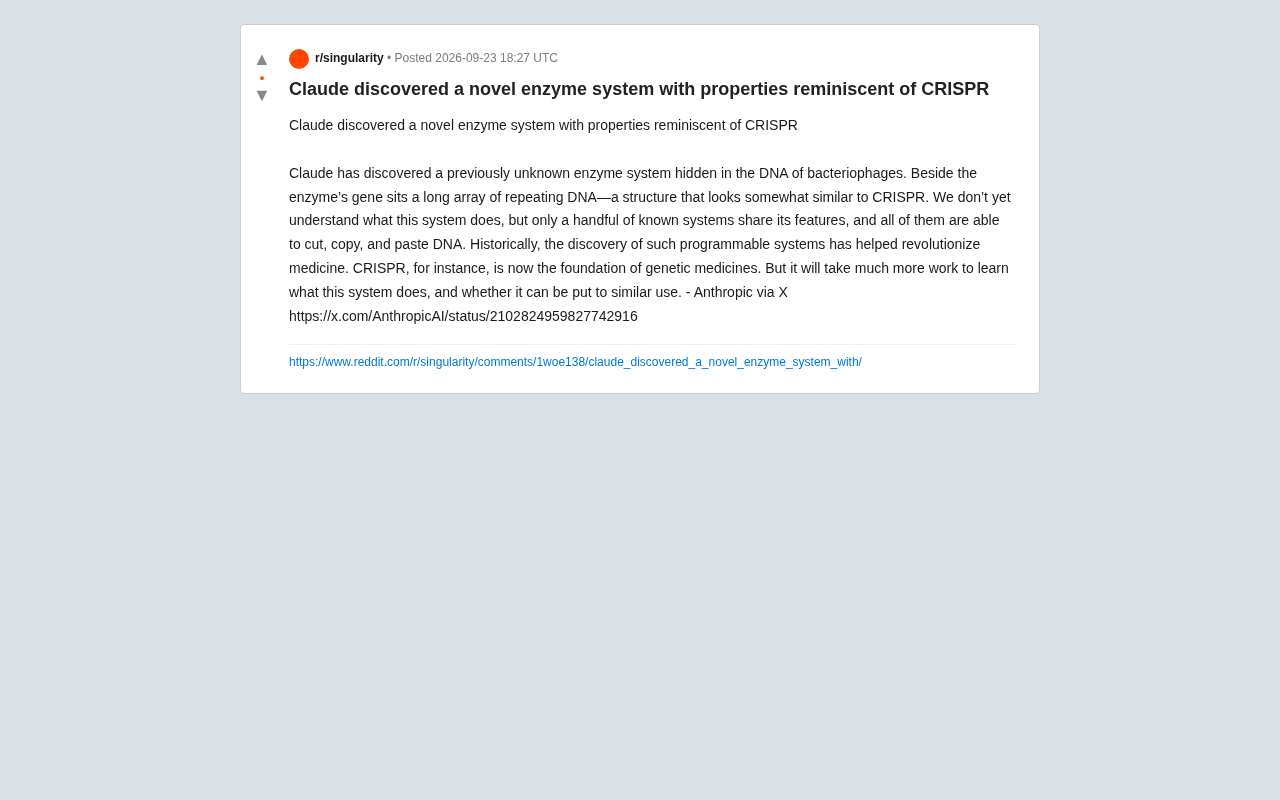
Anthropic announced a striking development on the social platform X: its AI model Claude has discovered a previously unknown enzyme system within the DNA of bacteriophages (viruses that infect bacteria). What makes this finding noteworthy is not only that it was made by an AI, but that the system's structural characteristics bear a resemblance to the well-known CRISPR.
According to information disclosed by Anthropic, the enzyme system Claude identified sits directly adjacent to a long repeating DNA array — an arrangement of "gene + repeat sequence" that is the hallmark organizational pattern of CRISPR systems. While the scientific community does not yet understand what this system actually does, the structural clues suggest it belongs to a very special family.
Bacteriophages are viruses that specifically infect bacteria. They are the most abundant biological entities on Earth, with an estimated total count exceeding 10^31, found widely in soil, oceans, and even the human gut. Because bacteriophages and their bacterial hosts have co-evolved over long periods, phages have developed extraordinarily diverse genetic "arsenals" under evolutionary pressure — including sophisticated molecular machines capable of manipulating host DNA. CRISPR itself was originally discovered within the arms race between bacteria (as an immune defense mechanism) and bacteriophages (as a counter-defense mechanism). For this reason, phage genomes are considered a natural treasure trove for discovering new genetic tools, and scientists have been systematically mining them for functional elements with potential biotechnology value.
Why a "CRISPR-like" Structure Matters
Only a handful of systems with this type of structural signature are currently known, and they all share one thing in common: they are capable of cutting, copying, and pasting DNA. This is the core capability of programmable genetic tools.
Looking back at the history of biotechnology, it is precisely the discovery of such programmable systems that has repeatedly rewritten the course of medicine. CRISPR is the most iconic example — from being first identified in bacterial immune mechanisms, to becoming the technical cornerstone of gene therapy, opening entirely new pathways for treating genetic diseases. Anthropic specifically referenced this historical trajectory in its announcement, hinting that the newly discovered system may harbor similar potential.
That said, Anthropic's language was notably restrained. They explicitly stated: "We don't yet understand what this system does." From identifying a structural clue, to understanding its biochemical function, to determining whether it can be developed into a practical gene-editing tool, there is a great deal of experimental validation work still to be done. This is the starting point of a long scientific journey, not the destination.
CRISPR (Clustered Regularly Interspaced Short Palindromic Repeats) was first incidentally observed in bacterial genomes in 1987, but its immune function wasn't elucidated until 2007. In 2012, Jennifer Doudna and Emmanuelle Charpentier developed it into a programmable gene-editing tool, earning them the 2020 Nobel Prize in Chemistry. The core logic of the CRISPR system is: a guide RNA "aims" at a target DNA sequence, while a Cas protein performs the cut. This modular "recognition + execution" design makes it engineerable for precisely editing any target gene. Multiple CRISPR-based therapies have already been approved, including treatments for genetic diseases like sickle cell disease. If the system Claude discovered possesses a similarly modular structure, it could theoretically also be adapted into an editing tool.
The Evolving Role of AI in Life Science Discovery
The real significance of this news lies in how AI's role in the scientific discovery process is shifting. In the past, AI in biology largely played the role of an "analytical assistant" — accelerating data processing or predicting protein structures (as with DeepMind's AlphaFold). What Claude did here is closer to actively proposing a new scientific hypothesis: sifting through vast amounts of bacteriophage genomic data to identify a candidate system with a specific structural pattern that humans had not previously noticed.
Bacteriophages are the most numerically abundant biological entities on Earth, and their genomic diversity far exceeds humanity's current annotation capacity. Hidden within mountains of unannotated sequences are countless potential functional elements. Using AI to screen this "dark matter"-like genetic ocean for targets worth deeper investigation is precisely where the combination of large language models and bioinformatics delivers value.
It is worth noting, however, that leads provided by AI are fundamentally still computational predictions. Real scientific conclusions must be repeatedly validated through wet lab experiments. Looking like CRISPR structurally does not mean functioning like CRISPR — biology is full of cases where things appear similar but behave very differently.
In bioinformatics, a "wet lab" refers to experiments conducted in a real physical environment with biological materials — for example, verifying the actual function of a gene in cells or test tubes. In contrast, a "dry lab" refers to purely computational analysis and prediction. A key difference between large language models and traditional bioinformatics tools is that the latter rely on pre-designed search rules (such as sequence alignment algorithms), while the former can theoretically identify more subtle structural patterns that human researchers have not yet codified into rules. However, this also makes their predictions harder to interpret — researchers often struggle to trace back why an AI flagged a particular sequence as interesting, which poses additional challenges for subsequent experimental design.
A Grounded View of This Discovery
Reporting on AI breakthroughs in science tends toward hype. This case is no exception. We need to distinguish between two levels:
- What has been confirmed: Claude identified a novel enzyme gene structure flanked by a repeat array, which resembles a small number of known programmable DNA systems.
- What remains unconfirmed: Whether this system genuinely has the ability to cut and edit DNA, and whether it could be developed into a medical tool like CRISPR.
Anthropic itself was measured in its language — "more work is needed to understand what this system does." That caution is exactly the right tone for scientific communication. For general readers, rather than asking "is AI about to upend gene medicine again," the more valuable observation is this: AI is becoming a partner in life science research that can actively identify new problems worth investigating.
If follow-up experiments confirm that this system does indeed possess programmable DNA manipulation capabilities, it could add a new member to the gene-editing toolkit. But until experimental data emerges, everything remains in the realm of an imagination-rich hypothesis.
Note: This article is based on information published by Anthropic on X. The relevant technical details and validation results have not yet been published in a peer-reviewed journal.
Related articles

Gaussian Process Bandit Optimization: Exploration Strategies and Inference Regret Guarantees
Cumulative regret guarantees in Bayesian optimization fail to reflect final recommendation quality. This article examines a new study that provides inference regret guarantees for Gaussian process bandit optimization through exploration query strategies and fill distance analysis, validated on hyperparameter optimization and control tasks.

The Most Detailed Codex Guide on Bilibili: From Installation to Real-World Practice
The most detailed Codex guide on Bilibili: from app store installation to daily work mode configuration, with a real coffee shop project demonstrating file organization, data extraction, dashboard creation, and other practical tasks. Learn to use Plan Mode and desktop pets to leverage Codex efficiently.

Appearance Compensation in Volume Rendering: Why RGB Accuracy Cannot Guarantee Density Correctness
Volume rendering research reveals that volumetric data perfectly reproducing external RGB views may still contain density errors: appearance compensation can double central density and keep external rays unchanged even when L2 error exceeds 14.52%. Density recovery depends on appearance capacity, spatial resolution, and measurement design.