Claude Duet Released: A New Paradigm for Human-AI Collaborative Programming

Anthropic launches Claude Duet, a collaborative programming product, sparking debate on HN.
Anthropic released Claude Duet, a collaborative programming product that earned 327 points and 292 comments on Hacker News. Positioned for real-time two-way collaboration between developers and Claude in the same workspace, it aims to solve context continuity in collaboration and shorten the loop from requirement to code integration. HN discussion focuses on usability, latency, flow disruption, and code privacy. The move marks Anthropic's expansion from model supplier to developer workflow tooling, pressuring Cursor and Windsurf, though actual experience remains unverified.
Anthropic released its new product Claude Duet on Hacker News, quickly garnering 327 points and 292 comments and sparking heated discussion in the developer community. The product is seen as an important step for Claude in the direction of "human-AI collaborative programming."
What Is Claude Duet?
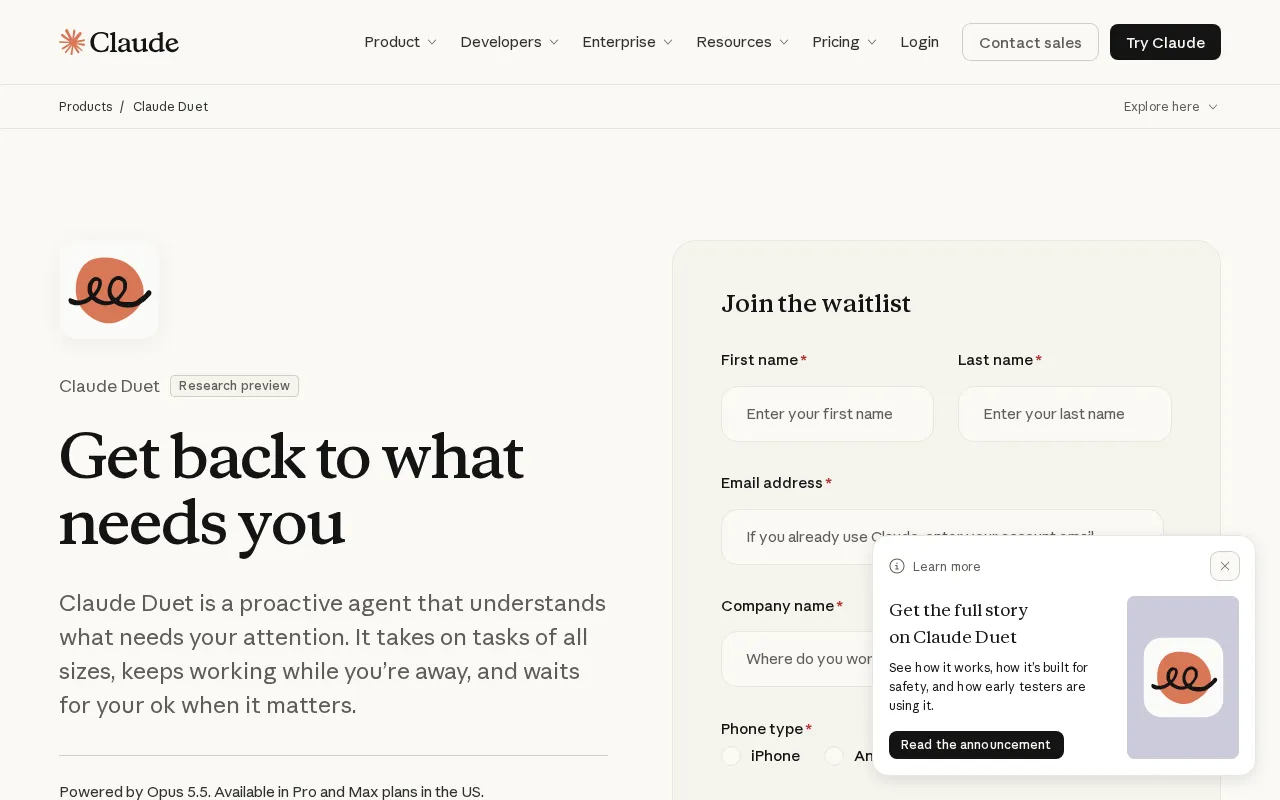
Judging from the official product page, the core positioning of Claude Duet is to let developers collaborate with Claude in real time within the same workspace. Unlike the traditional "ask-wait-copy code" model, Duet emphasizes two-way interaction: Claude can perceive the user's editing context, and users can directly modify the code Claude generates, creating an experience close to pair programming.
This positioning differentiates it from existing AI programming tools on the market. For example, GitHub Copilot leans more toward code completion, Cursor focuses on in-IDE conversation and refactoring, while Duet attempts to solve the continuity of the "collaboration process" itself—how to keep the human and the model in sync throughout a single task.
Why Is It Worth Watching?
The Pain Points of Collaborative Programming
The problem with most current AI programming tools is context fragmentation. The user describes a requirement, the model outputs code, and the user then manually integrates it—any misstep in between requires re-communicating. Duet's product approach is to shorten this loop so that Claude continuously understands intent while the user edits, rather than starting from scratch each time.
"Context fragmentation" often corresponds to a specific problem in engineering practice: large language models have limited effective context windows, and each request is stateless. When a user pastes model output back into the editor and then makes the next request based on the new code, the model doesn't know which lines the user changed or why—it can only rely on the user to restate them. Collaborative tools typically mitigate this by continuously reading editor state, maintaining session-level memory, or incrementally syncing file changes, but this also means higher token consumption and more complex synchronization logic—a key trade-off between product experience and cost.
Reaction from the HN Community
With 292 comments, the discussion is clearly heated. Hacker News discussions usually focus on practical usability and boundary conditions—for example, whether the model distracts the user's thinking, whether collaboration latency disrupts flow, and questions of code ownership and privacy. These concerns precisely reflect developers' real expectations for collaborative AI tools: they need to be not only smart but also unobtrusive.
Hacker News is a tech community under Y Combinator, and its ranking mechanism is based on a weighted algorithm of votes and time decay: the higher a post's score and the shorter the time since posting, the more likely it is to appear on the front page. A post scoring above 300 usually means it has entered the day's hot discussions, and the number of comments often reflects the controversy and actual interest of a topic better than the score. HN's audience consists mainly of senior engineers, entrepreneurs, and open-source contributors, and the discussion style tends toward nitpicking and technical details, so feedback received in this community is often regarded as one of the bellwethers for a product's early reputation.
Impact on the AI Programming Tool Landscape
The emergence of Claude Duet means Anthropic is no longer just a foundation model supplier but is directly competing in the developer workflow space. This puts pressure on products already positioned in this track, such as Cursor and Windsurf, and may also drive further optimization of Claude model capabilities in real development scenarios.
However, the information disclosed on the product page is currently limited, and whether the actual experience can deliver the sense of collaboration implied by "Duet" still needs to be verified by developers themselves. For teams focused on AI programming efficiency, this is a new option worth following.
Cursor and Windsurf are AI-native IDEs built on forks of VS Code, and the core of their business model is subscription rather than model licensing, so they are both customers and potential competitors of Anthropic. When a model vendor enters the application layer itself, it triggers the classic tension of "platform versus ecosystem partner competition," similar to the situation cloud vendors face when launching their own SaaS products. For developers, this may bring more deeply integrated experiences in the short term; in the long term, they need to watch for changes in tool lock-in, data flows, and pricing strategies.
One-line Summary
Anthropic launches the collaborative programming product Claude Duet, sparking heated discussion among developers on HN.
Paragraph Summary
Anthropic released the collaborative programming product Claude Duet, which earned 327 points and 292 comments on Hacker News. The product is positioned to let developers and Claude collaborate in real time and bidirectionally within the same workspace: Claude can perceive the user's editing context, and users can directly modify generated code, creating an experience close to pair programming. Unlike GitHub Copilot's completion model or Cursor's conversational model, Duet attempts to solve the problem of context continuity during collaboration, shortening the loop from requirement description to code integration. HN discussion centers on practical boundaries such as usability, latency, flow disruption, and code privacy. This also marks Anthropic's extension from model supplier to developer workflow tooling, putting pressure on Cursor, Windsurf, and others—but with limited product information disclosed, the actual experience remains to be verified.
Related articles

T3 Code: The Open-Source AI Coding Assistant's Comeback Story
T3 Code is an open-source AI coding assistant that unifies subscriptions like Codex and Claude, with powerful remote control and parallel task management.

Never Elected, Yet Ruled New York for 30 Years: The Ultimate Case Study in the Mechanics of Power
Robert Caro's biographies reveal how unelected Robert Moses ruled New York for 30 years through legal drafting and public authorities, and how Lyndon Johnson built leverage as a "powerless" Senate Majority Leader. Unpacking the underlying logic of accumulating and sustaining power.

The CPython 3.10 Recursion Trap and Synthetic Recovery in TokenGuard, an LLM Circuit Breaker
TokenGuard's author recounts a recursion crash caused by OrderedDict.pop in CPython 3.10 and introduces v0.3.0's Loop Nudge synthetic recovery, inline DLP scanning, and other new LLM agent circuit-breaker capabilities.