Claude Duet Takes the Initiative: AI Agents Start Watching Things for You

Claude Duet launches proactive agents, with cost, security, and routing boundaries in focus.
This daily report uses Anthropic's Claude Duet as its entry point to discuss the cost and boundary issues of proactive agents shifting from "you ask, it answers" to "it finds things to do on its own": background polling consumes subscription quota, creating tension between proactive service and usage-based billing. Other updates include Tipo extending API prompt caching to 12 hours with permanent caching for Codex and Work; OpenAI disclosing GPT 5.6 and Wiz independently finding a critical PHP vulnerability; LightLAM 1.107 implanted with credential-stealing malicious code, highlighting supply chain risks; OpenAI's new model routing and gateway rules taking effect November 20, while models and Codex enter Google Cloud enterprise channels. Also covered: local coding model Flint, diffusion-based Mercury 3, Nvidia's on-device and AI factory solutions, Tencent's parent-child product, and Walmart's agent gateway. Bottom line: Opus 5.5 leads the leaderboard, but the real divide is who can handle proactive capabilities, cost, and security boundaries all at once.
Title
Claude Duet Takes the Initiative: AI Agents Start Watching Things for You
Anthropic has given Claude a new identity—it starts working before you even ask. Claude Duet, revealed in the Baiya AI Daily, is built on Opus 5.5 and connects personal context with daily tasks to proactively remind and assist. It sounds like it genuinely earns the word "assistant," but background polling also consumes subscription quota—before you even start work, it's already running up the bill.
This round of updates brings proactive agents, caching strategies, supply chain security, and model routing rules all at once, pointing to the same question: when AI shifts from "you ask, it answers" to "it finds things to do on its own," who bears the cost and where are the boundaries?
Claude Duet: The First Real-World Test for Proactive Agents
According to the Baiya AI Daily, Claude Duet is currently in research preview for Pro and Max users in the US. Its differentiator isn't model capability but the trigger mechanism—it no longer depends on user input, instead connecting personal context with daily tasks to proactively remind and assist.
Proactivity is good, but it's also a cost. Background polling consumes subscription quota, meaning there's inherent tension between "proactive service" and "usage-based billing." What users need to judge is: are the things it proactively watches worth that quota? The research preview positioning also shows that Anthropic itself is still gauging acceptance of this interaction model.
Proactive Agents and Background Polling
A proactive agent refers to an agent form that, without the user initiating a request each time, periodically checks status in the background according to preset conditions, determines whether action is needed, and proactively pushes reminders or executes operations. Its biggest difference from traditional "you ask, it answers" passive interaction is the trigger source: from user input to time, events, or data changes. The common implementation is polling, where a client or server repeatedly queries the model or data source at fixed intervals. The cost of polling is that each check may generate a model call—even if there's ultimately nothing to remind about—continuously consuming tokens and subscription quota. This is precisely the core contradiction in commercializing proactive agents: the stronger the proactivity and the more frequent the checks, the higher the hidden costs, and the balance between billing models and product experience needs to be redesigned.
Cache Extension: Day 16 of Tipo's 28-Day Plan
Tipo's 28-day plan has reached day 16, and this time it's a cache extension: API prompt caching extended to 12 hours, with permanent caching for logged-in Codex and Work. Reducing repeated context processing is the focus of this update. In the agent era, context is cost, and cache duration directly determines whether long tasks can run economically.
There's no new confirmation on quota resets this time—for heavy users, this remains an unresolved variable.
Prompt Caching
Prompt caching is an optimization mechanism offered by model APIs: a piece of reusable context (such as system prompts, long documents, or codebase snippets) is pre-processed and stored, and subsequent requests that hit the cache directly reuse the already-computed state rather than re-encoding from scratch. This significantly reduces latency and input token costs. Caches typically have a time-to-live (TTL) and must be rewritten after expiration. "Cache extended to 12 hours" means the same context can be reused across multiple calls within half a day, which is especially critical for agent tasks requiring long sessions and multi-turn tool calls; "permanent caching" further eliminates the overhead of recomputation after expiration. Cache duration directly determines the economics of long tasks: the longer the context and the more frequent the calls, the more pronounced the cost difference caching makes.
AI Is Catching Up on Finding Vulnerabilities
OpenAI disclosed that Calif used GPT 5.6 to discover a critical PHP vulnerability, Wiz independently found the same issue, PHP maintainers have released a fix, and Codex provided verification support. Multi-source cross-validation makes this case more convincing: AI's speed at writing code has picked up, and its speed at finding vulnerabilities in old code is starting to catch up too.
Security has more than one side. According to media reports, LightLAM version 1.107 was implanted with malicious code that steals credentials; the malicious package was uploaded at 11:39 UTC on October 21 and quarantined by 13:20. Teams that used this version need to check their environments and exposed credentials—upgrading dependencies also means guarding against supply chain landmines.
Software Supply Chain Attacks and Dependency Poisoning
A software supply chain attack refers to an attacker indirectly implanting malicious code by poisoning upstream components (open-source libraries, package managers, build tools) that the target system depends on, rather than directly breaching the target. The implantation of credential-stealing malicious code in LightLAM version 1.107 is such a case: the attacker published a tampered version, and once developers upgrade or install it, the malicious code enters the runtime environment along with normal dependencies, thereby stealing keys, tokens, and other sensitive credentials. A key characteristic of such incidents is that the window from upload to quarantine is often only a few hours, but already-downloaded instances do not automatically roll back. Countermeasures include pinning dependency versions, verifying package signatures and hashes, using private mirror sources, and immediately rotating potentially exposed credentials and auditing build and runtime environments after an incident.
New Model Routing Rules: Access Businesses Must Pass Review First
OpenAI announced new rules for model routing and gateways. Starting November 20, services that directly provide model access must first undergo review and approval. For those in the model access business, competing on price won't be enough—they'll have to pass this gate first.
On the other side is cooperation: OpenAI announced that its models and Codex will enter Google Cloud's enterprise customer access channels, with specific availability to follow subsequent rollouts. Competing while cooperating has become the norm in this round of platform relationships.
Local Coding Models and Diffusion-Based Generation
Recursive released Flint, a local coding model with 40 billion total parameters, about 2.5 billion weights activated per token, under the Apache 2.0 license, with OpenHands as the launch partner. It's betting on moving coding agents to local environments; speed performance will depend on hardware configuration.
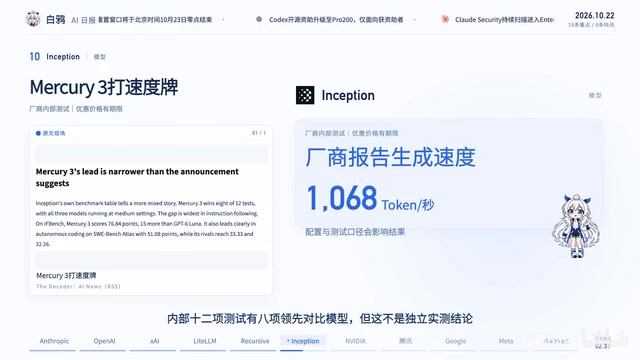
Inception's Mercury 3 continues to bet on diffusion-based generation, with the vendor reporting 1,068 tokens per second and leading comparison models on 8 of 12 internal tests. But this isn't an independent benchmark conclusion—response wait times may be shorter, but real-world experience still needs external validation.
Mixture of Experts (MoE) and Diffusion-Based Language Generation
Flint's "40 billion total parameters, about 2.5 billion weights activated per token" is a typical Mixture-of-Experts (MoE) architecture: the model contains a large number of expert subnetworks, but each forward pass only routes and activates a small subset, thereby significantly reducing per-inference compute while maintaining a large total capacity—this is also the prerequisite for its local deployment. Mercury 3's bet on diffusion-based generation differs from mainstream autoregressive token-by-token prediction; it borrows from the idea of image diffusion, generating text segments in parallel through multi-step denoising, which in theory can greatly shorten response wait times. The vendor-reported 1,068 tokens per second is self-tested data; actual throughput is affected by hardware, batching, and task type, and still requires independent benchmark validation.
On-Device, Cloud, and Scenarios: Different Paths for Nvidia, Tencent, and DeepMind
Nvidia's open model family continues to expand: SuperVL is already available, Boot E4B for 4GB memory is expected to launch on October 23, and Apamayo 2 Edge is scheduled for later this month, covering vision, on-device, and autonomous driving together. Nvidia also announced the DSX-POD modular AI factory solution, which can be deployed in as little as 14 days once the site is ready, with delivery expected in early 2027—making data centers more like assembled products, though the power and cooling preparation beforehand cannot be skipped.
According to media reports, Tencent is internally testing a product for parent-child users and frontline teachers that can turn natural language into interactive picture books, animations, and courseware, and users can also remix community works. Let kids play hands-on first, then pack in the knowledge.
Also according to media reports, DeepMind has employees leaving over concerns related to military contracts, with controversy centered on military uses of AI and internal commitments, and Google has responded. The faster model capabilities advance, the harder it becomes to avoid the question of where the technology is actually used.
Agents Enter the Wallet: Walmart Puts Brakes on AI
According to media reports, Walmart has launched an agent gateway that lets vetted AI retrieve inventory and place orders on behalf of users, and the launched agent profiles can set primary approver requirements or spending limits.
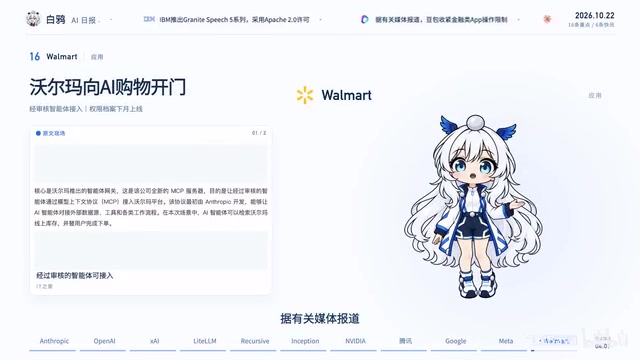
In the future, you won't just have to manage your own shopping impulses—you'll also have to install brakes on AI's wallet. This is what proactive agents really look like in practice: beyond capability, approval and spending limits are what make them trustworthy.
Meta disclosed that MUSE has reached 10 million users, with a quarter of users who completed setup using it daily, and the company has set a goal to continue significantly improving cost efficiency. Whether people stay day after day once they arrive is a bigger test of a product than registration numbers.
Comprehensive Model Leaderboard: Opus 5.5 Leads
Today's comprehensive model leaderboard score is not accuracy: Claude Opus 5.5 ranks first with 73.4, Gemini 4 Argon second with 72.8, and GPT 6.1 Sol eighth with 68.9. The gap at the top is small; the real divide may not be on the leaderboard but in who can handle proactive capabilities, cost, and security boundaries all at once.
One-line Summary
Claude Duet launches proactive agents, with cost, security, and routing boundaries in focus.
Paragraph Summary
This daily report uses Anthropic's Claude Duet as its entry point to discuss the cost and boundary issues that arise when proactive agents shift from "you ask, it answers" to "it finds things to do on its own": background polling consumes subscription quota, and there's inherent tension between proactive service and usage-based billing. Other updates include Tipo extending API prompt caching to 12 hours, with permanent caching for Codex and Work to reduce context costs; OpenAI disclosing that GPT 5.6 and Wiz independently discovered a critical PHP vulnerability, and LightLAM 1.107 being implanted with credential-stealing malicious code, highlighting supply chain risks; OpenAI's new model routing and gateway rules taking effect November 20, while models and Codex enter Google Cloud's enterprise channels. Also covered are the local coding model Flint, diffusion-based generation Mercury 3, Nvidia's on-device and AI factory solutions, Tencent's parent-child product, Walmart's agent gateway, and more. The bottom line: Opus 5.5 leads the comprehensive model leaderboard, but the real divide is who can simultaneously handle proactive capabilities, cost, and security boundaries.
Related articles
Underdog Saluki 27B: A Practical Guide to Tool Calling Under 2-Bit Quantization
An in-depth look at Underdog Saluki 27B's GSQ-RCO-based 2-bit quantization, covering GGUF header structure, memory usage analysis, and BFCL tool-calling test points under native llama.cpp.

GPU-unlock: Unlocking the FP/BF16 Instruction Issue Rate of Nvidia 3000-Series GPUs
gpu-unlock explores the FP16/BF16 instruction issue rate limits of Nvidia 3000-series GPUs, covering measurement methods, unlocking approaches, community debates, and implications for GPU performance optimization.

Cognition Open-Sources Devin Vulnerability Fixes Plugin: AI Agent Automatically Patches Critical PHP/Node.js/GitLab RCE Flaws
Cognition open-sources Devin Vulnerability Fixes, with 3 MIT-licensed agent skills targeting critical RCE flaws in PHP, Node.js, and self-hosted GitLab—automating inventory, patching, testing, and one PR per repo.