Claude Fable 5.1 Incident Review: 21-Minute Error Window and Rapid Fix

Claude Fable 5.1 experienced ~21 minutes of request errors; the team quickly identified and fixed the issue, offering response recommendations.
This article reviews a brief service incident with Claude Fable 5.1 on October 25. According to the official status page, the impact window was 01:08 to 01:29 Pacific Time (08:08 to 08:29 UTC), about 21 minutes. The response went through four states: Investigating, Identified, Monitoring, and Resolved—with Investigating and Identified completed in the same minute, showing near-simultaneous alerting and root-cause identification. About 19 minutes of monitoring followed fix deployment before resolution was confirmed. The notice was restrained, disclosing no specific error codes or scope. The article recommends developers trace logs by the time window, configure exponential backoff retries, build fallback plans such as backup models or caching, and factor service availability into model selection.
Claude Fable 5.1 Incident Review: 21-Minute Error Window and Rapid Fix
A seemingly brief service disruption often reveals the true resilience of AI infrastructure. According to the official status page, Claude Fable 5.1 experienced an elevated request error rate on October 25, with roughly 21 minutes from detection to resolution. For developers relying on this model's API, this is an availability event worth noting.
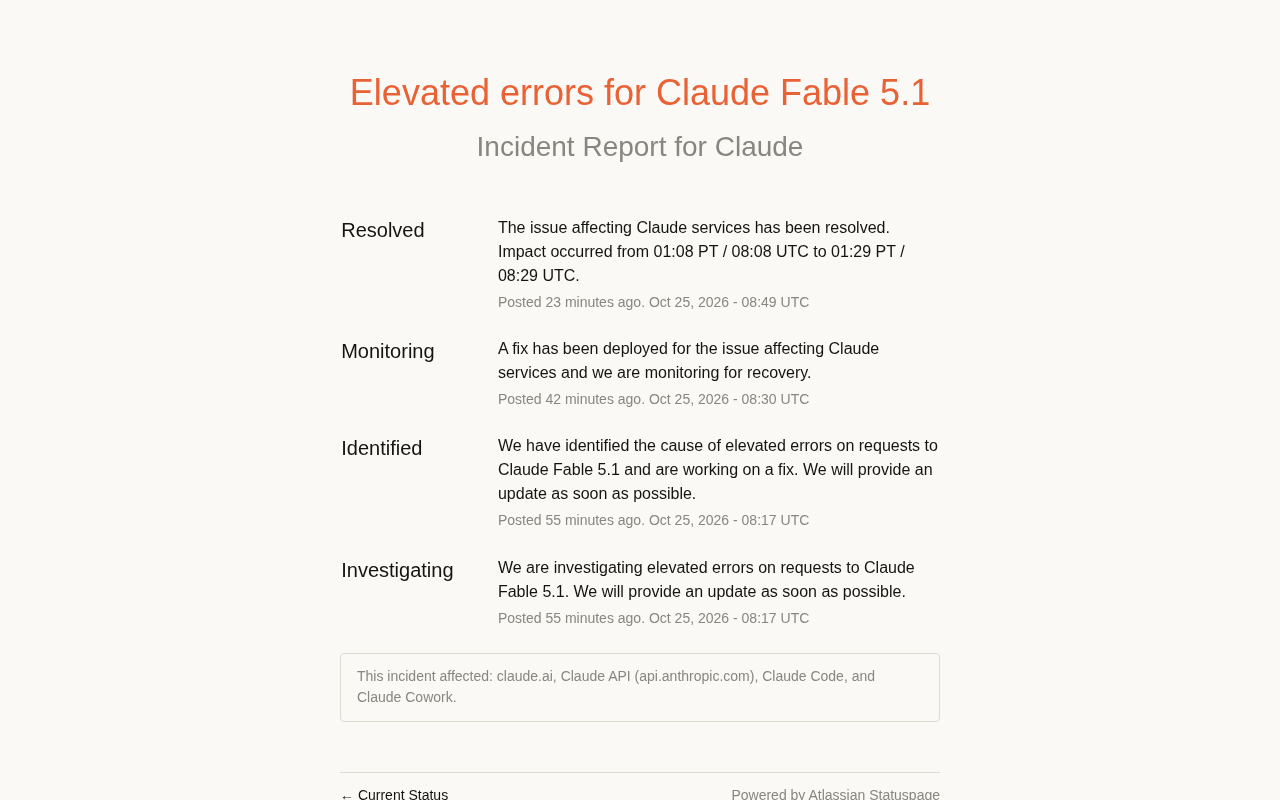
Event Timeline: From Investigating to Resolved
Status page timestamps show the entire process followed a standard incident response flow:
- 08:17 UTC: The official team opened an Investigating status, confirming they were looking into elevated error rates on requests to Claude Fable 5.1.
- 08:17 UTC: Status updated to Identified, with the team stating the cause had been located and a fix was underway.
- 08:30 UTC: Status moved to Monitoring; the fix had been deployed and the team was monitoring recovery.
- 08:49 UTC: Status marked Resolved; the issue was fixed.
The official impact window was 01:08 to 01:29 Pacific Time (08:08 to 08:29 UTC), approximately 21 minutes. This means actual troubleshooting was compressed into under half an hour, from the first errors to the completed fix deployment.
You may not have noticed how tightly packed the timestamps are—Investigating and Identified appeared in the same minute, indicating that monitoring alerts and root-cause identification were completed almost simultaneously. This level of efficiency is uncommon in model service incidents, and it suggests the issue may have been at the configuration or deployment layer rather than a complex underlying logic defect.
Investigating, Identified, Monitoring, and Resolved on a status page are not arbitrary word choices—they derive from the standard state machine of the ITIL incident management process. Investigating means the team is aware of an anomaly but has not confirmed the root cause; Identified means the root cause has been located and the fix direction determined; Monitoring means the fix is live and in an observation period to confirm metrics have returned to normal; Resolved means the incident is closed. The value of this state division is that it gives external observers a predictable progress signal—for example, the interval between Monitoring and Resolved typically corresponds to a fixed observation window rather than an arbitrary wait. Understanding this process lets you infer troubleshooting difficulty from the speed of state transitions: the faster Investigating moves to Identified, the more likely the problem is a surface-level configuration issue rather than deep logic.
What the Status Page Wording Reveals
During the Identified phase, the official statement used the phrase "elevated errors on requests to Claude Fable 5.1" without specifying error codes, scope of impact, or the proportion of affected users. This restrained wording is standard practice for status page communications: before the root cause is fully confirmed, avoid disclosing details that could be misinterpreted.
Another detail: the Monitoring phase mentioned "a fix has been deployed" rather than "a workaround has been applied." The former typically means the fix has entered production and is taking effect, while the latter is more common for temporary workarounds. From deploying the fix to confirming resolution, 19 minutes elapsed—a monitoring window length consistent with a typical recovery observation period.
For teams building applications with Claude Fable 5.1, the practical value of such notices lies in the precision of the time window. The official notice provided clear dual timezone references (PT and UTC), making it easy for developers to trace logs and identify affected request batches.
Practical Impact on Developers and Recommendations
A 21-minute outage is a short-lived failure in AI services, but for high-concurrency or latency-critical applications, it can still cause noticeable impact. If you encountered request failures during this window, consider investigating at three levels:
- Log tracing: Filter error logs by the official UTC 08:08 to 08:29 window to confirm whether failed requests cluster in that interval.
- Retry strategy: Check whether your client has exponential backoff retry configured. For short outages, a reasonable retry mechanism often automatically absorbs most failed requests.
- Fallback plan: For businesses with high availability requirements, consider configuring a backup model or local cache fallback to prevent a single model service disruption from directly reaching users.
From a broader perspective, such events remind us that beyond model capability, service availability is also an important consideration when choosing a provider. The speed of status page responses, transparency of communication, and efficiency of fixes are all reference indicators for evaluating an AI provider's engineering maturity.
Exponential backoff is a common client-side strategy for handling short service failures: after a request fails, don't retry immediately—wait for a base delay, then multiply the wait time for each subsequent retry, typically adding random jitter to spread out retry traffic. This serves two purposes: first, it gives the server time to recover and avoids overwhelming it with a retry flood during the outage; second, it prevents large numbers of clients from retrying in sync and creating a "retry storm." In short outages like this 21-minute one, reasonable backoff parameters (e.g., 1-second base, 30-second cap, up to 5 retries) often allow requests to succeed automatically after service recovery without manual intervention. Note that retries only apply to idempotent requests or safely repeatable operations; calls with side effects should use idempotency keys.
Summary
The handling of the Claude Fable 5.1 incident demonstrated a fairly standard emergency response flow: rapid identification, fix deployment, recovery monitoring, and resolution confirmation. The 21-minute impact window was manageable for most applications, but developers should still incorporate retry and fallback mechanisms into routine operations rather than improvising when failures occur.
Related articles

What Improves During Pretraining? Temporal Variability Score Reveals Knowledge Learning Dynamics
Researchers propose the Temporal Variability Score (TVS) using point-in-time models to track knowledge learning dynamics during pretraining. High-TVS entries improve faster later on and ultimately perform better in 34/36 settings, with an average advantage of 7.3 percentage points.

The AI Compute Hunger Behind the RTX 5090 Price Surge
A Reddit discussion reveals the truth behind the RTX 5090 price surge: in the German market, prices rose from 3,000 to 9,000 euros as consumer GPUs are reconfigured for server farms.

A New Evaluation Method for Audio-Language Models: Same-Class Controls Reveal the True Impact of Local Audio Evidence
A new study proposes a matched same-class control protocol to distinguish whether audio-language model answer changes stem from event categories or waveform rewrites. Experiments show different-class replacements cause 49.7-60.9 percentage points more answer changes, while same-class accuracy remains stable.