Claude Fable 5.2 and Mythos 5.2 Released: A Shift in AI Model Naming and Iteration Paths

Anthropic announced two newly named Claude models in a single sentence, and the information vacuum is more worth interpreting than the release itself.
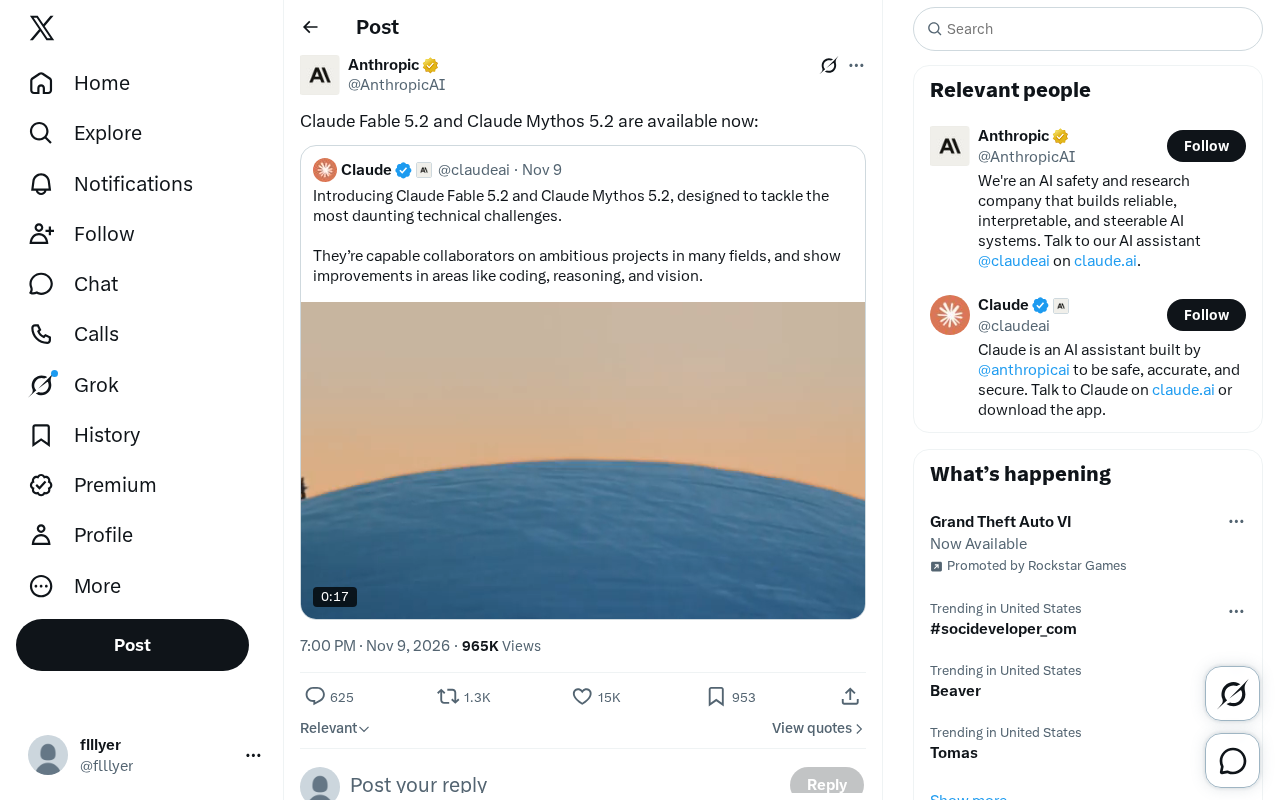
Anthropic announced on social media in a single sentence that Claude Fable 5.2 and Claude Mythos 5.2 are available, without parameters, pricing, or benchmark data. The article notes that Fable and Mythos break the Sonnet/Haiku/Opus layered naming convention; the two are parallel and share the 5.2 version number, suggesting branch products of the same foundation generation rather than a generational leap. With official docs, model cards, and API pricing pages absent, developers cannot yet confirm identifiers, cost tiers, or prompt compatibility, so it should be treated as a pending verification rather than a production-ready upgrade.
Anthropic announced on X that Claude Fable 5.2 and Claude Mythos 5.2 are officially available, with a single-sentence post that included no parameters, capability descriptions, or benchmark data. What this minimalist release announcement reveals may be more worth interpreting than what it omits.
From Sonnet and Opus to Fable and Mythos: The Naming System Speaks
Claude's version naming has long followed the Sonnet, Haiku, Opus vocabulary that layers products by performance and cost, and users have developed a stable mental mapping of which name corresponds to the flagship and which to the lightweight option. Fable and Mythos are new terms appearing for the first time in an official release context; both lean toward narrative and mythological semantics rather than functional references to musical or literary genres.
Naming changes are rarely casual. They may mean Anthropic is redefining the dimensions of its product line—perhaps no longer layering purely by inference cost, but categorizing by capability type or application scenario; or it may mean the company has internally iterated a new-generation architecture that cannot be aligned with the old vocabulary. A single release post cannot confirm the specific motivation, but what can be confirmed is that the default logic users are familiar with—"Sonnet is the medium cup, Opus is the large cup"—temporarily no longer applies to the new names.
This kind of naming drift is not uncommon in the industry. When model capabilities expand from single-axis language generation to composite dimensions such as multimodality, long context, and tool calling, the original single-axis layered vocabulary quickly loses descriptive power, and vendors often switch to a new set of terms to carry a new product narrative. Fable and Mythos appearing together with the same version number, 5.2, indicates that they are parallel rather than hierarchical, which is markedly different from the hierarchical relationship between Sonnet and Opus in the old system.
The relationship between foundation models and branch models is worth distinguishing. A foundation model refers to the underlying model that has undergone large-scale pretraining and possesses general capabilities; branches are multiple variants derived from the same foundation through continued pretraining, instruction fine-tuning, alignment training, or distillation, each with a focus on specific capability dimensions. Branch models sharing the same version number usually mean they come from the same pretraining checkpoint, with differences mainly arising from data mix ratios and optimization objectives in the post-training stage—which also explains why branch models of the same generation are close in language capability yet diverge in specialized areas such as tool calling or long context.
What the 5.2 Version Number Says
The two new models share the minor version number 5.2, suggesting they share the same generation of foundation or are branch products of the same training iteration. In Anthropic's past release cadence, minor version numbers typically correspond to capability patches, context window adjustments, safety policy updates, or tool-calling reliability improvements rather than generational leaps.
This also means existing users should not expect a complete architectural replacement. A more practical judgment is that 5.2 is more likely a targeted enhancement on top of existing capabilities; which dimensions are enhanced specifically, the official announcement this time does not answer. For teams currently evaluating whether to switch models, the lack of a capability card and benchmark data is a real decision obstacle—migration costs, prompt compatibility, and output stability all need to be re-verified.
Model cards are the standard disclosure documents that current large-model vendors publish when releasing new models, typically including a model architecture summary, training data scope, context window length, benchmark scores, known limitations, and safety evaluation results. They serve both as the basis for developers' model selection and as an entry point for regulatory and academic review. Anthropic's previous major model releases all came with relatively complete model cards and system cards, the latter additionally disclosing red-team testing and abuse risk handling. Therefore, when a release lacks a model card, the industry by default interprets it as insufficient information disclosure rather than a mere publicity pacing issue.
The Information Vacuum of the Official Announcement
The text of this release announcement is nearly zero in length: no link to a blog, no model card, no API pricing page, and no explanation of what tasks each of the two models targets. In Anthropic's previous release conventions, important model launches were usually accompanied by detailed technical explanations and benchmark comparisons, making this contrast quite striking.
One explanation is that the release cadence got ahead of the documentation—the social account builds hype first, and details are filled in later; another explanation is that these two models have a special positioning, perhaps aimed at specific partners or controlled channels, and are not suitable for disclosure in the form of public capability cards. Neither explanation can be confirmed from the available information, but they point to the same operational recommendation: before seeing official model documentation or third-party hands-on tests, this announcement should not be treated as a basis for immediate production deployment.
Practical Impact on Developers
If you maintain a product that depends on the Claude API, the safest approach is to first confirm whether the model identifiers have already appeared in the official documentation and API list. A time lag between social media release announcements and actual API availability is common, especially when documentation links are absent.
Second, pay attention to pricing and rate-limiting policies. Under the old naming system, users could roughly predict the cost tier from the name; the new names strip away this layer of information, so costs need to be checked one by one on the official pricing page. For batch-calling scenarios, the impact of this item is far greater than the naming itself.
Finally, there is prompt compatibility. Different branch models of the same foundation generation may have subtle differences in instruction-following style; before migrating, running A/B comparisons on small samples is safer than switching everything at once.
Model identifiers and alias mechanisms are key details when calling the API. The interfaces of mainstream vendors generally require the model identifier string to be explicitly passed in the request, and some vendors also provide floating aliases pointing to the latest version (such as a -latest suffix), so that callers do not need to change code with each version update. When a new model launches, the identifier is usually first published in the documentation and model list, and only afterward made available on the server side. Therefore, in the absence of documentation links, developers cannot confirm the correct string spelling, nor can they determine whether there is an alias compatible with the old interface—this is the most direct technical gap between a social media announcement and production availability.
Conclusion
Regarding the release of Fable 5.2 and Mythos 5.2, the only fact that can currently be confirmed is the word "available." The new naming breaks the product-line semantic conventions of the past few years, which is itself a signal worth watching, but the specific meaning of the signal needs to be filled in by official documentation and hands-on data. Before the information is complete, treating it as an update that needs verification rather than an upgrade that can be directly relied upon is the more rational attitude.
One-line Summary
Anthropic announced two newly named Claude models in a single sentence, and the information vacuum is more worth interpreting than the release itself.
Paragraph Summary
Anthropic announced on social media in a single sentence that Claude Fable 5.2 and Claude Mythos 5.2 are available, without parameters, pricing, or benchmark data. The article points out that Fable and Mythos break the Sonnet/Haiku/Opus layered naming convention for the first time; the two are parallel and share the 5.2 version number, suggesting they are branch products of the same generation foundation rather than a generational leap, and also implying that the product-line division dimension may shift from cost layering to capability type or scenario categorization. Since official documentation, model cards, and API pricing pages are all absent, developers currently cannot confirm model identifiers, cost tiers, or prompt compatibility; the author recommends treating this as an update pending verification rather than an upgrade ready for production until third-party hands-on tests and official documentation are completed.
Related articles

A 19-Year-Old's Rental Horror Story: Ceiling Collapse, Bug Infestation, and the Lessons It Taught Me
At 19, my first off-campus rental brought bug infestations, no heat, a collapsed ceiling, and a ruined laptop with no renter's insurance. Here are the hard-won lessons for first-time student renters.

Veda Nurse's Cranial Nerve Exam: Why ASMR Role-Play Is Going Viral
Bilibili creator Veda's cranial nerve exam ASMR video goes viral, blending humor and sensory triggers through nurse role-play. This article analyzes its unique appeal and the audience psychology behind ASMR role-play.

LG Cinebeam AI Review: 120-Inch Giant Screen + 3000 Lumens, a New Choice for the Living Room Theater
LG Cinebeam AI projector review: 3000 ANSI lumens, 4K, 100 inches from about 8 cm and 120 inches from about 18 cm. Built-in webOS, AI Concierge voice recommendations, AI Sound Pro 11.1.2 virtual surround, and Game Optimizer—positioned for fixed living room installation, complementing the portable Cinebeam S.