Claude Fable 5.5 and GPT-6.2 Rumored for Imminent Release? New Models from AI Giants Surface in Droves

Next-gen flagship models from Anthropic, OpenAI, and Google surface in droves as release enters the countdown.
This roundup covers new model clues around November 17: Anthropic's Devon app shows Silicon 2, suspected Fable 5.5 with higher pricing; OpenAI's embedded safety evaluation with four firms is underway, a leaker says the fixed safety review has ended, and Polymarket gives GPT-6.2 Extra a 52% chance of releasing the next day; Google's Gemini 4 family reveals codenames Neon, Roadrunner, and Hydrogen Sonar, with Neon possibly tied to a new subscription plan. Also notable: Liquid AI's omni-modal decision model, the DeepSeek quota controversy, the Claude gift card payment issue, and Shanghai AI Lab's Sage S2.1 Flash.
Introduction: The Prelude to a Wave of New Model Releases
The AI news scene on November 17 was unusually lively: a mysterious model codename was discovered in Anthropic's Devon desktop app, OpenAI's GPT-6.2 Astra was reported to have completed its fixed safety review, and Google's Gemini 4 family gained new members. According to a roundup analysis by a Bilibili creator, combined with cross-verification from multiple leakers, the release of the next-generation flagship models appears to be entering the final countdown.
This article will sort through these clues and analyze the competitive logic and safety review progress behind them.
Anthropic: Traces of Fable 5.5
"Silicon 2" in the Devon App
According to observations by a Bilibili creator, a new model named Silicon 2 has appeared in the Devon desktop app, listed under the Cloud category, with Fable 5.1's pricing used as a placeholder. The Silicon that appeared two weeks ago was later confirmed to be Fable 5.2, so Silicon 2 very likely points to Fable 5.5.
But there are doubts: it lacks Max reasoning effort, yet its price is shown as $10/$50, whereas Fable 5.2 is $8/$40. If the new model comes with a price increase, that doesn't quite fit the trend, so it may be a new tier of model.
Competitive Maneuvering: The Hidden IPO Battle Between OpenAI and Anthropic
The creator offered an interesting speculation: in order to complicate Anthropic's IPO, OpenAI may soon release GPT-6.2 or 6.5, and then Anthropic would immediately counter with Fable 5.5. This "you chase, I catch up" rhythm is a microcosm of the current large-model competition.
Additionally, rumors suggest that when Edward Witten went to Hong Kong University of Science and Technology to give a talk, Cloud was blocked the moment it was opened; other users reported having their accounts banned while attending the APEC summit. Although these account bans are individual cases, they reflect the sensitivity of platform risk controls.
OpenAI: Safety Review and the GPT-6.2 Release Timeline
Embedded Evaluation by Four Safety Companies
OpenAI stated that it is collaborating with four AI safety companies on embedded evaluation—giving external experts deep access to internal models and systems to study issues and test safety safeguards.
- Apollo Research: Focused on investigating whether models might secretly act against developers' intentions, and whether such behavior could go undetected.
- Goodfire: Stationing interpretability researchers who use the Goodfire platform to analyze internal model mechanisms, helping monitor training and troubleshoot issues.
- METR: Responsible for identifying misaligned behavior in models, including issues that OpenAI's own evaluation and monitoring systems might miss.
- Transluce: Assessing the quality and coverage of OpenAI's post-training evaluations, with plans for broader follow-up evaluations in early 2027.
In other words, the latest model can only be released after the investigation is complete and safety is confirmed. If this is just the beginning, then a new model within a month may be out of the question.
Embedded Evaluation is a collaboration model in the AI safety field in which external safety research organizations station personnel inside model developers to directly access undisclosed model weights, training pipelines, and deployment systems before release for independent testing and risk investigation. Unlike traditional "black-box" external evaluations, embedded evaluation allows safety teams to examine internal model mechanisms (such as interpretability analysis), thereby uncovering misaligned behavior or deceptive alignment issues that developers' own evaluations might miss. OpenAI's collaboration with Apollo, Goodfire, METR, and Transluce is of this type, and its conclusions directly affect whether a new model can pass the pre-release safety threshold.
Leaker Chris: Fixed Safety Review Has Ended
The good news is that a relatively reliable leaker, Chris, says OpenAI is about to launch a new model, and the fixed safety review has already ended.
According to community feedback, aside from regular paying users, almost everyone else has already used GPT-6.2 Astra. This kind of "gray-scale leak" is not uncommon in OpenAI's history.
Release Probability and Market Expectations
Currently, Polymarket puts the probability of GPT-6.2 Extra releasing tomorrow at 52%. The creator analyzed that there is a high likelihood the 6.2 series will launch in the early hours of tomorrow, and tomorrow is Tuesday—OpenAI loves releasing new models on Tuesdays and Thursdays.
Note that 6.2 and 6.5 are collectively referred to as the next-generation GPT model, since it's uncertain which version number will actually be released.
Research and Product Updates
OpenAI published five articles last night, none of which mentioned a new model. Key points include:
- Expanded free access to the research program: applications open on November 24 Beijing time, first come first served. The first 50,000 eligible people can receive free Plus access, and each also includes two writers who can use it for free, totaling 150,000 people.
- New ChatGPT classifier tool: significantly improved success rate in detecting child sexual abuse material, interrupting and suspending access for 24 hours when users attempt to search for content involving child sexual exploitation, with repeated violations potentially leading to account bans.
- ChatGPT for Healthcare update: including a more capable Computer Use agent, stronger clinical answers, and over 20 new medical plugins.
- GPT-6 Astra's research breakthrough: it wrote out and generated a proof that may solve a problem in the Standard Model of particle physics that has been outstanding for 50 years—how to accurately describe all fundamental particles and their interactions in the Standard Model within a computer's lattice model without violating physical laws. In the future, this may enable scientists to more completely and rigorously simulate the microscopic particle world via computers, studying complex physical phenomena that are difficult to compute with traditional methods.
Google Gemini: Neon, Oxygen, Sonar Advance on Multiple Fronts
Gemini 4 Neon: A New Subscription Plan?
Gemini 4 Neon has appeared in the code of the Gemini web app, lined up alongside Argon and Carbon, which likely means it's a new model in the Gemini 4 family.
At the same time, Neon is also a Gemini subscription plan—appearing in the web app code as User Subscription Tier Neon, marked as Gemini Ultra on the usage page but with its own independent usage quota, distinct from regular Ultra. So Gemini may be planning to launch a new subscription plan alongside Gemini 4 Neon. Could it be an Ultra 500 plan plus a new flagship model?
User Subscription Tier refers to the internal identifier that divides user subscription levels in AI products, with different tiers corresponding to different usage quotas, feature permissions, and prices. The "Neon" appearing in the Gemini web app code is marked as the Ultra tier but has an independent quota, meaning Google may be adding a sub-tier beyond the existing Ultra plan, similar to a high-usage or high-price plan like "Ultra 500." Such code leaks are usually a common signal before a product launch, as developers can discover unreleased feature entries or billing structures in advance through front-end web resources.
Roadrunner and Oxygen
Another mysterious model, Roadrunner, was discovered in Devon Desktop, appearing after Gemini 4 Hydrogen and Hyperion in the model list, offering four levels of reasoning effort, priced at $1.5 per million input and $9 output. Judging by price, it's somewhat more expensive than Hydrogen and cheaper than Argon, so it may be a new Flash model.
Whether Oxygen and Neon are the same model remains undetermined.
Gemini 4 Hydrogen Sonar
A new model named Gemini 4 Hydrogen Sonar has appeared in Anti-Gravity's model list, hosted on Google's servers, with one-trillion context, thinking, and vision capabilities; it's still unclear whether it's a new model.
Nano Banana Pro 2 and Subscription Price Increases
According to Lara's leak, Nano Banana Pro 2 has been deployed on Google Cloud and may be released soon, but test results so far are not ideal.
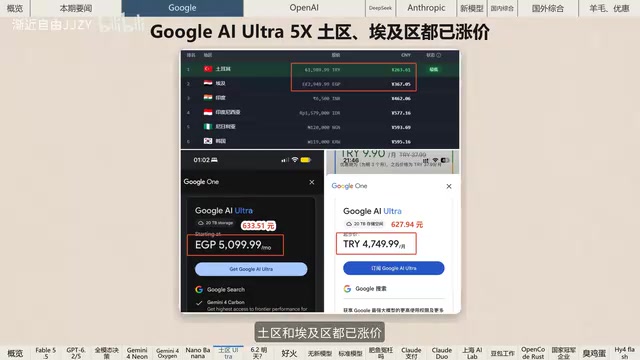
Google AI Ultra 5x plans have increased in price in the Turkey and Egypt regions, at around 630 yuan, roughly on par with the regular US price. If you previously subscribed at a low price, your renewal price won't increase, but this also creates a problem—you may not want to cancel your subscription because of it.
Other Notable Developments
Liquid AI Omni-Modal Decision Model
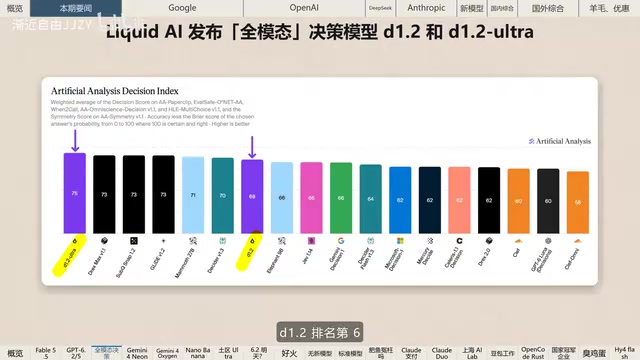
Liquid AI released the omni-modal decision model One Point Two and One Point Two Ultra, capable of processing text, images, and audio simultaneously, with new output capabilities. Ultra ranks first on the Artificial Analysis Decision Index, and One Point Two ranks sixth.
One Point Two and Ultra add five new tasks to the API, including: extracting text, numbers, or dates from input content; finding all matching text in a document; locating targets in images and marking single or all matching objects with bounding boxes; estimating a number; and selecting all matching answers from options. Audio input can be what you're currently saying or a recording.
Pricing is $0.14 and $0.28 per million input respectively, with no charge for output. Liquid AI says it will open the weights at some point—probably when nobody is using it anymore.
DeepSeek Quota Controversy
DeepSeekAd's quota changes were heavily criticized on Xiaohongshu. Many people posted complaints that the official announcement did not clearly notify in advance, arguing that they should either launch a paid plan or add a one-click chat history export. Some said that even if DeepSeek is irreplaceable, other software can also use DSR. Xiaohongshu is now full of promotions for DeepSeek alternatives, which feels like the next money-making trend—just build an app with AI, call the full DeepSeek API suite, screen paying users, and make money lying down.
API resale/wrapper apps refer to a business model in which developers directly call large-model vendors' APIs (such as the full DeepSeek suite), package them into their own branded App or service, and then charge end users. Such products do not train models themselves, and the core cost is only the API call fee, so the barrier to entry is low and profit margins are large, often called "wrappers." When the original vendor adjusts quotas or raises prices, the stability and cost structure of such apps are directly impacted; conversely, original vendor quota changes also spur a wave of "alternative" promotions, as users look for third-party entry points that can still be called reliably.
Claude Gift Card Payment Controversy
US customer service responded that Claude no longer supports payment with gift card balances, which scared quite a few users. But judging from the error message, this user had already subscribed to Claude with this Apple ID and now wanted to use the same Apple ID to open a subscription for another Claude account; a 180-day period without an active subscription is required before switching to a new account for top-up. That's where the problem lies—it has nothing to do with gift cards or account balances, and this error has existed for several years, not just in a recent update. Currently, it seems almost no one encounters this problem with normal payment.
Claude Code Desktop iOS Simulator
Claude Code Desktop's iOS simulator now supports iPhone Duo, and can fold and unfold the device to test different layouts. Now there's no excuse not to optimize your app for iPhone Duo. It's also unclear whether Android foldable devices will receive the same support in the future. App adaptation is such a tedious task—it's really well suited to handing off to AI.

Shanghai AI Lab Sage S2.1 Flash
Shanghai Artificial Intelligence Laboratory launched the scientific multimodal model Sage S2.1 Flash, designed specifically for research tasks requiring multi-round analysis and verification. The model supports over ten types of scientific input, including molecular graphs, crystal structures, protein sequences, and 3D structures. In the 15 tests shown, Sage S2.1 Flash ranked first in 4 benchmarks and second in 7. The model is now open-sourced on Modoscope.
Doubao Workspace Launch
Doubao Work launched its Workspace feature, an AI workspace providing pre-configured skills and tools for professional work scenarios, initially covering 21 scenarios including finance, healthcare, and education.
Volcano Engine Sedans 2.54K API Opens
Volcano Engine announced that the Sedans 2.54K API is now fully open.
OpenCode Browser Module Rewritten in Rust
OpenCode's browser module was rewritten in Rust, reducing memory by 25x and size by 23x. Previously it relied on PlayWrite to drive the browser, which was heavy and memory-hungry.
CommandCode Supports SubAgent Configuration
CommandCode now supports setting the model and reasoning effort for each SubAgent.
Trump Administration's "National Champions" Enterprise Plan
According to the Wall Street Journal, the Trump administration plans to designate more than 20 AI companies as America's National Champions, including NVIDIA, Amazon, Microsoft, OpenAI, Anthropic, and others. These companies will receive three policy supports: expedited approval of export licenses for chips and other technologies; US government support for overseas market expansion; and access to federal financing channels.
Zhipu AutoClaw Perks
Zhipu AutoClaw's new round of 100 million token perks has begun; log in to AutoClaw from November 16 to 22 to claim, expiring before the 23rd.
Member 4Flash Discount
Member 4Flash is now available on OpenRouter, with a 50% discount until November 30, at only $0.23 input and $0.94 output. For large batches of repetitive simple tasks, the cost-performance ratio is absurdly high. Member 4Flash is also free on Hermes for two weeks.
Conclusion: Will It Be Released Tomorrow?
Combining multiple sources, the possibility of GPT-6.2 being released in the near future does exist. Polymarket's 52% probability, leaker Chris's claim that the "safety review has ended," and the historical habit of Tuesday releases all point in the same direction. But the complexity of safety evaluation means variables remain.
Whether Anthropic's Fable 5.5 will follow closely behind, and when Google's Gemini 4 family will be unveiled, will determine the AI landscape for the coming month. For developers and users, staying informed and prepared is always a good idea.
One-line Summary
Next-generation flagship models from Anthropic, OpenAI, and Google surface in droves as release enters the countdown.
Paragraph Summary
This article summarizes new model clues in the AI world around November 17: Anthropic's Devon app shows Silicon 2, suspected to be Fable 5.5, priced higher than its predecessor; OpenAI conducts embedded evaluation with four safety companies, a leaker says the fixed safety review has ended, and Polymarket predicts a 52% probability of GPT-6.2 Extra releasing the next day; Google's Gemini 4 family reveals multiple codenames including Neon, Roadrunner, and Hydrogen Sonar, with Neon possibly corresponding to a new subscription plan. Other developments worth noting include Liquid AI's omni-modal decision model, the DeepSeek quota controversy, the Claude gift card payment controversy, and Shanghai AI Lab's Sage S2.1 Flash.
Related articles

AI Writes Your Code—Do You Still Need to Learn Git? Five Reasons
AI coding agents handle Git operations automatically—is it still necessary to learn Git? Five reasons: team communication, reviewing agent PRs, monitoring code changes, fallback when AI goes down, and the joy of learning—plus how the focus of learning Git is shifting in the agent era.

Anthropic Reportedly Prices IPO at $83 Per Share, Valuing Company at $1.5 Trillion
Anthropic reportedly prices IPO at $83 per share, above the expected range, with a fully diluted valuation of $1.5 trillion. This article analyzes the signal significance of the pricing and its impact on the AI industry's financing environment.

Open-Source Code Hosting Platform Codeberg Suffers Outage, Sparking Debate in Developer Community
Open-source code hosting platform Codeberg.org suffered an outage, sparking Hacker News debate over nonprofit platform stability and open-source infrastructure dependency risks.