Claude Haiku 5.5 Arrives on AWS: A High-Efficiency Model with ~75% Lower Costs

Claude Haiku 5.5 launches on AWS with ~75% lower costs, optimized for subagent and high-concurrency use cases.
Anthropic has launched Claude Haiku 5.5, now available via Amazon Bedrock and the Claude Platform on AWS. As the lightest model in the Claude 5.5 family, its headline feature is aggressive pricing — roughly 75% cheaper than Claude Haiku 4.5 for most tasks. The model is purpose-built for subagent architectures, where a primary model orchestrates dozens to hundreds of lightweight subagent calls per task, making per-token cost a critical factor. For existing AWS users, switching is low-friction, though Anthropic recommends validating quality on your specific workloads before migrating.
Claude Haiku 5.5 Is Now Live on AWS
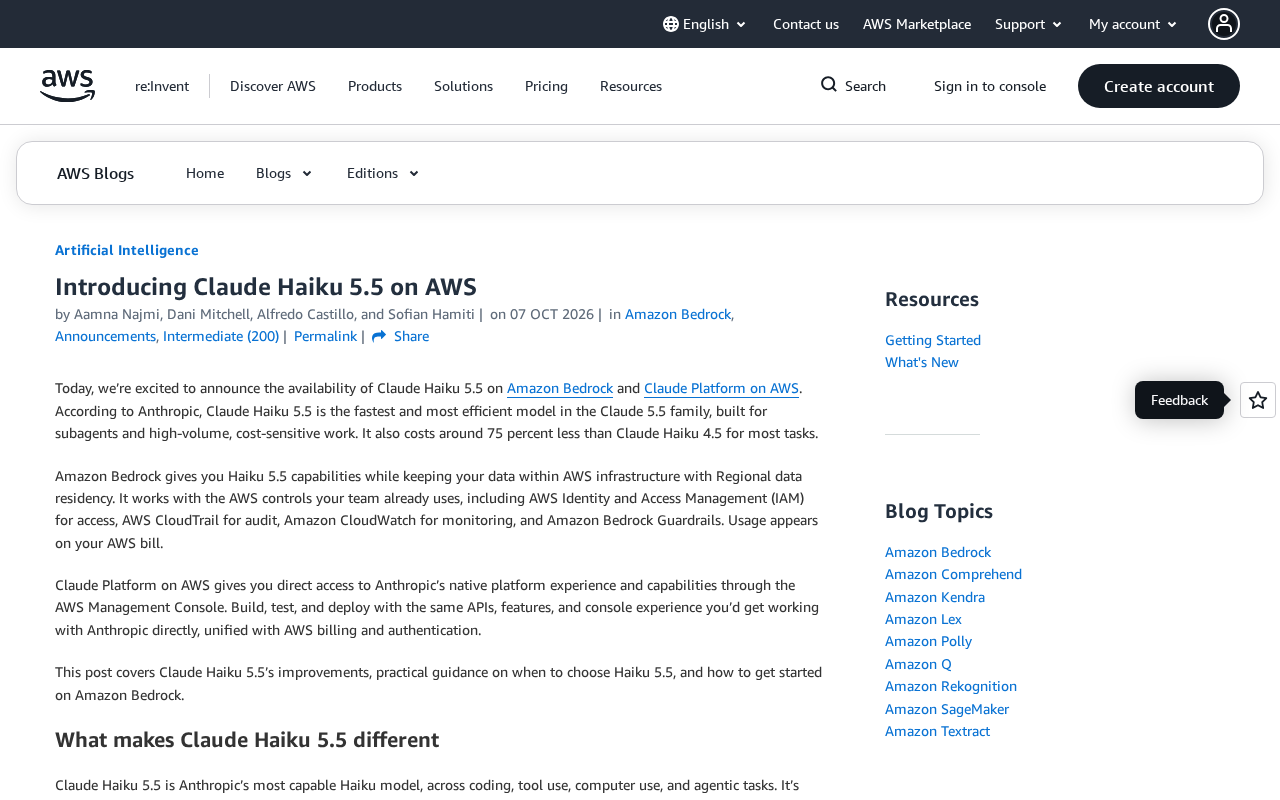
Anthropic has introduced a new addition to the Claude 5.5 family — Claude Haiku 5.5 — now fully available on Amazon Bedrock and the Claude Platform on AWS. According to Anthropic, this is the fastest and most efficient model in the Claude 5.5 series, purpose-built for subagent architectures and high-volume, cost-sensitive workloads.
For enterprise users handling massive request volumes while keeping a close eye on budgets, Haiku 5.5 represents a compelling price-to-performance option now available on a mainstream cloud platform.
The Headline Number: ~75% Lower Costs
The most attention-grabbing figure from this launch is the pricing. Anthropic states that for most tasks, Claude Haiku 5.5 costs approximately 75% less than its predecessor, Claude Haiku 4.5. That's an aggressive price cut — effectively reducing the per-call cost for equivalent tasks to about a quarter of what it was before.
For applications with high call frequencies, cost is often the critical threshold that determines whether a solution can scale in production. Whether it's customer service bots, content moderation, data cleaning, or massively parallel automated workflows, a significant drop in per-call costs translates directly into substantial savings on the total bill. Given that LLM inference costs remain broadly elevated, this pricing strategy helps expand the practical reach of AI in real-world applications.
Why Cost Matters So Much
In real production environments, models aren't called just once or twice. A typical agentic workflow might trigger dozens or even hundreds of model calls within a single task. When call volumes reach the millions, even small differences in price per thousand tokens compound quickly. Haiku 5.5 clearly targets the "high-volume, cost-sensitive" segment — and that's precisely where this pain point lives.
Built for Subagent Architectures
Anthropic specifically highlights that Haiku 5.5 is designed for subagent scenarios. In modern AI agent systems, a primary model typically handles planning and decision-making, then delegates specific subtasks to multiple lightweight subagents running in parallel.
This architecture places clear demands on subagent models: fast responses, low cost, and high throughput. As the lightest-weight model in the Claude family, Haiku is a natural fit for this role. Using a more capable model as the "brain" and Haiku as the "hands" is a popular pattern in the industry — it preserves overall decision quality while keeping execution-layer costs to a minimum.
The subagent (or orchestrator-worker) architecture is one of the dominant design patterns in modern AI systems. In this setup, a more capable "primary model" or orchestration layer handles user intent, breaks down complex tasks, and formulates an execution plan — while concrete atomic operations such as web search, code execution, database queries, and file I/O are distributed to multiple concurrently running subagents. Each subagent handles only a single, well-defined subtask, so the reasoning depth required is far lower than what the primary model needs.
The core motivation behind this layered design is balancing efficiency and cost: using a large model for global planning is expensive, but there's no need to "waste" it on repetitive execution steps. Mainstream agent frameworks like LangGraph, AutoGen, and CrewAI all adopt similar hierarchical call mechanisms, and it's not uncommon in production for a single user request to trigger dozens of subagent calls. This is precisely why the subagent layer is far more sensitive to low latency and low per-call cost than direct end-user interaction scenarios.
Getting Started
Since Claude Haiku 5.5 is already integrated into Amazon Bedrock, existing AWS users can call it directly through the familiar Bedrock interface without any additional infrastructure setup. Access is also available through the Claude Platform on AWS.
For teams currently using Claude Haiku 4.5, the cost-benefit case for migrating to 5.5 is straightforward — lower bills alongside improved performance. That said, before making the switch in production, it's worth running an evaluation pass against your specific tasks to verify that the new model meets your quality requirements.
Amazon Bedrock is AWS's fully managed foundation model service, allowing developers to call models from Anthropic, Meta, Mistral, Cohere, and other providers through a unified API — without managing GPU infrastructure or model deployment pipelines. Bedrock comes with enterprise-grade compliance features built in, including IAM integration, VPC endpoint support, and in-region data residency. For organizations already deeply invested in the AWS ecosystem, onboarding a new model is extremely low-friction: you simply swap the model ID parameter in your existing Bedrock SDK calls, while logging, monitoring, and billing all carry over from the existing setup.
Wrapping Up
The launch of Claude Haiku 5.5 continues the competitive trend among foundation model providers toward faster, cheaper, and more scalable offerings. Rather than chasing the absolute capability ceiling, it precisely serves cost-sensitive use cases like subagents and high-concurrency workloads. For enterprises looking to deploy AI applications within the AWS ecosystem while maintaining strict cost controls, this is a new option well worth evaluating.
One caveat: the information in this article is primarily based on Anthropic's official announcement. Specific performance benchmarks and real-world quality assessments will need to be verified through independent third-party evaluations.
Related articles

Amphibious Transforming Drone: Beyond 100x Power Savings, What Are the Real Needs?
Is the amphibious transforming drone just a gimmick? Starting from the 100x power difference of the M4 Morphobot, explore real application scenarios and thesis topic ideas, analyzing boundary conditions where pure drones and pure ground robots both fail.

Warhound Raises $200 Million: Genetically Engineered "War Dogs" Paired with Anduril Gear
Warhound raises $200M, backed by Ben Lamm and Palmer Luckey, to genetically engineer dogs for military and law enforcement use and equip them with Anduril gear. This article analyzes its technology direction, funding logic, and ethical controversy.

Claude API Comes to Google Cloud: IAM Integration and SDK Access Guide
Anthropic hosts the full Claude API on Google Cloud with IAM-controlled permissions and unified billing. This guide covers the Vertex AI and Anthropic-hosted entry points, IAM role configuration, and SDK access.