Claude Haiku 5.5 Lands on Cursor: Short-Request Costs Drop to 1/10

Claude Haiku 5.5 lands on Cursor, cutting short-request costs to one-tenth of the previous generation
Claude Haiku 5.5 has officially launched in the Cursor editor, with official claims that its cost for handling short requests is a full 10 times lower than the previous-generation Haiku 4.5. Developers can enable it manually in the Models tab of Cursor Settings. The article points out that high-frequency short requests such as inline completion, small-scope refactoring, and quick Q&A are the main source of Cursor usage. However, it also cautions that deep reasoning, cross-file analysis, and architecture design should still go to heavyweight models like Sonnet or Opus, and the pragmatic approach is to route models by scenario.
Claude Haiku 5.5 has officially arrived in the Cursor editor. According to the official tweet, when handling shorter requests, the model's call cost is a full 10 times lower than the previous-generation Claude Haiku 4.5. Developers can enable it manually in Cursor Settings > Models.
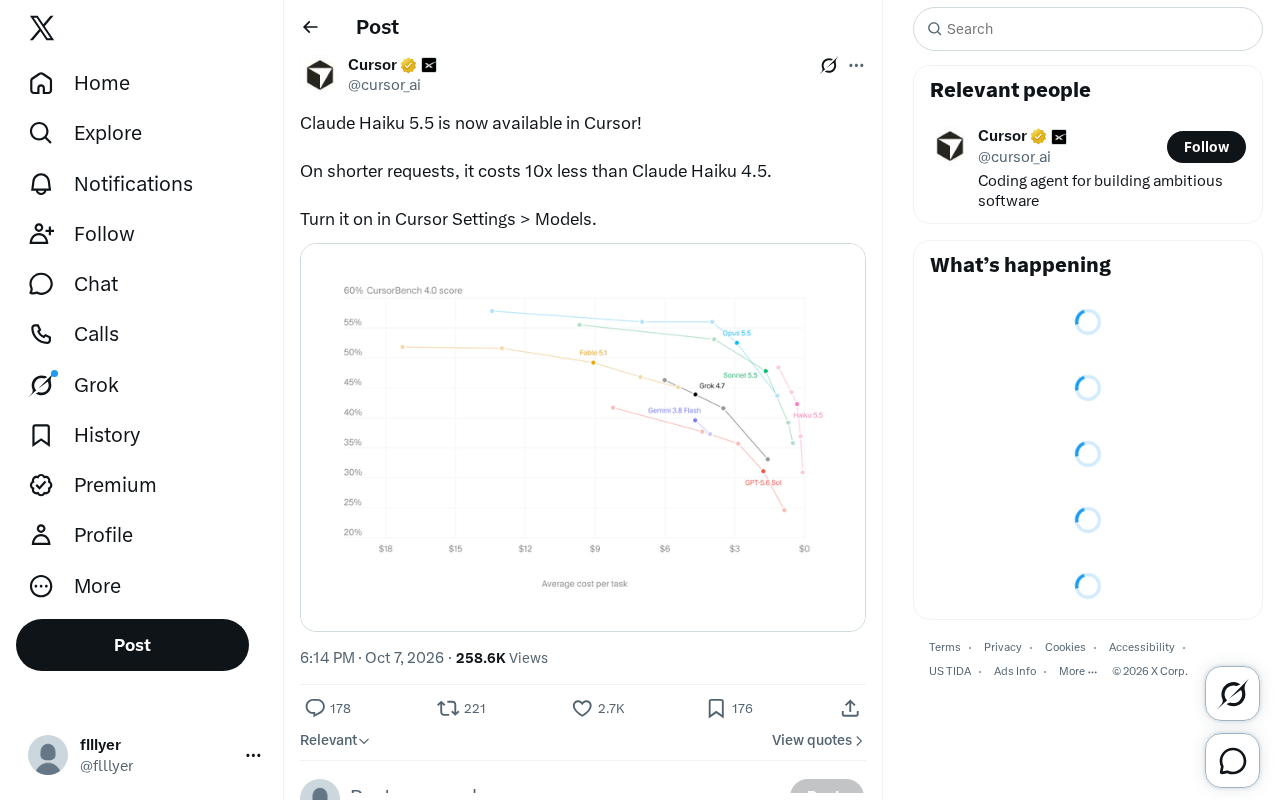
What a Sharp Drop in Short-Request Costs Means
Cursor is one of today's mainstream AI-assisted programming tools, and many of its features—inline completion, small-scope refactoring, quick Q&A—are essentially short requests. The per-call cost of these invocations isn't high, but their frequency is extremely high, and the accumulated bill often exceeds expectations.
In short-request scenarios, Haiku 5.5 compresses costs to one-tenth of Haiku 4.5, directly changing the cost structure for Cursor users. In the past, developers might have reduced the frequency of background completions or lightweight conversations out of cost concerns; now those concerns are noticeably eased.
Anthropic's Haiku series has always been positioned as a lightweight, low-latency model suited to high-frequency, short tasks. The 5.5 version further lowers the price while maintaining this positioning, suggesting possible improvements in inference efficiency and underlying architecture.
Claude Haiku is the lightest tier in Anthropic's Claude model family, forming—alongside Sonnet and Opus—a capability gradient that runs from fast to powerful and from cheap to expensive. Haiku takes its name from the smallest and swiftest of whales, corresponding to its low-latency, low-unit-price positioning; Sonnet and Opus correspond to more balanced and most powerful reasoning capabilities, respectively. In API calls, all three share the same interface, letting developers switch based on task complexity without changing their business code structure. As a result, upgrades to the Haiku series have historically focused not just on "being smarter" but on "being cheaper and faster while still being good enough"—which fits perfectly with programming completion scenarios that are sensitive to response time and undemanding on reasoning depth.
How to Enable It in Cursor
The enabling process has no extra barriers. Open Cursor's Settings, go to the Models tab, find Claude Haiku 5.5 and turn it on. No code changes or plugin installations are required.
For team users, it's advisable to also confirm in the admin backend that model access permissions have been opened, to avoid individual members not seeing the option in their settings.
Cursor's Settings > Models panel is essentially a model routing entry point. Users can enable or disable specific models here, and can also assign default models separately for different features—for example, routing inline completion to a lightweight model and conversational Q&A to a heavyweight model. Enabling a model usually means it enters the selectable list and may be counted toward usage; for users on Team or Enterprise plans, whether a model is available also depends on policies pushed down by administrators in the backend, so members not seeing a model in their local settings is often not a client-side issue but a matter of permissions not yet being opened.
Applicable Scenarios and Trade-offs
A 10x cost reduction doesn't mean all tasks should be switched to Haiku 5.5. Complex refactoring requiring deep reasoning, cross-file analysis, and large-scale architecture design are still better suited to heavyweight models like Claude Sonnet or Opus.
Haiku 5.5's value is concentrated in quick, lightweight tasks: single-line completion, variable renaming, small function generation, quick documentation lookups, and simple bug localization. Routing these requests to a low-cost model while reserving heavyweight models for complex tasks is currently the more pragmatic strategy.
Cursor itself supports configuring different models per scenario. Developers can specify models separately for completion and conversation, using Haiku 5.5 in the highest-frequency, lowest-complexity positions, balancing both results and cost.
The difference between "heavyweight models" and "lightweight models" is mainly reflected in parameter scale, context-handling capability, and reasoning chain length. Heavyweight models can sustain longer multi-step reasoning, making them suitable for cross-file dependency analysis, architecture-level refactoring, and tasks requiring understanding of entire repository semantics; lightweight models tend to complete local, clearly bounded operations in one pass. It's worth noting that routing requests to low-cost models isn't purely beneficial: lightweight models are more prone to giving surface-correct but actually erroneous changes on complex tasks, and without review this can increase rework costs. So while routing by scenario, human verification should still be retained.
Signals for the AI Programming Tool Market
Haiku 5.5 entering Cursor with a 10x cost advantage reflects a trend: the competitive focus of AI programming assistants is shifting from model capability to unit cost. Completion and short Q&A are the features users trigger most every day, and whoever can make this layer cheap enough and good enough will retain users.
For developers, this means the same subscription budget can support higher-frequency AI assistance. For Anthropic, Haiku 5.5 is a step toward capturing the high-frequency invocation entry point within the Cursor ecosystem.
One-line Summary
Claude Haiku 5.5 lands on Cursor, cutting short-request costs to one-tenth of the previous generation
Paragraph Summary
Claude Haiku 5.5 has officially launched in the Cursor editor, with the company saying its cost for handling short requests is a full 10 times lower than the previous-generation Haiku 4.5. Developers can enable it manually in the Models tab of Cursor Settings. The article notes that high-frequency short requests such as inline completion, small-scope refactoring, and quick Q&A are the main source of Cursor usage—the unit price is low but the accumulated bill is considerable, and a tenfold cost reduction will directly change users' cost structure. However, the article also cautions that deep reasoning, cross-file analysis, and architecture design should still be handled by heavyweight models like Sonnet or Opus, and the pragmatic approach is to route models by scenario. This move also reflects that the competitive focus of AI programming tools is shifting from model capability to unit cost.
Related articles

Amphibious Transforming Drone: Beyond 100x Power Savings, What Are the Real Needs?
Is the amphibious transforming drone just a gimmick? Starting from the 100x power difference of the M4 Morphobot, explore real application scenarios and thesis topic ideas, analyzing boundary conditions where pure drones and pure ground robots both fail.

Warhound Raises $200 Million: Genetically Engineered "War Dogs" Paired with Anduril Gear
Warhound raises $200M, backed by Ben Lamm and Palmer Luckey, to genetically engineer dogs for military and law enforcement use and equip them with Anduril gear. This article analyzes its technology direction, funding logic, and ethical controversy.

Claude API Comes to Google Cloud: IAM Integration and SDK Access Guide
Anthropic hosts the full Claude API on Google Cloud with IAM-controlled permissions and unified billing. This guide covers the Vertex AI and Anthropic-hosted entry points, IAM role configuration, and SDK access.