Claude Haiku 5.5 Launches, API Credits Added, Grok Integrates Opus 5.5

Anthropic launches Haiku 5.5 with API Credits, Grok routes tasks to Opus 5.5 and others, OpenAI ships GPT-6 and Intelligent UI.
A busy day across the AI industry: Anthropic officially launched Claude Haiku 5.5 and announced that Max 5X/20X subscribers will receive equivalent API Credits, bridging the gap between consumer subscriptions and developer use. Grok revealed it will route tasks to specialized backend models including Opus 5.5, Midjourney, and Suno, signaling a broader industry shift toward multi-model routing strategies. OpenAI rolled out GPT-6 alongside an Intelligent UI capable of dynamically generating visual and interactive response components. On the security front, Google expanded SynthID Detector — though only for watermarked media — while Cloudflare warned operators about an upcoming DNS Root Zone KSK rotation requiring advance action.
Anthropic's Busy Update Cycle: Haiku 5.5 and API Credits Land Together
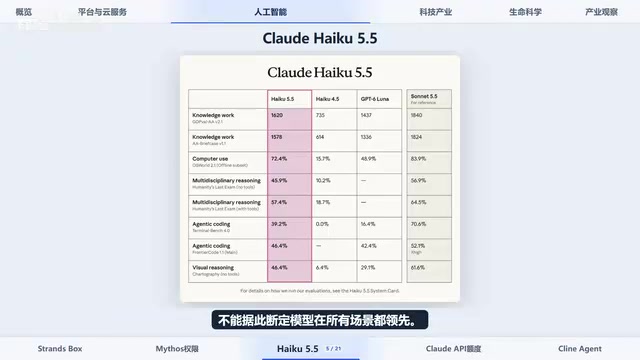
Anthropic has been moving fast in this latest round of updates. According to the official release page, Claude Haiku 5.5 officially launched on October 7, 2026. A task benchmark comparison table was published alongside the announcement — though it's worth noting that rankings vary across different tasks, so it would be a stretch to claim the model leads in every scenario. This restrained disclosure approach is commendable, as it avoids the common trap of overgeneralizing from selective benchmarks.
What will resonate most with paying users is the new API Credits policy. The official Claude account confirmed that Max 5X and 20X subscribers will receive equivalent API Credits — $100 and $200 per month respectively. The help documentation further clarifies that Team plan credits accumulate per seat, with an organizational reading credit cap of $500. This means heavy users now have a directly usable API budget on top of their subscription, further breaking down the wall between consumer subscriptions and developer use cases.
The client is also evolving in parallel. The Claude web interface has added an Agent mode with multiple model options including Claude, DeepSeekAd V4, and Flash, meaning users can switch between different backends as needed within the same interface.
Additionally, Anthropic has expanded controlled access to Mythos under the Cyber Verification Program, allowing qualified cybersecurity professionals to apply on a tiered basis. This is a restricted program for a specific audience — not a public release — and its positioning is clear.
Grok Routes Tasks to the Right Model: Opus 5.5 Joins the Backend
In a statement about Grok, Elon Musk hinted at an intriguing direction — Grok will use the most suitable backend model depending on the task, citing Claude Opus 5.5, Midjourney, and Suno as examples.
The signal here is significant: large model products are shifting from a "one proprietary model for everything" approach to a multi-model routing strategy where different models are called based on context. For specialized tasks like image generation and music, integrating mature external models is simply more pragmatic than forcing a general-purpose model to handle everything. The fact that Grok is willing to incorporate a competitor's model — Anthropic's Opus 5.5 — as a backend option suggests that in today's competitive landscape, product experience takes priority over turf wars.
Multi-model routing has been gradually taking shape across AI products recently. The core logic is treating different models as tools with distinct capabilities rather than mutually exclusive alternatives. From a technical implementation standpoint, the routing layer needs to classify task types — distinguishing between code generation, image creation, long-form reasoning, and so on — then dispatch requests to the backend model that performs best in that dimension. The advantage of this architecture is that it sidesteps the enormous cost of training a single universal model while enabling rapid integration of external specialized capabilities. The tradeoffs include increased system complexity, potentially higher latency, and the need to reconcile differences in output formats and safety policies across models. OpenAI's GPT-4o has also adopted a similar hybrid inference mechanism in certain deployments, while Grok's explicit public acknowledgment of using a competitor's model is a relatively rare commercial statement.
OpenAI Rolls Out GPT-6 and Intelligent UI
OpenAI announced that GPT-6 and Intelligent UI are rolling out to ChatGPT users. The Intelligent UI can combine text, visual content, and interactive components to answer questions, moving beyond a purely text-based conversational flow.
This represents a meaningful shift in interaction paradigms: when a model's capabilities are strong enough, its output doesn't have to be just a block of text — it can dynamically generate interface components tailored to the specific question. Alongside OpenAI's math repository currently listing 719 manuscripts and 372 results, this shows OpenAI is continuing to invest on both the product and fundamental research tracks simultaneously. That said, the repository explicitly notes that results vary in their degree of verification and not all have been formally proven, so readers should remain cautious about what "results" actually means here.
Content Authenticity and Security: SynthID, DNS Key Rotation
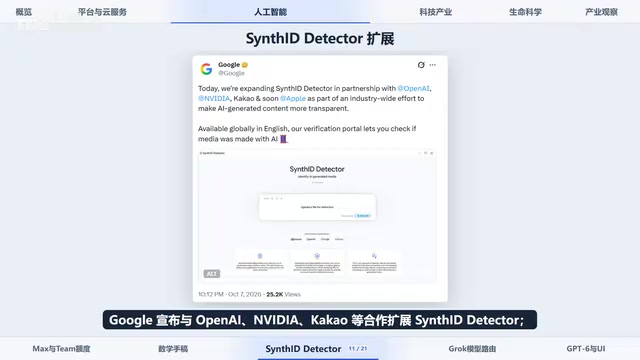
Google announced an expansion of SynthID Detector in partnership with OpenAI, NVIDIA, Kakao, and others. The official post states that the verification portal is open globally in English, with a media upload detection interface available on the web.
One critical limitation must be made clear: SynthID Detector's detection capability is scoped to media from participating parties that have embedded SynthID watermarks. It is not a general-purpose AI content detector. In other words, it can identify AI-generated content that has been watermarked, but it cannot detect content that has not been tagged. Treating it as a universal AI content verification tool would be misleading.
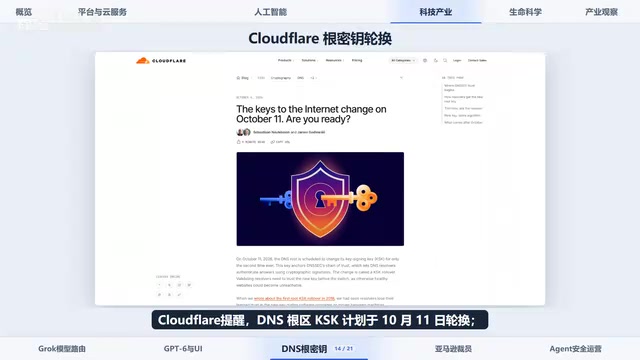
On the infrastructure side, Cloudflare reminded operators that the DNS Root Zone KSK is scheduled for rotation on October 11. Resolvers performing DNSSEC validation must trust the new key before the switchover. This kind of low-level key rotation is invisible to regular users, but for operations teams it's a hard deadline that must be addressed in advance — neglecting it could result in resolution failures.
Cloudflare also introduced its multi-agent security operations framework, aimed at scaling security alert analysis workflows to its own operational scale. AWS, meanwhile, released Strands Box in developer preview, embedding the Dogwood policy engine into agent runtime environments to determine whether agent actions are permitted to execute — agent security is clearly becoming a shared focus area for major cloud providers.
SynthID is a digital watermarking technology developed by Google DeepMind that marks content provenance by embedding invisible statistical signatures into AI-generated images, audio, video, or text. Unlike traditional metadata tagging, SynthID watermarks are encoded into the content itself and remain reasonably robust even after screenshots, compression, or format conversion. Its limitations follow directly from its technical design: only media generated by content producers who have integrated the SynthID embedding tool — such as Google's own Imagen and Lyria models, or third parties who have joined the partnership program — will carry detectable watermarks. This is why the article specifically emphasizes it applies to "participating party media" — the entire system depends on active cooperation from content producers, not passive identification of arbitrary AI-generated content.
DNSSEC (Domain Name System Security Extensions) adds digital signature verification to the DNS protocol to prevent attackers from forging DNS responses and redirecting users to malicious sites. Its chain of trust begins at the Root Zone and extends downward: the Root Zone KSK (Key Signing Key) is the anchor of the entire trust chain, responsible for signing the ZSK (Zone Signing Key), which in turn signs lower-level domain records. KSK rotation is a periodic security maintenance operation that replaces this top-level key. The last root zone KSK rotation occurred in 2018, at which time resolvers that had not updated their trust anchors in time experienced widespread resolution failures. Recursive resolvers performing DNSSEC validation must add the new KSK to their Trust Anchor list in advance — otherwise, once the old key is retired, they will be unable to verify signatures, causing all DNSSEC-enabled domain queries to return SERVFAIL errors and disrupting users and services that depend on those resolvers.
Hardware, Research, and Market Developments
Microsoft's product page now shows the Surface Laptop Ultra with NVIDIA RTX Spark priced at $2,599.99 with a pre-order option, bringing greater clarity to the price range for high-end AI PCs. Meanwhile, Business Insider reported that several Amazon teams have been hit by another wave of layoffs, though verifiable evidence at this point only confirms multiple teams are affected without disclosing the number of people impacted.
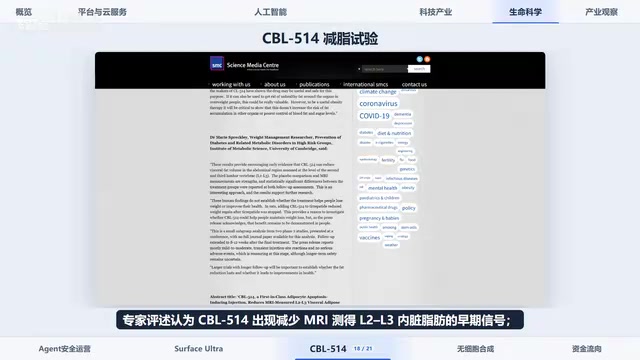
Two research developments are worth noting. Nature reported on a cell-free transcription-translation system that can synthesize proteins in a test tube and be used to develop biosensors and design synthetic cells. Separately, expert commentary noted that CBL-514 showed early signals of reducing MRI-measured L2 and L3 visceral fat, but the small sample size and short follow-up period mean no weight loss or health benefit has been proven yet — a typical early signal still far from clinical conclusions.
On the market side, IIF estimates that emerging market equities and bonds saw a combined net outflow of approximately $26.3 billion in September, marking the first monthly net outflow since June — though the data alone does not point to any single cause.
Finally, Google launched an experimental Playground where users can create, play, and share custom games through prompts, with no coding required according to the official description — yet another consumer-facing attempt at "natural language as development."
Related articles

Gaussian Process Bandit Optimization: Exploration Strategies and Inference Regret Guarantees
Cumulative regret guarantees in Bayesian optimization fail to reflect final recommendation quality. This article examines a new study that provides inference regret guarantees for Gaussian process bandit optimization through exploration query strategies and fill distance analysis, validated on hyperparameter optimization and control tasks.

The Most Detailed Codex Guide on Bilibili: From Installation to Real-World Practice
The most detailed Codex guide on Bilibili: from app store installation to daily work mode configuration, with a real coffee shop project demonstrating file organization, data extraction, dashboard creation, and other practical tasks. Learn to use Plan Mode and desktop pets to leverage Codex efficiently.

Appearance Compensation in Volume Rendering: Why RGB Accuracy Cannot Guarantee Density Correctness
Volume rendering research reveals that volumetric data perfectly reproducing external RGB views may still contain density errors: appearance compensation can double central density and keep external rays unchanged even when L2 error exceeds 14.52%. Density recovery depends on appearance capacity, spatial resolution, and measurement design.