Claude Managed Agents Workshop: From Failed Architecture to Multi-Session Orchestration

Anthropic reviews lessons from managed agent architecture failures and shares core API and multi-session orchestration design.
Anthropic's Managed Agents team spent two hours at the AI Engineer workshop breaking down the design logic of managed agents. Starting with a retrospective on the first architecture's failure, they acknowledged that production-grade agent systems are hard to design right the first time and require room for refactoring. They then introduced the core API organized around the "Pets vs Cattle" operations philosophy—agent instances are treated as replaceable work units managed through declarative interfaces. The workshop also covered multi-session orchestration for long-running tasks across sessions and listed a mechanism called "Dreaming" as a topic without disclosing details. Overall, the session demonstrated a real engineering path: fail first, then abstract, and finally form a reusable managed layer.
Anthropic's Managed Agents team spent two hours at the AI Engineer workshop breaking down the design logic behind managed agents—including why the first version of the architecture failed, how the core API is organized, how multi-session orchestration is implemented, and a mechanism called "dreaming." This content offers direct reference value for developers building production-grade agent systems.
Lessons from the Failure of the First Architecture
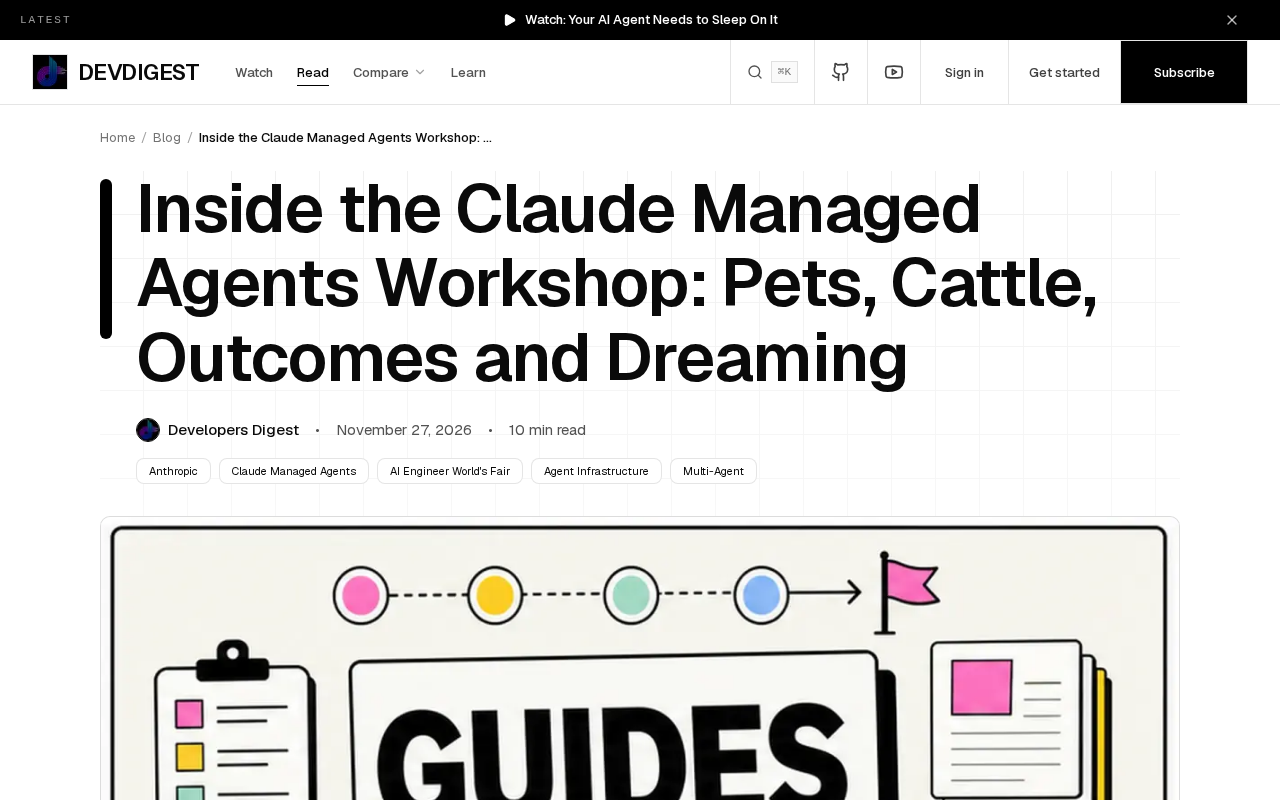
The workshop opened not with success stories but with a retrospective on the initial architecture design. According to the team, the first version exposed obvious problems in actual operation, prompting them to rethink the fundamental assumptions of managed agents. Although the original article did not elaborate on specific technical details, this admission itself sends a signal: production-grade agent system architectures often require iteration, and early designs rarely get it right the first time.
For developers, this means that when building agent infrastructure, you should leave room for architectural refactoring rather than treating the first version as the final state.
Core API and the "Pets vs Cattle" Operations Philosophy
The phrase "Pets, Cattle" in the title points to a classic distinction in infrastructure: pets are individuals that require careful care and cannot be replaced, while cattle are units that can be managed in bulk and replaced. The design of Managed Agents clearly leans toward the latter—agent instances should be treated as replaceable work units rather than unique entities requiring manual care.
This philosophy directly influences the design orientation of the API: sessions, tasks, and execution units need to be exposed to callers in an orchestratable and rebuildable manner. The core API discussed in the workshop is organized around this principle, enabling developers to manage the agent lifecycle declaratively rather than manually intervening in every instance.
The term "Pets vs Cattle" originates from the infrastructure operations field and is often traced back to a talk by Microsoft engineer Bill Baker around 2012 on data center architecture. In traditional operations, servers are treated like pets—named, individually monitored, and carefully nursed back to health when sick. In the cloud-native era, servers are treated as cattle—managed in bulk by number and replaced rather than repaired when they fail. This thinking later became the ideological foundation for containerization, immutable infrastructure, and Kubernetes self-healing mechanisms. Analogizing agent instances to "cattle" means system design should assume that any instance may fail at any time, state should be externalized to persistent storage, and instances themselves should be stateless, disposable, and rebuildable on demand—thereby achieving elastic scaling and fault isolation.
Multi-Session Orchestration: From Single Conversations to Persistent Tasks
Single-session agents are already relatively mature, but real business scenarios often require sustained work across sessions. The workshop specifically covered multi-session orchestration—how to maintain task context across multiple sessions, coordinate execution order, and handle interruption and recovery.
This part is particularly important for teams building long-running tasks. The original article mentions that the workshop covered this topic, indicating that Anthropic views multi-session capability as one of the core differentiators of managed agents.
In the agent context, a "session" typically refers to a continuous conversation context containing message history and tool call records. The core problem that multi-session orchestration must solve is: when a task spans multiple independent sessions, how to preserve and pass state. Common approaches include decoupling task state from conversation context, persisting it to external storage (such as a database or key-value store), and having an orchestration layer inject necessary context when switching sessions, record execution progress, and support idempotent retries and checkpoint recovery. This is similar to checkpoint and event sourcing patterns in workflow engines, and is also a key engineering challenge that distinguishes long-running agent tasks from single-turn Q&A.
Dreaming: A Mechanism Worth Watching
"Dreaming" at the end of the title was the most intriguing part of the workshop. The original article only listed it as one of the discussion topics without providing mechanism details. Judging from the name, it may relate to some kind of background processing or experience consolidation during agent idle periods, but without more information, one should not over-interpret. It is recommended to watch for whether Anthropic subsequently releases related workshop materials or documentation.
In the intersection of machine learning and cognitive science, "dreaming" often refers to the process by which a system replays, compresses, and consolidates existing experience during offline or idle phases. This metaphor can be traced back to memory consolidation theory in biological sleep, and also appears in experience replay in reinforcement learning and the Dreamer series of world model work—the latter trains policies in an "imagined" latent space. If Anthropic follows this naming convention, Dreaming likely involves background processing of historical interactions during inactive periods, such as distilling long-term memory, optimizing prompts, or policies. However, since public details are currently lacking, the above is only reasonable speculation at the naming level, and the actual mechanism should be based on official documentation.
Implications for Developers
The value of this workshop lies not in providing a universal solution but in demonstrating a real engineering path: fail first, then abstract, and finally form a reusable managed layer. For teams building their own agent platforms, three directions deserve priority consideration—replaceability design of instances, cross-session state management, and the declarative degree of the core API. These are precisely where Anthropic has invested effort in managed agents.
Related articles

A 19-Year-Old's Rental Horror Story: Ceiling Collapse, Bug Infestation, and the Lessons It Taught Me
At 19, my first off-campus rental brought bug infestations, no heat, a collapsed ceiling, and a ruined laptop with no renter's insurance. Here are the hard-won lessons for first-time student renters.

Veda Nurse's Cranial Nerve Exam: Why ASMR Role-Play Is Going Viral
Bilibili creator Veda's cranial nerve exam ASMR video goes viral, blending humor and sensory triggers through nurse role-play. This article analyzes its unique appeal and the audience psychology behind ASMR role-play.

LG Cinebeam AI Review: 120-Inch Giant Screen + 3000 Lumens, a New Choice for the Living Room Theater
LG Cinebeam AI projector review: 3000 ANSI lumens, 4K, 100 inches from about 8 cm and 120 inches from about 18 cm. Built-in webOS, AI Concierge voice recommendations, AI Sound Pro 11.1.2 virtual surround, and Game Optimizer—positioned for fixed living room installation, complementing the portable Cinebeam S.