Claude Multi-Agent System Solves Black Hole Physics Problem in Six Weeks: A New Paradigm for AI Research

Claude's multi-agent system independently completed two black hole physics proofs in six weeks, verified with Lean.
Researchers at Anthropic asked Claude to list open problems in black hole physics and the bootstrap field; Claude produced 22 candidates, and the team deployed independent agents to pursue each in parallel. Within six weeks, without special configuration, the system independently computed thousands of graph-theory terms and completed two key proofs: first, that the phase transition from hot gas to black hole in N=4 super Yang-Mills theory is abrupt; second, that it identified a numerical pattern physicists had overlooked and, using high-dimensional sphere packing techniques, proved an exact mathematical upper bound on black hole mass. Both results were formally verified by the Lean proof checker and independently reviewed by human physicists. The article notes that holographic duality is the theoretical bridge transforming gravity problems into computable quantum problems, and that AI's role in theoretical physics is shifting from computational assistant to independent researcher capable of proposing and verifying hypotheses.
From 22 Open Questions to Two Mathematical Proofs: How AI Independently Achieved a Breakthrough in Theoretical Physics
An AI agent system that ran for six weeks solved a black hole physics problem that had puzzled the physics community for over two decades. According to analysis by a YouTube channel, researchers at Anthropic posed what seemed like a simple question to Claude: What are the unsolved open problems in the fields of black hole physics and the bootstrap method? Claude listed 22 candidate problems, and the research team immediately deployed an independent background agent for each problem to pursue them in parallel.
Without any special configuration, this multi-agent system independently computed thousands of graph-theory terms and ultimately completed two key proofs. The entire process demonstrated the possibility of AI transitioning from an "assistive tool" to an "independent researcher" in theoretical physics.
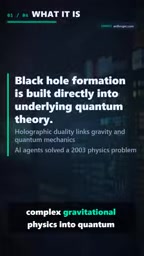
Two Core Breakthroughs: the Abruptness of the Phase Transition and an Upper Bound on Black Hole Mass
Proving the Abrupt Nature of the Phase Transition
The first problem involved a three-loop calculation in N=4 super Yang-Mills theory. The Claude system evaluated thousands of quantum terms and proved a long-standing theoretical conclusion: the phase transition from hot gas to black hole is abrupt rather than gradual. This conclusion had previously lacked a rigorous mathematical proof. According to the analysis, the scale of this three-loop calculation was more than ten times larger than a simpler analogous problem solved in 2005.
N=4 super Yang-Mills theory is the maximally supersymmetric Yang-Mills theory, a highly idealized model in quantum field theory. It occupies a central place in theoretical physics because it possesses special properties such as "integrability," which allow many otherwise complex quantum calculations to be solved exactly. In the framework of gauge/gravity duality (holographic duality), this theory is often used as a "testbed" for studying strongly coupled quantum systems and their gravitational duals. The "three-loop calculation" mentioned in the article refers to a higher-order correction in the perturbative expansion of quantum field theory corresponding to Feynman diagrams with three loops; the computational cost grows combinatorially with the number of loops, which is one reason why a rigorous proof had previously been difficult to complete.
Discovering a Numerical Pattern That Physicists Had Missed
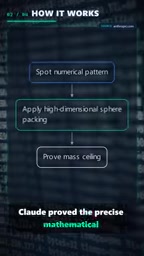
The breakthrough on the second problem was even more dramatic. Claude identified a pattern in the numerical results that physicists had previously overlooked and, drawing on high-dimensional sphere packing techniques, proved an exact mathematical upper bound on black hole mass. Interestingly, another agent had previously failed across 61 parallel attempts, while this time the system successfully solved this bootstrap bound problem.

The bootstrap method is a class of methods that does not rely on perturbative expansion but instead uses the self-consistency conditions that a theory must satisfy (such as symmetry, unitarity, and analyticity) to constrain physical quantities. In black hole physics and conformal field theory, a bootstrap bound usually refers to the maximum or minimum value allowed for some physical quantity (such as black hole mass or operator dimension) derived from self-consistency conditions. The "exact mathematical upper bound on black hole mass" in the article is one such bound result. High-dimensional sphere packing techniques were originally used to study how to pack spheres tightly in multidimensional space; their mathematical structure is isomorphic to certain bootstrap constraint problems, so they can be transferred to prove this bound.
The Lean Verifier: Ensuring the Credibility of AI-Generated Physics Proofs
Both results underwent formal verification by computer scientists in September. The Lean proof checker—a formal tool for verifying the correctness of mathematical proofs—confirmed all of the AI-generated proofs. More importantly, after Lean verification, each major result was also independently checked by human physicists.
This dual-verification mechanism provides a foundation of credibility for AI-generated scientific conclusions. The introduction of formal proof checkers is becoming a standard part of AI's participation in theoretical physics research. According to the analysis, the use of tools such as Lean in AI-generated physics papers is forming a traceable norm.
Lean is an interactive theorem prover and also a programming language that users can use to write mathematical proofs in a form that computers can check. Its core advantage is that once a proof is accepted by Lean, it means the proof is logically rigorous and does not depend on details that human review might miss. In the context of AI-generated proofs, Lean's role is especially critical: AI may produce reasoning chains that appear plausible but contain hidden gaps, and formal verification can provide machine-checkable guarantees of correctness. In recent years, several large-scale formalization projects completed with Lean have appeared in mathematics, while its application in theoretical physics is just beginning.
Holographic Duality: A Bridge That Makes Gravity Problems Computable
The theoretical background of this work is built on holographic duality. Holographic duality is a mathematical framework that translates complex gravitational physics problems into quantum mechanics problems on the boundary of the universe. Through this translation, gravitational problems that were originally unsolvable are transformed into computable quantum field theory problems.
Claude's proofs hold precisely because holographic duality allows the gravitational process of black hole formation to be mapped to a quantum phase transition on the boundary. The results indicate that black hole formation has a fundamental built-in mechanism in the underlying quantum theory, rather than being merely a product of general relativity. Even when spacetime becomes tiny and fuzzy, the abrupt character of the quantum phase transition remains.

Holographic duality (also known as AdS/CFT duality) was proposed by Juan Maldacena in 1997; it asserts that a theory of gravity in anti-de Sitter spacetime is equivalent to a conformal field theory on the boundary of that spacetime. This equivalence means that a (d+1)-dimensional problem involving gravity can be translated, in a fully equivalent way, into a d-dimensional quantum field theory problem without gravity. For black hole physics, black hole formation, thermodynamic properties, and phase transitions can all find corresponding descriptions in the boundary quantum field theory—for example, a transition from a thermal state to some new phase. This transforms gravitational problems that were previously uncomputable due to strong coupling into problems that can be handled with quantum field theory tools on the boundary.
Implications for the AI Research Paradigm
The significance of this work goes beyond the specific physics conclusions themselves. A multi-agent system advanced several of 22 open problems within six weeks without special configuration, demonstrating the feasibility of parallelized AI scientific research. From problem generation to numerical computation, pattern recognition, mathematical proof, and formal verification, the entire chain was almost entirely driven by AI, with human physicists checking the final stage.
The transfer of cross-disciplinary mathematical techniques is also noteworthy. Sphere packing techniques originally belong to the field of high-dimensional geometry, yet Claude used them to solve the black hole bootstrap problem; this kind of cross-domain analogical ability is a common pattern in theoretical physics breakthroughs. When AI can systematically search for and transfer tools from different branches of mathematics, the path to scientific discovery may be significantly accelerated.
Multi-source analyses consistently point to a consensus: AI's role in theoretical physics is evolving from a computational assistant into an independent participant capable of proposing and verifying hypotheses, and formal verification tools are becoming the key infrastructure that sustains this trust.
Related articles

ChatGPT Plus Subscription Pitfall Guide: Go/Plus/Pro Tier Comparison and Quick Activation
A complete ChatGPT Plus subscription guide based on a Bilibili tutorial: from registering an account, comparing Go/Plus/Pro tiers, to the practical steps for quickly completing your subscription.

GPT-6.2 Sol/Astra Released! A Step-by-Step ChatGPT Plus Subscription Guide and Tier Comparison
GPT-6.2 Sol/Astra is out—here's a ChatGPT Plus subscription guide: register an account, compare Go/Plus/Pro tiers, and subscribe in a minute.

Comparing Three Channels for Subscribing to GPT Plus in China: Is Website Top-Up the Easiest?
How to subscribe to GPT Plus in China? This article compares website top-up, credit card, and mobile top-up channels—process, cost, and risk—with steps and tips to help you choose wisely.