Claude Mythos 5 Becomes a Red Teaming Powerhouse: Cisco's Adaptive Red Teaming Engine Gets an Upgrade
Cisco integrates Claude Mythos 5 into its Adaptive Red Teaming Engine with a hyper-governed framework for proactive AI self-testing.
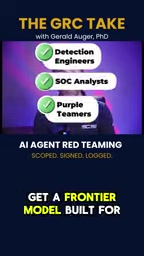
Cisco announced the integration of Anthropic's Claude Mythos 5 into its Adaptive Red Teaming Engine, giving defenders, detection engineers, SOC analysts, and purple teams a frontier model built for offensive security. The article notes that the security community has long focused on "will AI attack us" while overlooking "using AI to test ourselves." The integration lets teams red team AI agents and applications before attackers do. Even more notable is its hyper-governed framework—upfront scope definition, human sign-off, and full logging—mirroring human red team rules of engagement. The article argues governance design may matter more than the model itself for enterprise adoption.
Cisco has announced the integration of Anthropic's Claude Mythos 5 into its Adaptive Red Teaming Engine, giving defenders, detection engineers, SOC analysts, and purple team members access to a frontier model purpose-built for offensive security. This means security teams can red team their own deployed AI agents and applications before attackers do—taking purple team exercises to the extreme.
Why This Matters
For a long time, the security community's attention has been focused on "will AI attack us," with little discussion of "using AI to test ourselves." Cisco's integration is a direct response to this blind spot.
According to the release, Claude Mythos 5 is not simply a repurposed general-purpose chat model—it is a frontier model tuned for offensive security scenarios. Defenders can use it to simulate real attackers' thinking and techniques, uncovering weaknesses in AI agents and applications ahead of time.
The core idea is "attack to defend": rather than passively waiting for external attacks, teams proactively exercise within their own environments. For teams that have already integrated AI agents into business workflows, this self-testing capability is especially critical—agent behavioral boundaries, tool-calling permissions, and prompt injection risks all need to be systematically verified before real attacks occur.
Red Teaming originates from military exercises, referring to an independent team playing the attacker role to conduct adversarial testing of one's own systems and expose weaknesses. In cybersecurity, red teams typically simulate real attackers' tactics, techniques, and procedures (TTPs) to assess the effectiveness of defensive systems. Traditional red teaming relies on security experts operating manually—costly, time-consuming, and difficult to scale. Bringing frontier AI models into the red teaming toolchain enables automated generation of attack ideas, mutation of attack payloads, and rapid iteration of test cases, substantially increasing test coverage and frequency while maintaining human oversight.
Purple Team is a collaboration mechanism between red teams and blue teams (defenders) that emphasizes information sharing and joint improvement of detection and response capabilities. The core of purple team exercises is not about winning or losing, but about translating red team findings into actionable detection rules and defensive strategies for the blue team. Cisco's integration of AI red teaming capabilities into its Adaptive Red Teaming Engine is precisely to enable purple teams to carry out this translation continuously in their daily work, rather than relying on one-off annual exercises.
Hyper-Governed: Making AI Red Teaming Controllable and Auditable
More noteworthy to security governance (GRC) practitioners than the model's capabilities is its governance framework. Cisco emphasizes that the tool is "hyper governed":
- Scope defined upfront: The scope of operations for each exercise is clearly delineated before it begins;
- Human sign-off required: A human signer must be designated and authorized;
- Full logging: Every action is recorded.
These rules align with the rules of engagement followed by human red teams. A simple litmus test: if your AI agent has no defined scope, no sign-off authorization, and no logging, it can't be considered governed.
Rules of Engagement (RoE) is a formal document jointly signed by the authorizing party and the executing party before a red team operation, specifying the test scope, permitted techniques, prohibited systems, time windows, emergency contacts, and legal authorization basis. RoE is the cornerstone of the legality and safety of red team operations—offensive testing without RoE may constitute illegal activity. Cisco brings this framework into its AI red teaming tool, requiring upfront scope definition, human sign-off authorization, and full logging—essentially transplanting the compliance practices of human red teams onto AI agents.
Prompt Injection is a typical attack vector faced by AI applications: attackers embed malicious instructions in inputs to trick large language models into deviating from their original tasks or leaking sensitive information. For AI agents with tool-calling capabilities, prompt injection can lead to privilege escalation, data exfiltration, or even supply chain attacks. Red team testing needs to systematically verify agents' resistance to various injection payloads—precisely a scenario where offensive security models can play a role.
What This Means for Security Teams
For defenders and purple teams, the value of this integration lies in bringing red teaming capabilities down to daily work. Detection engineers can use it to validate the effectiveness of detection rules, SOC analysts can use it to understand the shape of attack chains, and purple teams can conduct attack-defense exercises under the same governance framework.
It should be noted that the above information comes from a Cisco-sponsored launch video; more technical details and complete documentation should be found in Cisco's official blog. For teams looking to establish auditable processes for AI security governance, this "scope—sign-off—logging" triad provides a practical template to follow.
Overall, Claude Mythos 5's entry into the red teaming toolchain marks AI security's shift from "worrying about attacks" to the practical phase of "proactive verification"—and the design of the governance framework may matter more than the model itself in determining whether enterprises actually adopt it.
Detection Engineering is a critical function in security operations, responsible for designing, writing, and maintaining detection rules (such as SIEM rules and EDR detection logic) to identify malicious behavior. The effectiveness of detection rules cannot be assumed—it must be validated against real attack behavior. AI red teaming tools can generate behavioral samples that closely resemble real attack chains, helping detection engineers verify whether rules trigger, identify blind spots, and continuously optimize false positive and false negative rates. For SOC analysts, understanding the complete shape of an attack chain helps them more quickly reconstruct attack intent from alerts and shorten response time.
One-line Summary
Cisco integrates Claude Mythos 5 into its Adaptive Red Teaming Engine, using a hyper-governed framework to let security teams proactively test their own AI systems.
Paragraph Summary
Cisco announced the integration of Anthropic's Claude Mythos 5 into its Adaptive Red Teaming Engine, providing defenders, detection engineers, SOC analysts, and purple team members with a frontier model built for offensive security. The article notes that the security community has long focused on "will AI attack us" while overlooking "using AI to test ourselves." This integration lets teams red team AI agents and applications before attackers do, with the core idea of attacking to defend. Even more noteworthy is its "hyper-governed" framework: upfront scope definition, human sign-off authorization, and full logging—consistent with the rules of engagement for human red teams. The article argues that the governance framework's design may matter more than the model itself in determining whether enterprises truly adopt the tool.
Related articles

Seven Years of Evolution: How Far Has the Foldable Come From the First Generation?
From the first foldable to today's latest models, what has seven years changed? Shallower creases, higher brightness, thinner bodies, and smoother software migration—has the foldable crossed the chasm from enthusiasts to ordinary users? This article discusses the question based on a video comparison.

When Did Humans Start Eating Salt? A 10,000-Year History of Salt
When did humans start eating salt? From salt use at the dawn of agriculture 11,000 years ago to ancient seawater evaporation and rock salt mining, and on to the salt trade, salt taxes, and Gandhi's Salt March, this article traces salt's key role in human civilization.
Microsoft Paza Research: How African Language Speech Recognition Breaks Through Architecture and Data Bottlenecks
Microsoft's Paza research evaluates 53 speech models across 39 African languages, revealing architecture choice matters more than pre-training coverage, 200-300 hours is the practical data threshold, and language typology deeply influences recognition performance.