Claude Opus 4.5 in Action: AI Autonomously Decompiles and Ports Classic Games to Modern Platforms

A user claims Claude Opus 4.5 autonomously decompiled and ported StarFox and Sonic CD using just one prompt.
A Reddit post sparked debate after a user with no reverse engineering background claimed to have used Claude Opus 4.5 — via a single natural language prompt — to fully decompile StarFox, StarFox 2, and Sonic CD and port them to Windows, Mac, and Linux, complete with resolution upscaling, frame rate improvements, and widescreen support. The significance lies not in the ports themselves, but in AI independently handling ROM analysis, hardware runtime construction, and source code modification across a complex multi-stage pipeline. However, the post lacks third-party verification, the true extent of human involvement is unclear, and commercial ROM decompilation carries real copyright risks — so healthy skepticism is warranted.
When AI Starts Independently Tackling Game Reverse Engineering
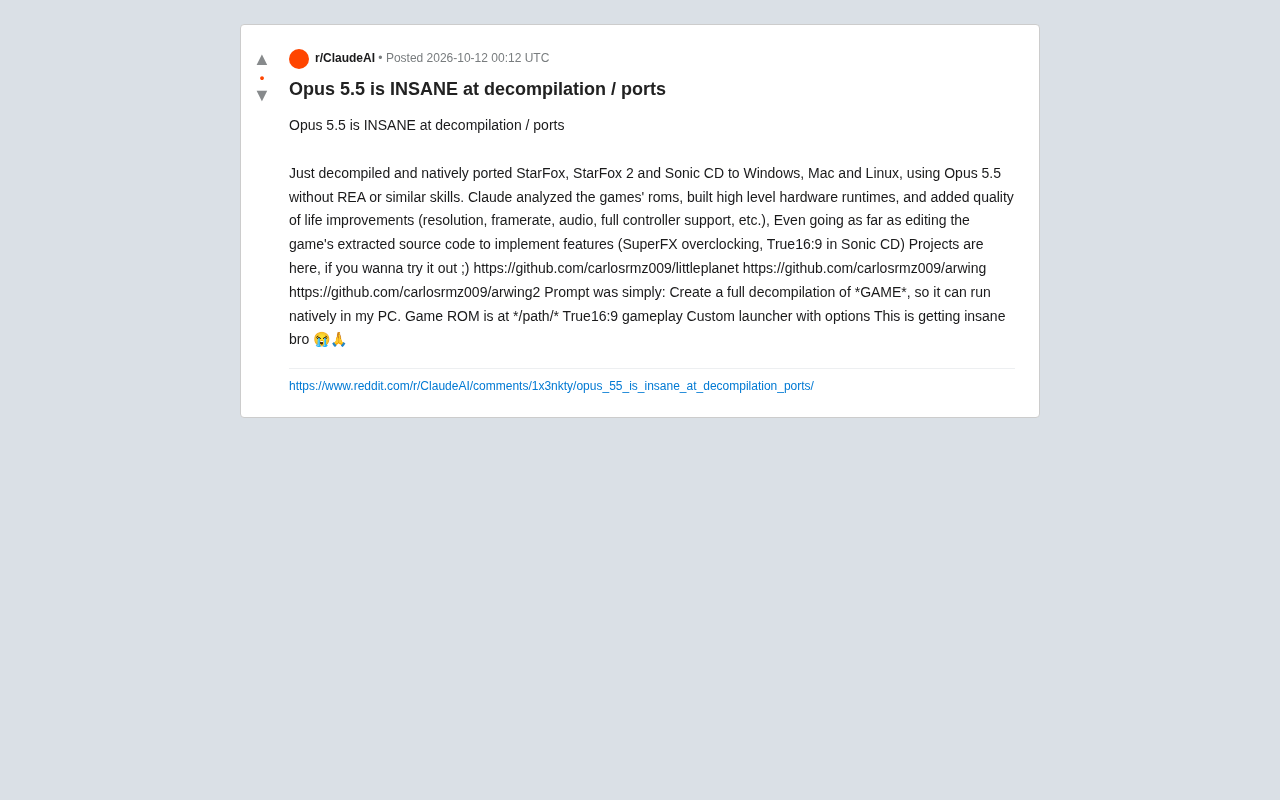
A post on Reddit sparked heated discussion in the developer community: a user claims to have successfully decompiled StarFox, StarFox 2, and Sonic CD and natively ported them to Windows, Mac, and Linux — entirely using Anthropic's Claude Opus 4.5, with no prior reverse engineering (RE) background whatsoever.
What makes this noteworthy isn't the act of "porting old games" itself — the community already has countless decompilation projects maintained by seasoned reverse engineers — but the fact that the entire process was driven almost entirely by AI. The prompt the user provided was almost absurdly simple: "Create a full decompilation of GAME, so it can run natively in my PC. Game ROM is at /path/"
What Claude Actually Did
According to the poster, Opus 4.5 handled a remarkably complete engineering pipeline — not just writing a few snippets of code.
From ROM Analysis to Hardware Runtime
The model first analyzed the game's ROM file, then constructed a high-level hardware runtime. This is the most critical and difficult part of the entire porting process — the original games ran on specific console hardware like the SNES and Sega CD, so making them run natively on x86 PC architecture requires understanding and reconstructing the behavior of the original console's CPU, graphics chip, audio subsystem, and more.
High-Level Hardware Runtime (High-Level Emulation / HLE) is one of the core technical approaches in the emulation and porting space, as opposed to Low-Level Emulation (LLE). LLE aims to simulate every circuit behavior of the original hardware cycle-accurately — high precision, but computationally expensive. HLE instead reimplements hardware functionality at a higher level of abstraction. Rather than fully simulating every instruction of the graphics chip, for example, it identifies the graphics subroutines the game calls (like "draw polygon") and uses the target platform's native APIs to achieve equivalent rendering. The SNES's SuperFX coprocessor and the Sega CD's Motorola 68000 sub-processor are classic targets for this HLE approach. This also explains how AI can build a runnable port by recognizing high-level behavioral patterns without fully understanding every assembly instruction — at the cost of potential inconsistencies with original hardware details.
More Than Just Running — Experience Enhancements Too
The poster noted that the AI didn't stop at "making it run" — it proactively added a range of modern quality-of-life improvements:
- Resolution upscaling
- Frame rate optimization
- Audio processing
- Full controller support
The model reportedly even edited the extracted source code to implement features not present in the original, such as overclocking the SuperFX chip that StarFox relies on, and implementing true 16:9 widescreen support for Sonic CD. These aren't simple parameter tweaks — they involve deep modifications to the game's rendering pipeline and logic.
The poster also mentioned the project ships with a custom launcher featuring various configuration options, suggesting a fairly polished overall result. The relevant projects have been open-sourced on GitHub (three repositories: littleplanet, arwing, and arwing2).
SuperFX is a dedicated coprocessor chip developed by Nintendo for the SNES, designed by Argonaut Software, primarily used to achieve 3D polygon rendering within the SNES's limited hardware constraints. StarFox was the first commercial application of SuperFX, and its 3D visuals were considered a technical marvel at the time — though frame rates were constrained by the chip's clock speed (approximately 10.7 MHz), typically running at 10–20 fps. Overclocking SuperFX (i.e., increasing its simulated clock speed in an emulation/port environment) is a common technique for improving StarFox's frame rate, and some SNES emulators like higan/bsnes offer similar options. However, overclocking breaks the game's original timing design and can cause audio-video desync or collision detection anomalies, making such changes somewhat controversial from a preservation standpoint. The AI's ability to identify the SuperFX emulation layer and intervene in its parameters suggests a fairly deep understanding of hardware abstraction.
Why This Matters
The Barrier to Reverse Engineering Has Been Significantly Lowered
Game decompilation has long been the exclusive domain of hardcore enthusiasts and reverse engineers. Famous decompilation projects like those for Super Mario 64 and Zelda typically require years of community effort and dozens of specialists, involving assembly reading, hardware documentation research, byte-by-byte comparison, and other painstaking work.
If Opus 4.5 can genuinely handle most of that pipeline through a single natural language prompt, it means tasks that once required deep professional expertise are being compressed to the level of "just describe what you want." For individual developers and game preservation enthusiasts, this represents a real leap in productivity.
Game Decompilation projects are difficult because the original game code is stored in ROM as machine code or assembly, and reverse engineers must restore it to readable high-level language (usually C) — while ensuring that recompiling the decompiled code produces a binary that matches the original ROM byte-for-byte (Matching Decompilation). This requires engineers to not only read assembly fluently, but also understand the optimization habits of compilers from that era, the ABI conventions of the target platform, and to painstakingly reconstruct the intent of every function and variable. The famous N64 Super Mario 64 decompilation project (sm64decomp) took years of community collaboration before completing in 2020; projects like The Legend of Zelda: Ocarina of Time have similarly demanded enormous expert effort. For this reason, even if the AI's output isn't a strict Matching Decompilation — just a functional reconstruction "good enough to run" — the engineering efficiency gains are still highly significant.
Demonstrating Frontier Models' Long-Chain Autonomous Capabilities
Decompilation and porting is a quintessential multi-stage complex task: analyze, understand, reconstruct, test, optimize — each step depends on the correctness of the previous one, with minimal room for error. A model's ability to coherently advance such a long chain and handle hardware-level abstractions reflects the rapidly expanding capability boundaries of today's frontier large models on Agentic engineering tasks.
Reasons for Caution
It must be emphasized: this is a single user's post on Reddit, and as of now there has been no independent third-party reproduction or verification. Several key points warrant skepticism:
- Completeness is unverified: The post doesn't show detailed runtime performance, compatibility data, or a complete engineering log. There may be a significant gap between "entirely completed by AI independently" and "AI-assisted with substantial human intervention."
- Extent of human involvement is unknown: Even with a simple prompt, the actual iteration process likely involved considerable debugging, error correction, and guidance — details the post does not disclose.
- Legal and copyright risks: Decompiling and distributing commercial game ROMs raises clear copyright issues. Readers who wish to experiment should assess compliance risks on their own.
Rationally speaking, this case is better viewed as a demonstration of AI's capabilities in the reverse engineering domain, rather than a conclusion that "anyone can port any game with a single click."
Conclusion
Regardless of whether the underlying engineering details hold up to scrutiny, this post points to a clear trend: AI coding assistants are evolving from supporting roles of "write functions, fill in code" toward "understand complex systems, independently complete end-to-end engineering tasks." As models begin touching domains like hardware abstraction and reverse analysis — traditionally high-barrier territories — both the landscape of development tooling and the skill structure of developers may be in for significant change. Interested readers can head directly to the author's GitHub repositories to evaluate the true quality of these projects for themselves.
Related articles

@ai-sdk/vue 3.0.306 Patch Release Syncs with [email protected] Update
@ai-sdk/vue 3.0.306 released, synced with [email protected]. A routine patch release for the Vercel AI SDK ecosystem with no public API changes; the Vue adapter layer stays version-aligned with the core package.

Gemini 4 Argon API Launches: The Era of Million-Token Output Begins
Google launches Gemini 4 Argon with sparse MoE architecture, up to 1M output tokens, and a 68.90% Vals Index score, available across API, AI Studio, and the Gemini app.

DukaanAI: Turning Product Photos into Inventory Lists with Open-Source AI
DukaanAI is an AI inventory tool for small retailers that turns product photos into inventory entries using the open-source Gemma 3 model, with local inference, editable fields, and CSV export.