Claude Opus 4.5 Shines on Long Documents: Why Anthropic Users Fear Model "Nerfs"

A power user praises Claude Opus 4.5's long-document recall and urges Anthropic to keep the model stable — revealing a key trust issue in AI subscriptions.
A heavy Anthropic Max subscriber posted on Reddit praising Claude Opus 4.5 for near-perfect recall across 30,000–50,000 word documents, pledging to renew for years if Anthropic doesn't "nerf" it. The article examines why context utilization quality — not window size — is the real measure of a model's usefulness, explains the community anxiety around silent model updates, and highlights a structural tension in subscription AI: users pay for today's experience but can't lock in tomorrow's behavior. Version pinning is suggested as a potential remedy for power user anxiety.
A Power User's Honest Take
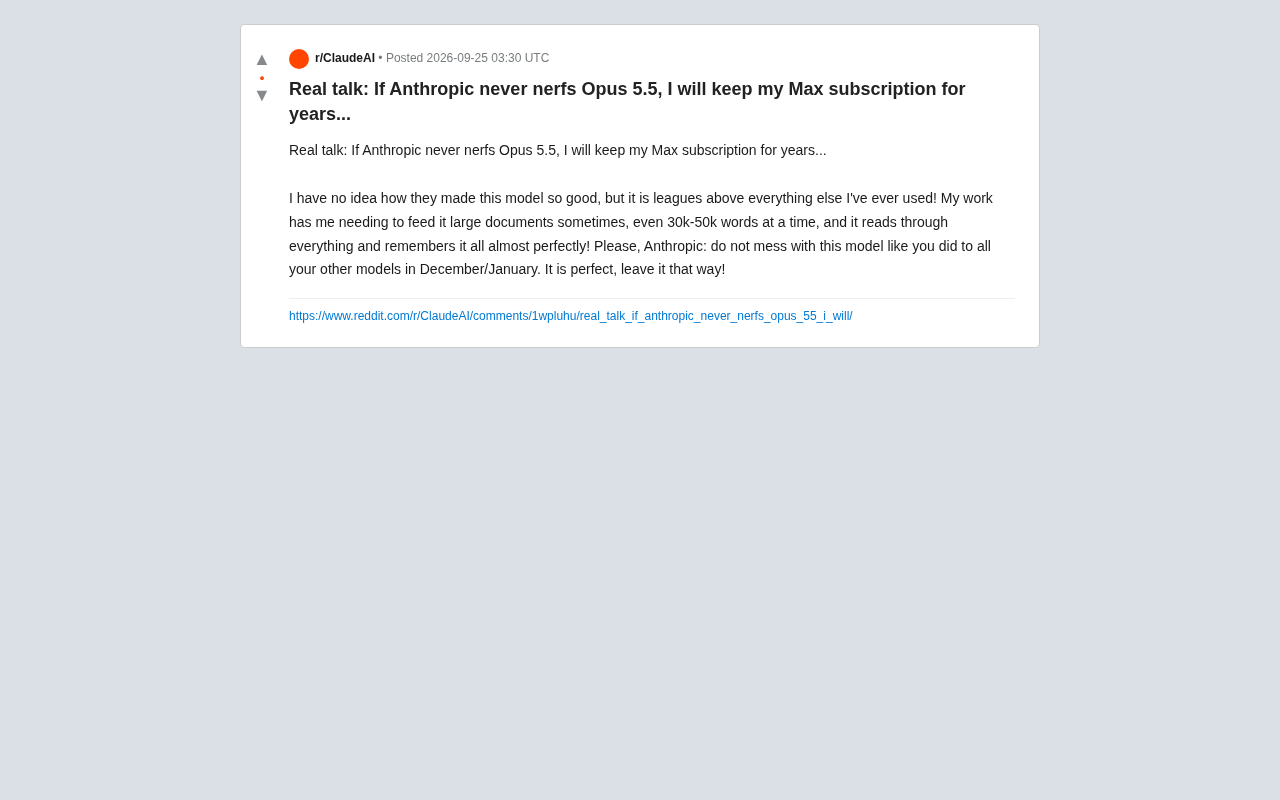
A Reddit user recently posted an unfiltered appreciation for Anthropic's latest model, Claude Opus 4.5. This Max subscriber said he'd be happy to renew his subscription for years — as long as Anthropic doesn't "nerf" the model.
His core use case involves processing extremely long documents — sometimes feeding the model 30,000 to 50,000 words in a single session. According to him, Opus 4.5 can "read through everything and remember nearly every detail almost perfectly." That kind of long-context reliability directly determines whether a model is actually usable in professional workflows, which is why he described it as "miles ahead of anything I've used before."
Why Long-Context Performance Has Become the Benchmark
For professionals working with legal documents, research reports, or technical documentation, a model's ability to consistently "remember" tens of thousands of words of input is the single most important variable for productivity. Context window size is easy to advertise, but the real challenge is context utilization quality — whether the model loses information buried in the middle of a long document (the well-known "lost in the middle" problem).
When this user says the model "remembers nearly everything," he's specifically pointing to consistent information recall even under extremely long inputs. That kind of experiential stability reflects a model's real-world value far better than benchmark scores or parameter counts.
"Lost in the middle" is a phenomenon identified and named by a Stanford research team in 2023: when input text exceeds a certain length, large language models tend to maintain high recall for information at the beginning and end of the text, while significantly forgetting or ignoring content in the middle sections. Experiments show this problem becomes more pronounced as context length increases, causing models to miss critical evidence or reach incorrect conclusions. This is why there's a massive gap between "supports 200K token context" and "can actually make good use of 200K tokens" — the former is an engineering parameter, the latter is real reasoning quality. The industry has explored various solutions including positional encoding improvements (such as RoPE scaling), attention mechanism optimization, and specialized long-text training data, but no definitive solution exists yet. When evaluating long-context models, users often need to design tests specifically targeting mid-document recall to truly measure practical usability.
Why Users Fear Model Nerfs
One notable detail in the post is that the user explicitly asked Anthropic to "not mess with this model like they did to others back in December/January."
In AI community parlance, a "nerf" typically refers to a user-perceived drop in model performance after an update — whether that's lower response quality, increased refusals, or weaker reasoning. These complaints surface repeatedly across major model communities, and they often reflect real tradeoffs vendors make between inference costs, safety alignment, and service load.
It's worth noting that this is a single user's subjective experience, not an officially confirmed performance change. The feeling that a model has "gotten worse" sometimes stems from actual adjustments, but can also come from changes in use case or shifting expectations. Still, this widespread anxiety reveals a structural tension in subscription-based AI products: users pay for the experience they have today but have no way to lock in how the model will behave tomorrow.
The "model nerf" phenomenon has real technical roots. After commercial deployment, vendors typically continue making post-training adjustments to their models — including reinforcement learning from human feedback (RLHF), safety alignment fine-tuning, and enhanced filtering for specific harmful outputs. While these adjustments improve safety and reduce misuse risks, they can sometimes have side effects on instruction-following ability, output style, or creative performance on specific tasks. OpenAI publicly acknowledged in 2023 that GPT-4 had a user-perceived "getting dumber" problem and released a technical report attempting to clarify the situation. Academic research has also found statistically measurable differences in model outputs when calling the same API endpoint at different points in time. This "silent update" model — where models change substantively without any version labeling — is a major source of user anxiety, and has pushed some enterprise users toward API calling patterns that demand explicit version locking.
Subscription Stability: The Trust Game Between Vendors and Users
The deeper significance of this post is really about trust. When a user is willing to "subscribe for years" to a model, they're not just buying current capabilities — they're buying an expectation of future consistency.
For vendors like Anthropic, the challenge is maintaining a stable, perceptible user experience while continuously optimizing cost structures. This is the key to retaining high-value paying users. Any update that gets interpreted as a "downgrade" can instantly shatter that trust — even if there are perfectly valid engineering reasons behind it.
From a product perspective, transparent version management and optional version pinning mechanisms may be the path forward for addressing this anxiety. Allowing power users to continue using the model version they've validated in their workflows might do more for satisfaction than chasing metric improvements alone.
Takeaway
This feedback from a real paying user is brief but precise: it highlights Opus 4.5's core strength — stable handling of extremely long documents — and identifies the central pain point in the AI subscription market: users' strong demand for model consistency. For anyone evaluating whether to subscribe to the Max plan, long-context performance is a dimension worth testing carefully. At the same time, community claims about "models being nerfed" deserve a measured reading — they're expressions of subjective experience, not quantifiable conclusions.
Related articles

Chain of Thought Isn't Just for AI: How Humans Can Use CoT to Improve Thinking Quality
Chain of Thought isn't just a prompt trick for large models. Starting from a Hacker News discussion, this article analyzes why CoT works for human thinking too, breaks down actionable ways to transfer it, and highlights the key differences between human CoT and machine CoT.
Cloudflare Teams Up with OpenAI: Closi…
Cloudflare Teams Up with OpenAI: Closing the Loop from Vulnerability Discovery to Defense with AI
Cloudflare uses OpenAI Daybreak to investigate security vulnerabilities and generate reviewable remediation plans, while developers use Codex to boost coding efficiency and quality.

Orca Multi-Agent Orchestration in Practice: A Guide to Parallel Collaboration with Claude and Codex
Orca is Stable AI's free open-source agent workbench supporting 34 agents like Claude Code and Codex in parallel. Learn its Git worktree isolation, multi-model orchestration, and mobile management.