Claude Opus 5.5 Spotted in Hidden Testing, Set for a Head-On Battle with GPT-6

Claude Opus 5.5 stealth testing leaked, alongside confirmed launches from Zhipu, Silicon Flow, and Jimeng.
This article covers five key AI developments in a single day. Anthropic is reportedly testing Claude Opus 5.5 under the codename 'Cloud Wafer EAP' with Adaptive reasoning and alleged performance surpassing GPT-6 — though unconfirmed. xAI's Grok 4.7 also briefly appeared on OpenCode Zen before being pulled. Confirmed news includes: Zhipu open-sourcing ZCode under Apache 2.0 (with community collaboration disabled), Silicon Flow launching SIM 4.0 with 256K context for free, and Jimeng clarifying that Image 2.1's research license restricts model use but not user-generated output rights.
Claude Opus 5.5 Enters Stealth Testing
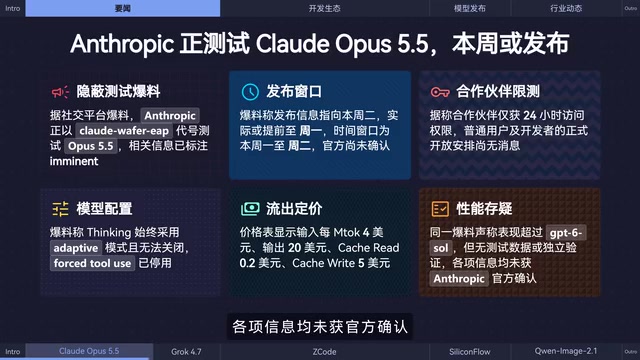
According to community leaks, Anthropic is conducting stealth testing of its Claude Opus 5.5 model under the codename "Cloud Wafer EAP," with a possible launch as early as Monday local time. The leaked information indicates that the new model's Thinking reasoning phase will always use Adaptive mode, meaning the model will dynamically adjust its reasoning depth based on task complexity rather than requiring users to manually switch settings.
Another leaker has claimed that Opus 5.5 will outperform OpenAI's yet-to-be-released GPT-6 (codenamed Sol) across the board. It's worth emphasizing, however, that none of this information has been officially confirmed by Anthropic — it remains firmly in the realm of community rumors, far from verified. Given Anthropic's established iteration cadence for the Claude series, claims of "cross-generation superiority" should be treated as expectation-setting rather than established fact.
If the leaks prove accurate, the normalization of Adaptive mode would represent a significant product shift. It reflects a broader effort by leading AI vendors to resolve the tension between reasoning costs and response efficiency — letting the model decide "when to think harder" rather than offloading that burden onto users.
EAP (Early Access Program) is a controlled testing mechanism commonly used by tech companies, sitting between internal alpha testing and public beta testing. Participants are typically vetted developers or partners, with the goal of gathering real-world feedback and uncovering edge cases before a full launch, while keeping distribution limited. The codename "Cloud Wafer" carries no functional meaning — it's purely an internal identifier to prevent premature leaks. These codenames often become clues the community uses to track release timelines once leaked, but it's important to note: model capabilities, pricing, and final product form during the EAP stage can differ significantly from what ships publicly.
Adaptive reasoning mode emerged in response to a common pattern with current leading reasoning models (such as Claude 3's Extended Thinking and OpenAI's o-series), which typically allow users to manually set reasoning "budgets" or depth levels. This approach puts the judgment burden on users. Adaptive mode, by contrast, lets the model autonomously assess task complexity and dynamically allocate compute resources — quick responses for simple questions, deep chain-of-thought only when warranted. If this direction pans out, it will directly affect both API billing logic and latency experience.
Grok 4.7 Briefly Appears, Then Disappears
Community reports indicate that xAI's Grok 4.7 briefly appeared on the OpenCode Zen platform before being removed and is no longer accessible. This information also has not received official confirmation.
This kind of "brief appearance followed by a pullback" is not uncommon in recent model releases. It typically signals that a model is in an internal grey-testing or API integration phase, picked up prematurely by a platform before it meets the standard for an official launch. For developers tracking competitor activity, this type of signal is more useful for gauging a vendor's release window than for actually testing the model — after all, a pulled version is neither stable nor representative of the final product.
Zhipu Open-Sources ZCode and Completes Security Remediation

Zhipu AI has announced the open-sourcing of ZCode alongside the completion of security remediation. The company stated that the latest version has removed the RepoWiki entry point and the local repository snapshot upload pipeline, with no related code data retained. The China Academy of Information and Communications Technology (CAICT) and Lvmeng Technology conducted and confirmed an evaluation of the remediation measures.
Looking at the open-source specifics, the repository covers first-party code ranging from the desktop application to the Agent CLI, released under the Apache 2.0 license. However, there are a few notable omissions: the original commit history is absent, and both the issue tracker and pull request functionality have been disabled. This means the community can access the code but cannot participate through standard collaborative channels or trace the development history.

The official notice also specifically states that the open-source version is not eligible for quota-based benefits under the GLM Coding Plan. This arrangement draws a clear line between "open-source code" and "commercial services" — what's being opened is the tool itself, not the accompanying paid resources. For enterprise users, adopting the open-source version means taking on compute and operational costs independently, which is a common commercialization strategy seen across domestic Chinese model open-source releases.
The Apache 2.0 license is one of the most permissive in the open-source software world, allowing commercial use, modification, and redistribution while requiring retention of the original copyright notice and license text. Compared to stricter licenses like GPL (which requires derivative works to be open-sourced) or AGPL (which extends that requirement to network services), Apache 2.0 is enterprise-friendly and permits closed-source integration. However, ZCode's open-source release lacks the original git commit history and has closed off community collaboration channels — meaning external developers cannot audit the code's evolution or submit bug fixes. The "collaborative" nature of open source is substantially diminished, making this closer to a "code disclosure" than genuine open development. This gap between open licensing and substantive community openness is fairly representative of domestic Chinese model open-source projects.
Silicon Flow Launches SIM 4.0 with Free API Access
Silicon Flow has launched the SIM 4.0.29 BA4B model with free API access open to all. The model natively supports a 256K context window and is specifically designed for complex engineering tasks and long-horizon Agent workflows.
The combination of a 256K context window and a long-horizon Agent positioning suggests this model is targeting codebase-scale engineering scenarios — where the model needs to maintain context coherence across lengthy, multi-step tasks. The free access strategy is a classic developer acquisition play, lowering the barrier to entry to build out a developer ecosystem. For teams working on Agent application development, this kind of free allocation is worth adding to the evaluation checklist — though real-world performance still needs to be validated on actual engineering tasks.
Jimeng Image 2.1 License Dispute Gets Official Clarification

In response to a prior licensing dispute, Jimeng Developers publicly clarified the licensing terms for Image 2.1. The official statement explains that the research license governing the model applies to the model weights, code, documentation, and related assets — meaning commercial use of the model itself requires obtaining a separate license.
The key clarification: users retain the rights to content they generate with the model, such as images. This distinction draws a clear line between two separate layers — use of the model itself is subject to the research license, while ownership of generated outputs stays with the user. This "model-restricted, output-free" licensing structure is becoming increasingly common in generative AI, protecting vendors' control over their model assets while giving users reasonable freedom to use generated content. For users who rely on AI image generation for commercial creative work, understanding these license boundaries is especially important.
Generative AI licensing typically operates across two independent tiers: the model layer (weights, code, training configuration) and the output layer (user-generated images, text, etc.). The former is governed by the developer's license terms; the latter follows separate contractual terms or established legal principles. A "Research License" typically prohibits commercial deployment of the model itself, but does not necessarily restrict using generated content for commercial purposes — which is precisely the distinction Jimeng clarified here. Commercial users should pay particular attention: using a research-licensed model to provide services to clients may itself constitute a license violation, even if the final generated images belong to the user. Confirming a model's commercial authorization status before building a business around AI-generated content is a necessary step in legal due diligence.
Wrap-Up
Among today's stories, the Claude Opus 5.5 stealth testing leak carries the most weight — but it deserves clear-eyed scrutiny. Like the Grok 4.7 sighting, it remains unconfirmed by any official source. In contrast, Zhipu's ZCode open-sourcing, Silicon Flow's SIM 4.0 launch, and Jimeng's Image 2.1 license clarification are confirmed developments with concrete implications for developers. In an environment where rumor and fact are constantly intermingled, distinguishing between a "leak" and a "verified fact" is itself an essential form of information literacy.
Related articles

Amphibious Transforming Drone: Beyond 100x Power Savings, What Are the Real Needs?
Is the amphibious transforming drone just a gimmick? Starting from the 100x power difference of the M4 Morphobot, explore real application scenarios and thesis topic ideas, analyzing boundary conditions where pure drones and pure ground robots both fail.

Warhound Raises $200 Million: Genetically Engineered "War Dogs" Paired with Anduril Gear
Warhound raises $200M, backed by Ben Lamm and Palmer Luckey, to genetically engineer dogs for military and law enforcement use and equip them with Anduril gear. This article analyzes its technology direction, funding logic, and ethical controversy.

Claude API Comes to Google Cloud: IAM Integration and SDK Access Guide
Anthropic hosts the full Claude API on Google Cloud with IAM-controlled permissions and unified billing. This guide covers the Vertex AI and Anthropic-hosted entry points, IAM role configuration, and SDK access.