Claude Opus 5.5 vs. GPT-6: A Real-World Test That Wasn't Even Close

Real-world tests show Claude Opus 5.5 comprehensively outperforms the GPT-6 lite tier in 3D modeling and interactive generation.
A hands-on comparison by a Bilibili creator pits Claude Code's Opus 5.5 against ChatGPT's GPT-6 (lite tier) under extended thinking settings across three tasks: Blender teapot modeling, a forest castle walkthrough, and a GTA-style mini game. Opus 5.5 led across completeness, dynamic interactivity (NPC movement, water animation), and system logic coherence, while GPT-6 largely produced static geometry. Both consumed surprisingly little compute (7% vs. 5%). The test also surfaced platform differences in rate-limiting transparency — Claude bans openly while ChatGPT serves silent 404s — with real implications for heavy users. Notably, the comparison was not tier-equivalent; GPT-6's variant reportedly reasons less deeply than even the lowest thinking tier of its predecessor.
In the early hours of the morning, Anthropic's Claude Code and OpenAI's ChatGPT pushed new models almost simultaneously — the former with Opus 5.5, the latter with the GPT-6 series. Two flagship models squaring off should have been a fair fight, but after a round of hands-on testing, the verdict was surprisingly one-sided: Opus 5.5 demonstrated jaw-dropping 3D generation and interactive capabilities, while GPT-6 turned in what can only be described as an unremarkable performance on the same tasks.
This article breaks down the capability gap behind this "unequal showdown," based on a head-to-head comparison published by a Bilibili content creator.
Test Setup: Extended Thinking Mode, Head to Head
Both models were configured with high thinking intensity for this test. Claude Code used Opus 5.5, and ChatGPT used GPT-6. Worth noting: the GPT-6 used here is a specific tier within the series (referred to in the video as a lighter/lower-compute variant), and OpenAI itself has acknowledged that this tier's reasoning depth may fall short of even the lowest thinking tier of its previous generation.
In other words, this was not a strictly apples-to-apples comparison. The content creator openly acknowledged that Opus 5.5's more legitimate rival would be a high-end model from the previous generation, but chose to pit the two newest releases against each other anyway. That's exactly where the "unequal showdown" framing comes from.

Test 1: Blender Modeling — A Teapot Riding a Bicycle
The first test was a classic community benchmark: "a teapot riding a bicycle" — a prompt notorious for producing mangled geometry and widely used as a litmus test for spatial reasoning. Both models were asked to invoke Blender for actual 3D modeling.
GPT-6 visibly struggled with structural coherence; the output was rough and detail-poor. Opus 5.5, also working through Blender, produced a noticeably more complete and convincing result. The creator's verdict: in this kind of spatial modeling task, the two models are "not really in the same league."
Blender is an open-source 3D graphics suite supporting modeling, rigging, animation, rendering, and the full production pipeline. When AI "uses" Blender, it typically generates Python scripts via Blender's built-in bpy module to drive modeling operations, rather than directly manipulating the GUI. The "teapot on a bicycle" prompt is a demanding benchmark precisely because it requires the model to reason about unconventional spatial topology — how a teapot's spout, lid, and handle might interface with a bicycle frame has no real-world reference. The model must independently derive plausible structural constraints; any misstep produces intersecting or floating geometry. This tests not just code generation, but implicit 3D spatial reasoning.
Test 2: A Forest Castle Scene — Visual Quality and Interactivity
The second test asked both models to build a walkable "forest + small castle" scene. GPT-6's output wasn't bad — all the expected elements were present — but the characters remained crude geometric shapes with no interactivity, despite the prompt explicitly requesting it. Overall: competent but unremarkable.
Opus 5.5's output under the same prompt was significantly richer: a misty valley, a winding path, and a layered castle scene. More importantly, it delivered on interactivity — NPCs inside the castle moved around (even if on simple loops), the fountain had water flow animation, and there was even a market vendor character with its own animations, which the creator described as having a certain "spark."
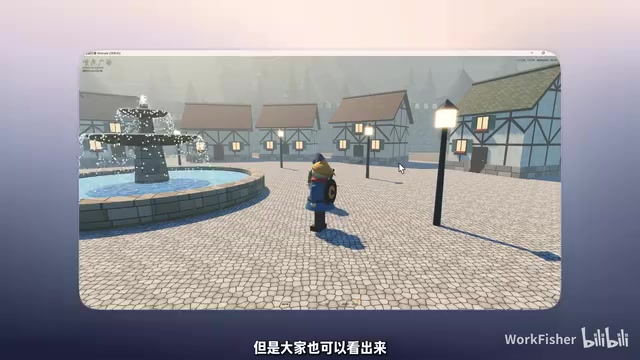
This leap — from static geometry to a dynamic, interactive scene — was the most viscerally clear illustration of the gap between the two models in this test.
Test 3: A GTA-Style Mini Game — System Completeness
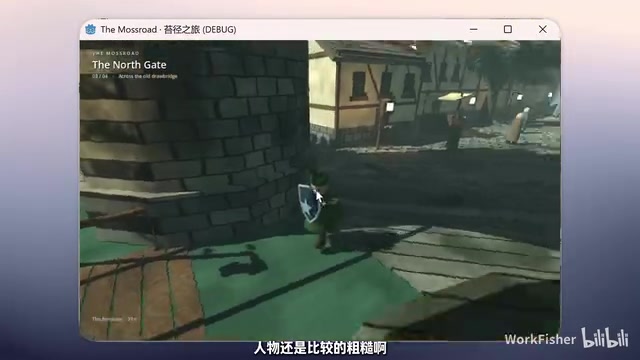
The third task was to build an open-world GTA-style scene. Opus 5.5's version implemented multiple system-level interactions: the character could enter buildings, get in and drive a car, watch TV, open the refrigerator, and navigate between floors. The apartment itself was sparse (bare walls, empty fridge), but the full interaction logic held together. Driving even came with retro music and a sunset atmosphere. These systemic features demonstrated the model's capacity for complex logic orchestration.
GTA-style games are frequently used as stress tests for system complexity in AI benchmarks because they require multiple tightly coupled subsystems to work simultaneously: character movement and collision detection, vehicle driving logic, indoor/outdoor scene transitions, interactive prop state management, and more. Generating runnable, complete code in a single prompt requires maintaining interface consistency across all these systems — a single naming conflict in a state variable or a flawed event loop design can bring the whole thing down. Successfully running all interaction paths is therefore a meaningful measure of a model's long-context code planning ability, not just its code style or single-function generation quality.
Compute Consumption: Surprisingly Efficient
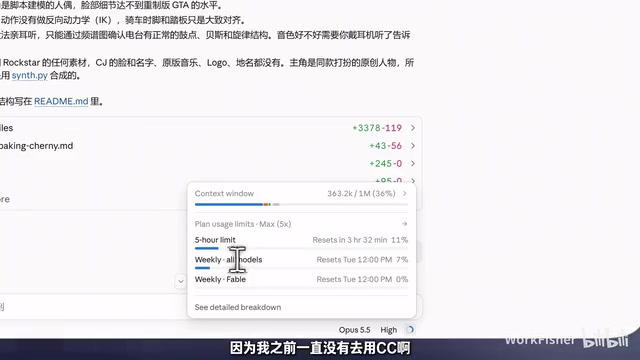
The consumption figures added another dimension to the comparison. After completing all three projects from scratch, Opus 5.5 consumed only 7% of the available quota — prompting the creator to exclaim, "I didn't expect it to be this lean." GPT-6 was even more frugal, using approximately 5% across the entire test, making it more efficient on raw compute alone.
However, the creator noted a subtle point: a model being overly "economical" isn't always a good thing — it may indicate compressed reasoning depth. Opus 5.5's balance between high output quality and low consumption was arguably its most impressive quality in this test.
The "consumption" figures here typically refer to token usage in API calls or the compute quota percentage displayed on the platform — not local device resources. For code-generation-heavy workflows like Claude Code, generating a complete project incurs substantial output tokens; 7% consumption means significant headroom remains within a subscription plan. It's also worth noting that Extended Thinking mode generates large volumes of internal reasoning tokens before producing output. How these are billed varies by platform — Anthropic prices thinking tokens separately and typically at a discount, which may partly explain why Opus 5.5's displayed consumption appears relatively low, and doesn't necessarily mean the model is doing less reasoning.
Account Availability: Honest Villain vs. Two-Faced Friend
Beyond the model tests, the creator raised a more practically relevant question about user experience. He holds three ChatGPT 20X accounts; two were throttled via route limiting, and after clearing that, all three returned 404 errors — no explicit ban message, yet functionally equivalent to being banned.
Claude Code, by contrast, has a reputation for outright banning accounts — but at least it's upfront about it. This prompted the running joke throughout the video: "Would you rather deal with an honest villain or a two-faced friend?" The question actually points to real differences in how AI providers handle rate limiting and service availability transparency. For heavy paying users, predictability itself has value.
Rate limiting and route degradation are standard tools for large AI platforms managing peak-load resources. "Routing" in this context refers to the platform dispatching user requests to backend model instances of varying quality or load — throttled users may unknowingly be served by lower-performance versions. ChatGPT's 404 responses typically mean the request was rejected server-side without explanation. The difference from an outright ban, from a user experience standpoint, is that 404s offer no clear path for appeal or recovery; users can't tell whether it's a temporary glitch or an account status issue — predictability is essentially zero. For heavy paying users, transparency around service availability directly affects workflow reliability, which is why "governance style" itself becomes a meaningful factor in platform selection.
Conclusion
This matchup was admittedly unequal in terms of model tier, but the takeaways are clear: on complex generative tasks like 3D modeling, scene interactivity, and game system construction, Claude Opus 5.5 demonstrated a significant edge — with surprisingly low compute consumption. GPT-6's corresponding tier performed conservatively, more like an efficiency-focused model optimized for throughput over quality. For creators who prioritize generation quality and interactive completeness, Opus 5.5 is the more compelling choice from this round of testing. Account availability and service transparency, meanwhile, are equally real factors that shouldn't be overlooked when choosing a platform.
Related articles

WorkBuddy Full Tutorial: Build an AI Office Automation Agent from Scratch
A complete WorkBuddy tutorial: installation, three working modes, multimodal picture book video practice, expert team agent building, and workflow configuration for low-cost AI office automation.

WorkBuddy Agent Complete Guide: From Beginner to Automation in 7 Days
Based on Bilibili's 256-episode WorkBuddy masterclass, this systematically breaks down Tencent's AI office workbench core capabilities: Agent principles, Skill encapsulation, cross-platform connectors, scheduled automation, knowledge bases, and zero-code development, with learning path recommendations.

8 AI Accounts, 7 Failed: An Honest Review of Using AI to Get Work Done
Only 1 of 8 AI-run Bilibili accounts succeeded. We break down the real difference between "performing AI" and "using AI to get work done."