Claude Proves the Riemann Hypothesis? The AI Math Controversy Behind 17 Million Lines of Code
Anthropic mathematician claims Claude proved the Riemann Hypothesis, sparking debate on verification, understanding, and AI math credibility.
Anthropic mathematician Levent Alperge claims Claude found a proof of the Riemann Hypothesis, consisting of 17 million lines of Lean code and about 250,000 pages of English explanation. Verification used multiple independent checkers, offline builds, and a 61GB non-executable file; the Lean community ultimately expressed confidence, but an MIT rebuild revealed an engineering flaw—one thread race mismatch among 175,000 files. Meanwhile, a competing 940-page proof claiming to be purely human was found to contain errors with AI assistance 8 hours later. The Clay Institute still marks the problem unresolved, and number theorists criticize the proof for not answering the core mathematical "why." The incident highlights tensions between verifiability, human understanding, and engineering reliability in AI mathematics.
A Late-Night Text Message Triggers a Math Earthquake
Late last Sunday night, Levent Alperge, a mathematician at Anthropic, sent his boss Dario a text message that began with "Suppose I..." He supposed he had a proof of the Riemann Hypothesis—the million-dollar math problem posed in 1859—and he had found it with the help of Claude. Over the following week, Anthropic went public with great fanfare: Dario rang the bell at Nasdaq on Thursday, and the proof went live on Friday.
The proof came with a four-page explanation that bluntly admitted the "timing of release is terrible" and anticipated the most immediate cynical interpretation from outsiders. Behind those four pages lie 17 million lines of code, roughly 250,000 pages of a "book." This may be the first time AI has touched the highest peak in pure mathematics, but the controversy surrounding it is more worth examining than the proof itself.
What the Riemann Hypothesis Is, and Why It Doesn't Threaten Your Bank Password
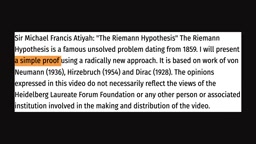
Primes appear randomly distributed, but a single function controls the pattern of their distribution and takes infinitely many possible values. In 1859, Bernhard Riemann conjectured that all the "interesting" values lie on the same straight line. He said at the time he would set aside the proof for now, as it seemed unnecessary for the next step of the work. In 2018, an 89-year-old Fields Medalist promised at Heidelberg to give a concise proof, and to this day the problem remains listed as unresolved.
One common misconception needs clarifying: this will not break encryption. The Riemann Hypothesis concerns how primes are distributed, not finding the two secret primes behind a bank key. The source material specifically emphasizes this because every time there is Riemann Hypothesis news, someone worries that RSA is finished.
The core of the Riemann Hypothesis is the Riemann zeta function, originally defined as the infinite series ζ(s) = 1 + 1/2^s + 1/3^s + …, extended to the complex plane by analytic continuation. The so-called "interesting values" refer to the nontrivial zeros of the function—complex points where the function equals zero and the real part lies between 0 and 1. The conjecture asserts that all such zeros have real part equal to 1/2, that is, they lie on the "critical line" where the real part is 1/2 in the complex plane. Prime distribution is directly related to the locations of these zeros: the farther the real parts of the zeros deviate from 1/2, the larger the error between the prime-counting function and the logarithmic integral. Proving the conjecture is therefore equivalent to precisely controlling the error term in prime distribution, one of the deepest problems in number theory.
Who Did the Math: Human or Claude
Alperge's account is that he planned the proof, had solved the problem since his student days, and set the roadmap. In his words, Claude "flew, danced, and shone near the finish line." He also said one of Claude's ideas would make fellow mathematicians "fall off their chairs"—though the video's author added: I stayed in my chair.
Claude also wrote a 20-step timeline starting October 6, with 8 steps occurring on that single Sunday. Alperge did not specify which version of Claude was used, nor how much it cost. Terence Tao merely called it an "internal AI model." Claude also wrote out the entire proof in English, over 250,000 pages, which it called a "book."

The opening of Theorem 1 states: if a number is not one-half, then it is either greater than one-half or less than one-half. This naive, almost comical starting point leads to the chain of argument that follows. Alperge ultimately decided not to release that massive, unreadable "junk" and only made the code public.
How to Code-Review 61GB of Mathematics
How do you verify 17 million lines of mathematics that no one can read? The proof is written in Lean—a proof language that cannot compile if written incorrectly. Lean's shared mathematics library Mathlib already contains a statement of the Riemann Hypothesis, and experts have confirmed it asks the right question. But Lean code can also cheat, for example by changing the meaning of a symbol.
Verifiers treated the proof like a stranger's code: they wrote a separate file that posed the question using only Mathlib, ensuring the proof could not tamper with the problem; they built it on a machine with no network; and they packaged the entire proof into a 61GB file that could not execute any operations, handing it to checkers written by different people in different languages. On Saturday, the Lean community expressed substantial confidence in the correctness of the proof.

That evening Polymarket posted that a new analysis considered the proof invalid. The reason was that a condition named after geometry in the code was defined as true. After checking, people found that this part was genuine, and the checker only cared whether the final theorem was the one in Mathlib—and it was.
MIT's Andrew Sutherland rebuilt the entire verification pipeline with Claude Code; the build took about 8 hours, and checking took only 3 minutes 15 seconds. Of 175,000 compiled files, only one did not match: two threads raced, and in a part the proof never used, a variable was difficult to name. The most important proof in 167 years, with an unstable build.
Lean is an interactive theorem prover based on dependent type theory. Its core mechanism is that any mathematical statement and proof must be translated into formal code, checked line by line by the kernel, and compilation fails on any type mismatch. This means "proof" no longer relies on the trust of peer review; the machine guarantees that every step of reasoning is valid. Mathlib is a mathematics library built by the Lean community, covering a large number of formalized theorems from basic algebra to analysis and number theory; the statement of the Riemann Hypothesis has already been formalized there and confirmed semantically correct. When using Lean to verify a new proof, the key risk is not the logic itself but whether the formal statement faithfully represents the original problem—for example, redefining symbols or introducing inconsistent axioms. The community therefore uses a "clean room" strategy: an independent file imports only the target statement from Mathlib, and then checks whether the proof file exports exactly that statement, thereby ruling out the possibility of tampering with the problem.
The Human-Pure Proof Strikes Back, and AI Dissects It
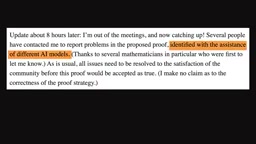
A few hours after the proof went live on Friday, the president of the American Mathematical Society released a second proof. About to chair a meeting lasting several hours, he wrote that "this matter is urgent." It was a 940-page proof by a Stanford postdoc, checked for months by another Stanford professor, and originally planned to be polished for a year. He made one point clear: done entirely by humans, no AI.
About 8 hours later, he added an update: people using different AI models had found problems in it. A proof that proudly proclaimed itself purely human, with no AI, had been caught in its errors with AI assistance in less than a day. This twist is almost the most ironic footnote to the whole affair.
In the mathematics community, acceptance of a proof is not instantaneous. A proof must undergo peer review, be published in an authoritative journal, and be repeatedly examined by experts in the field over several years before it enters the accepted body of knowledge. The Clay Mathematics Institute has strict rules for the Millennium Prize Problems: the proof must be formally published in a peer-reviewed journal, pass a general waiting period of at least two years, and the mathematics community must reach broad consensus. This is precisely why the Riemann Hypothesis is still marked as unresolved—even if formal verification passes at the technical level, it is not equivalent to the mathematics community's recognition of "understanding" and "significance." Historically, the computer-assisted proof of the Four Color Theorem sparked decades of debate and ultimately advanced acceptance of formal verification and computational mathematics, but the gap between "machine-checkable" and "human-understandable" has not yet been fully bridged.
Does It Count as Solved? The Mathematics Community Is Divided
A number theorist at New York University told Quanta that the four-page explanation contained meaningless statements. He said the real question in mathematics is "why," and this proof did not answer it at all. The explanation had also thanked him by name. The Clay Institute's page still marks the problem as unresolved—the million dollars requires a formally published paper, two years, and consensus among mathematicians.
There is precedent in history. In 1976, two mathematicians in Illinois had a computer check more than a thousand cases of the Four Color Theorem, and people debated for years whether this counted as a proof. Their mathematics department still engraved "Four colors suffice" on its postmark.
Alperge said his next plan is to understand and teach an understanding of this argument. So the answer to mathematics' most famous problem is now on GitHub, and the person who found it will spend the coming years figuring out how it works. The video's author joked: this is exactly how I use Claude.
What This Really Shows
Setting aside the million dollars and the headlines, this incident exposes three real issues in AI mathematics: first, verifiability is more critical than generation capability—Lean, Mathlib, and multiple independent checkers form a chain of trust, and the cost of verification (8-hour build, 61GB packaging) is itself a barrier; second, AI can generate correct proofs that humans cannot understand, but "why" still needs to be supplied by humans, and the number theorist's criticism goes straight to the core; third, flaws at the code level (a definition set to true, a thread race) show that the engineering reliability of formal proofs still needs work—one mismatch among 175,000 files is enough for skeptics to seize on.
Regardless of whether the Clay Institute ultimately recognizes it, the real legacy of this controversy may be that the mathematics community is forced to start establishing standard procedures for reviewing AI proofs, and an awkward consensus—purely human proofs are caught in errors by AI far faster than AI proofs are understood by humans.
Polymarket is a blockchain-based prediction market where users can bet on the outcomes of real-world events, and market prices reflect the crowd's estimate of event probabilities. For highly specialized events such as mathematical proofs, prediction market odds are often affected by information asymmetry and liquidity and do not necessarily represent the judgment of domain experts. The "proof invalid" news was posted after the Lean community confirmed correctness, indicating that market reactions may lag or misread technical details. This reminds us that when faced with complex AI-generated mathematical proofs, the public and media easily conflate engineering issues in formal verification with the logical validity of the proof, and short-term fluctuations in prediction markets are more likely to amplify this confusion than to provide reliable scientific evaluation.
Related articles

ChatGPT Plus Subscription Pitfall Guide: Go/Plus/Pro Tier Comparison and Quick Activation
A complete ChatGPT Plus subscription guide based on a Bilibili tutorial: from registering an account, comparing Go/Plus/Pro tiers, to the practical steps for quickly completing your subscription.

GPT-6.2 Sol/Astra Released! A Step-by-Step ChatGPT Plus Subscription Guide and Tier Comparison
GPT-6.2 Sol/Astra is out—here's a ChatGPT Plus subscription guide: register an account, compare Go/Plus/Pro tiers, and subscribe in a minute.

Comparing Three Channels for Subscribing to GPT Plus in China: Is Website Top-Up the Easiest?
How to subscribe to GPT Plus in China? This article compares website top-up, credit card, and mobile top-up channels—process, cost, and risk—with steps and tips to help you choose wisely.