Claude's Incognito Mode Still Recognized an Employer? The Real Truth Behind Its Privacy Mechanism

Claude's Incognito mode blocks cross-session memory — not the model's existing public knowledge.
A Claude paid subscriber was alarmed when the AI's Incognito Chat response referenced their employer's name. Consulting official documentation reveals Incognito mode's true scope: it prevents history logging, blocks reading and writing of Memory entries, and opts out of training data — but it does not erase the model's general knowledge. The apparent "employer recognition" most likely stems from a coincidental abbreviation, in-session context, or a misunderstanding of what the feature promises. The key takeaway: AI privacy labels have precise technical definitions, and understanding those boundaries is essential to using them correctly.
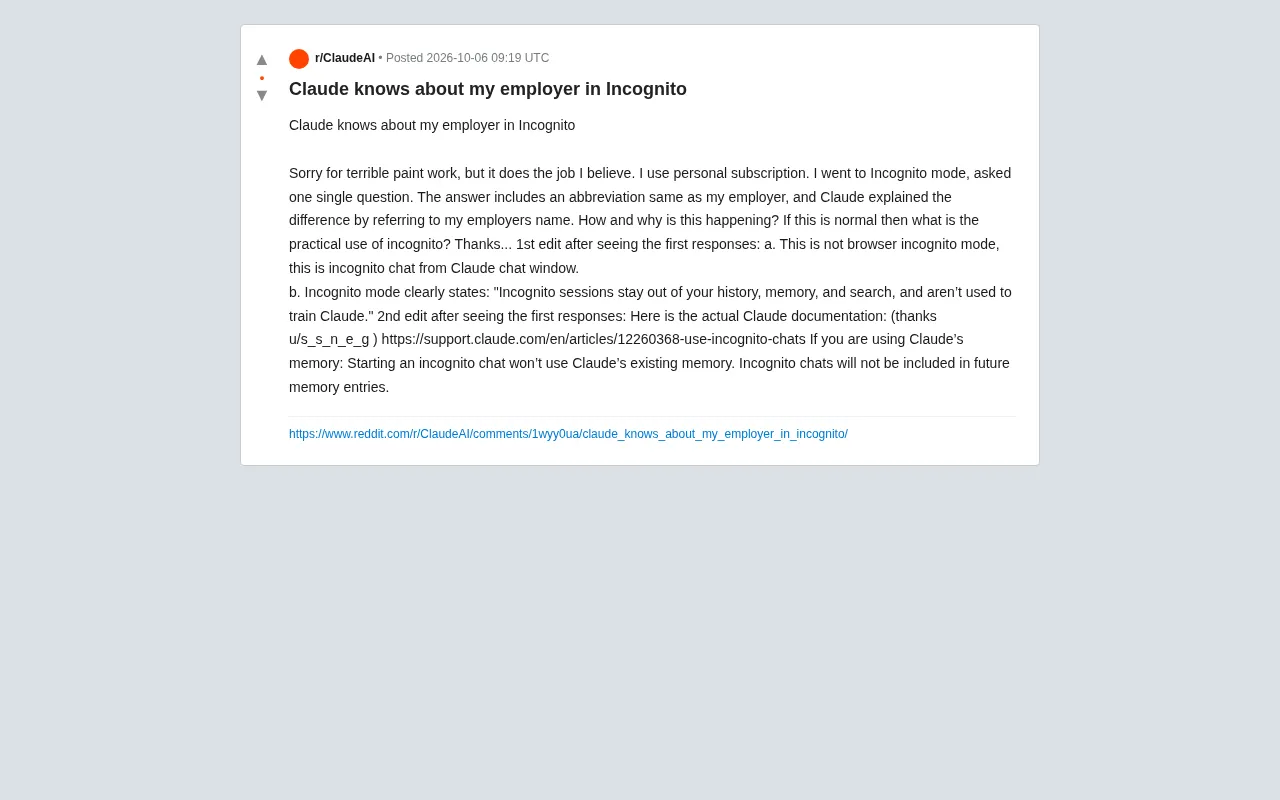
A Claude paid subscriber posted on Reddit with a troubling question: while using Claude's Incognito Chat feature and asking just a single question, the AI's response contained an abbreviation identical to their employer's name — and went on to reference the employer's full name to explain a conceptual distinction. This immediately sparked heated debate about AI privacy protections. If Incognito mode still "knows" who you are, what does it actually do?
Reconstructing the Incident: An Unexpected "Recognition" in Incognito Mode
According to the original poster, they were using a personal subscription account and had manually switched to Incognito mode within the Claude chat interface — not a browser incognito window, a distinction they specifically clarified in an edit. After asking just one question, Claude's response contained an abbreviation matching their employer's name, using the employer's full name to explain the difference between two concepts.
This left the user thoroughly confused. Claude's Incognito mode explicitly promises: "Incognito conversations won't appear in your history, memory, or search, and won't be used to train Claude." So why could the AI apparently still "recognize" their employer?
It's important to emphasize that this discussion is about Claude's built-in Incognito Chat feature — not browser-level private browsing. These two operate with entirely different privacy boundaries, and conflating them leads to serious misunderstandings.
What Does Incognito Mode Actually Promise?
Consulting Claude's official documentation (linked by Reddit user u/s_s_n_e_g) makes the actual mechanism clear:
- If you're using Claude's Memory feature, enabling Incognito Chat will not invoke any memories Claude has already stored.
- The contents of an Incognito Chat will not be added to future memory entries.
In other words, Incognito mode makes three core commitments: no history logging, no reading or writing of memory, and no use in model training. It severs the link between a session and the persistent data tied to your account.
But here lies a critical misconception: Incognito mode does not mean the AI knows nothing about you, or that it becomes a blank slate. The model's training data, its general knowledge, and any information you provide within the current session are all still accessible to it.
Claude's Memory feature is essential context for understanding this incident. It allows Claude to retain information about a user across multiple conversations — such as their profession, preferences, and habits — enabling more personalized responses over time. These memory entries can be managed manually by the user or automatically created and updated by Claude during conversations. The core protection logic of Incognito mode targets this mechanism specifically: it neither reads existing memory entries (preventing the AI from leveraging accumulated personal data in the current session) nor writes new ones from the conversation (preventing it from shaping future "profiles"). This means Incognito mode's privacy boundary operates at the account persistence layer, not the model inference layer — in other words, it governs data storage and retrieval, not the model's cognitive scope.
Why Did Claude "Say" the Employer's Name?
Based on the available information, the most likely explanation is not a privacy leak, but rather one of several more mundane causes:
Possibility 1: A Coincidental Abbreviation
The user mentioned that what appeared in the response was "an abbreviation identical to their employer's." Many company name abbreviations are industry-standard terms or common English acronyms. If the user's question touched on a specific professional domain, Claude would naturally draw on general knowledge from its training data when explaining conceptual distinctions — and happened to land on the same abbreviation as the employer's name. This is a probabilistic coincidence, not targeted identification.
Possibility 2: In-Session Context
Incognito mode cuts off cross-session memory, but it does not cut off in-session context. If the user provided any work-related clues during the current conversation — even inadvertently — Claude is fully capable of reasoning from those immediate inputs. This does not violate the Incognito promise in any way.
Possibility 3: A Misunderstanding of the Privacy Mechanism
Incognito mode protects against "your data being stored and reused" — not against "the model pretending it doesn't know any companies." If the employer is a well-known organization, its name already exists in the model's publicly sourced training knowledge. Claude mentioning a publicly searchable company name is categorically different from Claude "knowing where you work."
Where Does Incognito Mode Actually Add Value?
This incident reveals a widespread misunderstanding among everyday users about AI privacy features. Incognito mode's real purpose is to serve as a "temporary sandbox" for situations where you don't want a conversation to affect your personal profile, accumulate in memory, or be used for training.
It's well-suited for scenarios like:
- Exploring sensitive or experimental questions you'd rather not have appear in your history
- Preventing a conversation from being written into long-term memory and influencing the AI's future "model" of you
- Conducting quick, one-off queries on a shared device
What it is not is a switch that causes the AI to "forget everything" or "dumb itself down" — and it certainly cannot prevent the model from drawing on public knowledge it already has. Understanding this boundary is the key to using these features correctly.
It's worth noting that this "temporary sandbox" philosophy shares some conceptual similarities with browser incognito windows, but the two are technically implemented at entirely different layers. Browser incognito mode protects locally stored browsing history, cookies, and cached data on the device, preventing other local users or cross-site trackers from accessing session traces — but the server still receives the full request. Claude's Incognito Chat operates server-side, protecting the data persistence flow within the user's account. Neither delivers a "the other party has no idea what you're doing" experience, which is why in both contexts, "incognito" should be understood as a limited privacy tool rather than an anonymization solution.
Practical Advice for Users
If you genuinely care about privacy, relying on Incognito mode alone is not enough. A more robust approach includes: avoiding sharing personally identifiable information in any conversation; periodically reviewing and clearing Claude's memory entries; and approaching "coincidences" in AI responses with rational judgment rather than immediately attributing them to data leaks.
The real value of this Reddit discussion isn't that it proves Claude "leaked" anything — it's that it reminds us AI products' privacy labels often carry precise technical definitions. Users need to read the official documentation and understand the actual boundaries, rather than relying on intuition about what a feature "should" do.
Related articles

WorkBuddy Full Tutorial: Build an AI Office Automation Agent from Scratch
A complete WorkBuddy tutorial: installation, three working modes, multimodal picture book video practice, expert team agent building, and workflow configuration for low-cost AI office automation.

WorkBuddy Agent Complete Guide: From Beginner to Automation in 7 Days
Based on Bilibili's 256-episode WorkBuddy masterclass, this systematically breaks down Tencent's AI office workbench core capabilities: Agent principles, Skill encapsulation, cross-platform connectors, scheduled automation, knowledge bases, and zero-code development, with learning path recommendations.

8 AI Accounts, 7 Failed: An Honest Review of Using AI to Get Work Done
Only 1 of 8 AI-run Bilibili accounts succeeded. We break down the real difference between "performing AI" and "using AI to get work done."