Claude's Invisible Watermark Controversy: AI Output Can Be Traced and Tracked

Anthropic's hidden watermarks in Claude's output spark debate over AI content tracing, privacy, and ownership.
Anthropic has been discovered embedding invisible watermarks in Claude's text output, enabling AI-generated content to be identified and traced. This has triggered backlash from users concerned about privacy, transparency, and content ownership. The article explores the technical mechanisms behind AI text watermarking, the legal gray areas of AI content attribution, and the broader industry tensions between responsible governance and user autonomy.
Background: Anthropic Quietly Introduces Output Watermarking
Anthropic, the company behind the AI coding and writing assistant Claude, has recently become a focal point of controversy. According to discussions on the Hacker News community, users discovered that Anthropic has embedded some form of invisible watermarking mechanism in Claude's text output, enabling AI-generated content to be identified and traced back to its source. This discovery quickly sparked frustration and debate among developers and content creators.
Anthropic was founded in 2021 by former OpenAI Vice President Dario Amodei and his sister Daniela Amodei, with AI safety research as the company's core mission from the outset. Anthropic introduced the "Constitutional AI" alignment methodology, which has the AI critique and revise itself based on a set of explicit principles rather than relying entirely on human feedback. The company has raised over $7 billion in total funding from investors including Google, Salesforce, and Amazon. It is precisely this "safety-first" brand promise that makes any controversy involving user trust particularly sensitive—users naturally hold higher expectations for a company that positions itself around "safety."
In the context of AI text generation, so-called AI text watermarks are typically not visible graphic marks but rather invisible signals embedded through specific word choices, character encoding, or statistical patterns. These techniques allow detection tools to determine whether a given piece of text was generated by a specific model, in ways that are nearly imperceptible to the human eye. For users who rely on Claude for their daily work, this means their AI-assisted traces could potentially be identified by third parties.
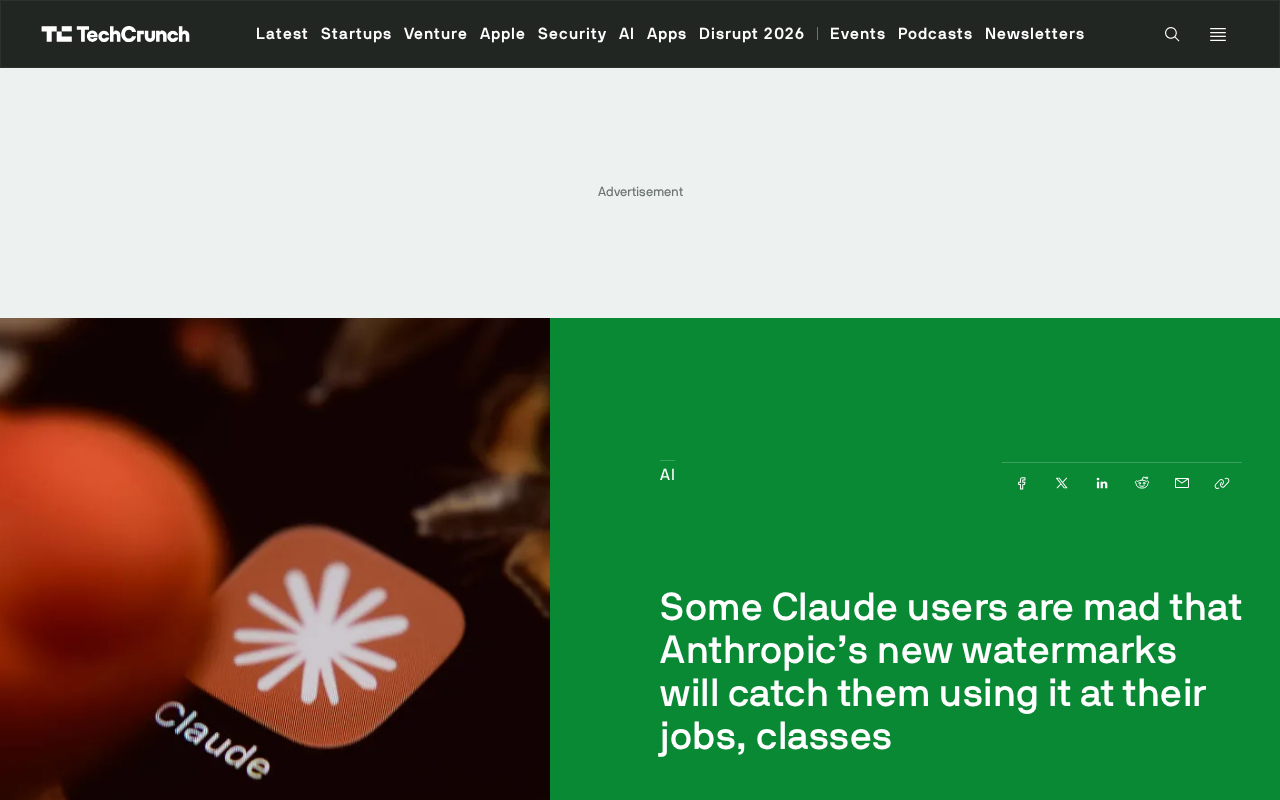
Why Users Are Angry: The Battle Over Privacy and Autonomy
Based on community feedback, user dissatisfaction primarily centers on the following concerns.
The Right to Know and Transparency
Many users stated that they were unaware their output was being embedded with traceable markers while using Claude. This approach of "enabled by default, without sufficient prior disclosure" touches on users' fundamental expectations of transparency. When a technology that affects content attribution judgments is silently deployed, users naturally ask: Why should a service I'm paying for stamp an irremovable mark on my work?
Real-World Concerns About Use Cases
For students, freelancers, content creators, and even corporate employees, AI assistance has become part of the workflow. Watermarking technology means these users could potentially be exposed as AI users when submitting assignments, delivering manuscripts, or producing reports—simply because the watermark was detected. In environments where some institutions still strictly limit or even prohibit AI use, this directly affects users' practical interests.
It's worth noting that the AI content detection field currently has two main technical approaches: post-hoc detection and watermark detection. Post-hoc detection, represented by tools like GPTZero and Originality.ai, infers whether content is AI-generated by analyzing statistical features such as perplexity and burstiness. However, these methods have relatively high false positive rates, especially with significantly reduced accuracy for non-English text and edited content. Watermark detection requires actively embedding signals during the generation phase and relies on key verification during detection, theoretically achieving near-zero false positives—but requiring active cooperation from the generator. OpenAI internally developed a text watermarking system in 2022 but shelved its release due to concerns about unfair impact on non-native English speakers, only reconsidering deployment in 2024. This industry context shows that watermark deployment is far from a purely technical decision—it's a complex choice that requires balancing fairness and effectiveness.
The Psychological Gap of "Being Monitored"
Users feel they've been transformed from tool users into monitored subjects. This psychological gap from the role reversal is a key factor in the controversy's continued escalation. Paying users expect a pure productivity tool, not a surveillance system that leaves tracking traces behind their backs.
Technical Perspective: What Exactly Is AI Text Watermarking?
To understand this controversy, it's necessary to clarify the technical principles behind AI text watermarking.
The concept of AI text watermarking was first systematically proposed by John Kirchenbauer and colleagues at the University of Maryland in their 2023 paper "A Watermark for Large Language Models." The core idea of their scheme is to introduce a pseudo-random function based on preceding tokens during the language model's token sampling process, dividing the vocabulary into a "green list" and a "red list," and embedding statistical signals by boosting the sampling probability of green list tokens. The elegance of this approach lies in the fact that the bias in any individual token selection is extremely small—imperceptible to human readers—but over sufficiently long text, the accumulated higher proportion of green tokens can be detected with extremely high confidence through statistical tests (such as z-tests). This technology was further developed by Google DeepMind's SynthID-Text scheme, which employs a more robust tournament sampling strategy and has been deployed in Gemini models.
How Invisible Watermarks Are Implemented
Mainstream text watermarking schemes fall broadly into two categories:
- Statistical watermarks: During the model's sampling phase, the vocabulary undergoes a pseudo-random "green list/red list" partition, favoring words from a specific subset. This creates a statistically detectable bias in longer texts that is virtually imperceptible to human readers.
- Special character encoding tricks: For example, inserting zero-width characters or using Unicode characters that look identical but have different encodings. However, these methods are relatively easy to strip away.
Regarding zero-width character watermarks, further explanation is warranted: Zero-Width Characters are a set of visually invisible characters in the Unicode standard that actually exist in the text encoding, including Zero-Width Space (U+200B), Zero-Width Non-Joiner (U+200C), Zero-Width Joiner (U+200D), and others. The principle of embedding watermarks using these characters involves inserting different combinations of zero-width character sequences at specific positions in the text, encoding metadata such as user IDs and timestamps. This method is simple to implement but weak defensively: a single regex cleanup can remove all zero-width characters. In contrast, statistical watermarks distribute signals throughout the text's vocabulary choices and cannot be removed through simple character-level operations—only through semantic-level rewriting. This is why statistical watermarks are considered to have greater practical deployment value.
The Reliability Boundaries of Watermarks
You may not have noticed, but no text watermark is foolproof. After rewriting, translation, truncation, or manual editing, watermark signals often degrade significantly or disappear entirely. This also means watermarks are better suited as auxiliary tools for large-scale content governance rather than precise "conviction" tools targeting individuals.
Deeper Industry Tensions
The controversy surrounding Claude's watermarks reflects several hard-to-reconcile contradictions in the AI industry today.
The Conflict Between Responsible Governance and User Experience
Anthropic has consistently positioned its brand around "safety" and "responsible AI." From the platform's perspective, embedding watermarks has a reasonable logic: facilitating abuse tracking, curbing AI-generated content used for misinformation, academic dishonesty, or large-scale fraud. However, the legitimacy of governance doesn't automatically translate into user acceptance—when the cost of responsibility is shifted onto ordinary users, a fracture in experience becomes inevitable.
The Ownership Dispute Over AI-Generated Content
The more fundamental question is: Who should hold the "source marking rights" over AI-generated content? Platforms believe they have the right to mark output sources as part of their platform responsibility; users argue that since they paid to drive the model's output, they shouldn't be forced to carry tracking signals. This ownership dispute, in an era where copyright law and platform terms remain unclear, is destined to have no simple answer.
From a legal perspective, copyright ownership of AI-generated content remains in a legal gray area globally. The U.S. Copyright Office stated clearly in 2023 that purely AI-generated content does not qualify for copyright protection because copyright law requires "human authorship." However, if a human makes substantial selections, arrangements, and edits to AI output, the human-created portions of that combined work may receive protection. The EU's AI Act requires deployers of AI systems to label AI-generated content but does not clearly define content ownership. In China, the Beijing Internet Court in a 2023 case first recognized that AI-generated images could receive copyright protection, provided the user made sufficient intellectual investment. This fragmented global legal framework means platform watermark policies lack a unified legal basis, leaving users in vastly different rights situations across different jurisdictions.
The Arms Race Between Detection and Anti-Detection
Predictably, as long as watermarks exist, "de-watermarking" tools will emerge, creating an ongoing cat-and-mouse game between detection and evasion. This arms race not only consumes resources on both sides but may ultimately undermine the governance value of watermarks themselves.
From a technical standpoint, the main approaches to watermark removal include: synonym substitution (replacing original words with semantically equivalent but different vocabulary), back-translation (translating text into another language and back), and using another non-watermarked language model to paraphrase the original text (paraphrasing attack). Multiple studies in 2024 showed that simple synonym substitution can reduce a statistical watermark's z-score by over 50%, while using a GPT-4-level paraphrasing model can almost completely eliminate the watermark signal while preserving semantics. To address this challenge, researchers have proposed more robust schemes such as "semantic watermarking," which embeds signals at the semantic representation level rather than the token selection level. However, these schemes are still in the academic research stage and have not been deployed at scale. This technical reality means that current watermarking schemes have limited effectiveness against users who intentionally circumvent them, and their governance value is more reflected in tracing "unconscious propagation."
Implications for Users and the Industry
For ordinary users, this incident reminds us: when using any AI service, pay attention to the terms of service regarding output processing, data retention, and content marking. AI tools are not purely neutral "pens"—the platform strategies behind them tangibly affect your output.
For AI vendors, the backlash triggered by Claude's watermarks is an important signal: transparency is indispensable for any technical decision involving user output. Providing sufficient advance notice, offering choices, and clearly explaining the boundaries of detection usage may be the proper path to resolving trust crises.
For the industry as a whole, finding a balance between AI content traceability governance and user rights will be a question that future regulatory frameworks and technical standards must jointly answer. Watermarking technology itself bears no original sin—the issue lies in how it's introduced, how it's used, and whether users always retain the initiative of being informed and having a choice.
Conclusion
The Claude watermark controversy may seem like a small-scale community grievance, but it actually touches the most sensitive nerve of the generative AI era: the three-way tug-of-war between transparency, ownership, and governance responsibility. As AI-generated content increasingly permeates work and life, how to build a traceability mechanism that can both curb abuse and respect users will test the wisdom and sincerity of every AI company. This discussion may be just the prelude to a much larger industry-wide debate.
Related articles

Beyond Vibe Coding: A Practical Guide to Enterprise-Level AI Programming
Go beyond Vibe Coding with enterprise AI programming: Claude Code, Codex tool selection, SuperPower plugin, and SDD workflows for production-ready projects.

Why Do ResNet Skip Connections Work? Reproducing the Deep Network Degradation Problem
Reproducing the deep network degradation problem on CIFAR-10: a 56-layer plain network achieves only 84% training accuracy vs. 95% for 20 layers. How ResNet skip connections solve this.

Entropic Scree: Reconstructing PCA Dimensionality Reduction by Replacing Variance with Information Entropy
Entropic Scree is a new information-theory-based dimensionality reduction method that replaces linear variance with entropy to estimate intrinsic data dimensions, with applications in neural network bottleneck design.