Claude Skills Explained: The Progressive Disclosure Mechanism for Extending Agent Capabilities

Claude Skills use progressive disclosure to solve MCP's context explosion and improve Agent tool calling accuracy.
This article traces the evolution of Agent capability extension through three stages: Tool Calling, MCP (Model Context Protocol), and Claude Skills. While MCP standardized tool integration, it suffers from context explosion when scaling to many tools. Skills introduce a progressive disclosure mechanism — loading skill details on-demand rather than all at once — balancing capability breadth with reasoning efficiency for production-grade Agents.
The Rise of Agents: Reading the Industry Signals
Recently, a Bilibili content creator specializing in AI technology education shared his observations after a three-day research visit to Alibaba's headquarters in Hangzhou. Two pieces of information he revealed deserve the attention of every practitioner in the field.
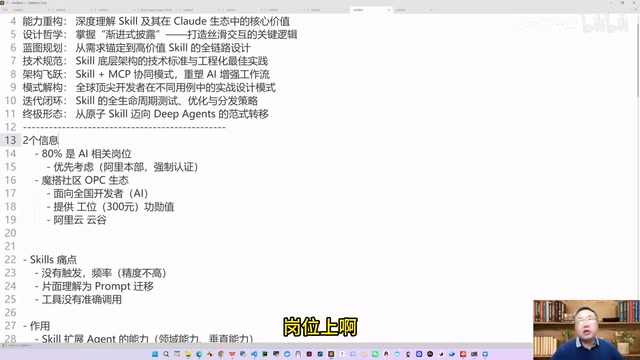
The first signal concerns a profound shift in job structure. According to his observations, approximately 80% of hiring positions at Alibaba's headquarters are now AI-related, falling into three main categories: application development, product and solutions, and algorithms and advanced architecture. This means that regardless of which business line you're in, AI capability has become a core competitive advantage.
That said, entering relevant positions at Alibaba headquarters requires a "hard prerequisite" — the Alibaba Cloud ACP (Alibaba Cloud Certified Professional) certification for large models. This certification covers a comprehensive range of topics, from basic Prompt engineering and RAG (Retrieval-Augmented Generation) to complex Agent task building, model fine-tuning, and cloud-based inference deployment — essentially spanning the entire chain of putting large models into production. At its core, it serves as a standard for enterprises to assess whether a developer possesses "engineering-oriented logical capability."
Several key technologies mentioned are worth elaborating on: Prompt engineering refers to the systematic methodology of carefully designing input prompts to guide large models toward producing high-quality outputs — it's the foundational skill for all large model applications. RAG (Retrieval-Augmented Generation) is an architectural pattern that combines external knowledge bases with a large model's reasoning capabilities. It retrieves relevant document fragments first and then has the model generate answers based on the retrieved results, effectively mitigating issues of outdated model knowledge and hallucinations. Fine-tuning involves secondary training on a pre-trained large model using domain-specific data to improve the model's performance in vertical scenarios. Cloud-based inference deployment involves deploying trained models to cloud servers, addressing engineering challenges such as concurrent request handling, latency optimization, and cost control. These technical components form the complete engineering pipeline from model capability to product deployment.
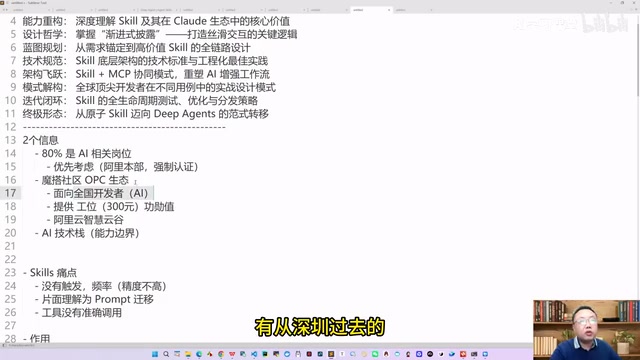
The second signal is the OPC (Open Project Community) ecosystem launched by the ModelScope community. It offers physical workstations to AI developers nationwide at Alibaba Cloud's Smart Cloud Valley for approximately 300 RMB per month, with the option to use community credits ("work points") to cover workstation fees and compute resources.
ModelScope is an open-source model community launched by Alibaba's DAMO Academy in 2022, positioned as a domestic counterpart to Hugging Face, aggregating thousands of open-source models and datasets. The OPC ecosystem extends this further as a developer co-creation space. This model isn't unique to Alibaba — Google has its TensorFlow community, Meta has the PyTorch ecosystem, and Baidu has the PaddlePaddle developer community — but Alibaba has pushed it to the point of providing physical workstations and compute subsidies, reflecting an important trend: the AI competition among tech giants has shifted from "who has the stronger model" to "who has the more thriving developer ecosystem." The sharing of compute resources lowers the cost of experimentation for independent developers and small teams, while the community credit system creates a virtuous cycle through contribution incentives.
Why Agents Have Become the Dominant Form for Application Deployment
Based on his on-site observations at the OPC community, developers from Shenzhen, Beijing, Chengdu, and other cities were almost universally building their production applications in the form of Agents. This is no coincidence — Agents can combine a large model's reasoning capabilities with external tools and data sources, evolving from "chatting" to "doing things," which is precisely the core demand for enterprise-grade AI applications.
From a technical perspective, an Agent has a well-defined meaning in the AI domain: it is a system capable of perceiving its environment, making autonomous decisions, and taking actions to achieve goals. Unlike traditional chatbots, an Agent possesses three core capabilities — Planning, Memory, and Tool Use. Planning allows an Agent to decompose complex tasks into multiple sub-steps; memory mechanisms (including short-term contextual memory and long-term knowledge storage) enable it to maintain consistency across multi-turn interactions; and tool use lets an Agent invoke external resources such as APIs, databases, and code executors. Since 2024, the emergence of Agent frameworks like AutoGPT, MetaGPT, and CrewAI has marked the transition of Agents from academic concept to engineering practice. Enterprise demand for Agents has primarily centered on customer service automation, data analysis, code generation, and process automation.
The Claude Skills mechanism discussed in this article is a critical component in the Agent capability extension ecosystem. To put it simply: Skills are mechanisms for extending Agent capabilities. To understand their value, we need to first review the evolution of Agent capability extension.
Three Evolutionary Stages of Agent Capability Extension
Stage 1: Tool Calling
In the earliest stage, extending Agent capabilities primarily relied on tool calling. Developers defined a set of tools (functions) for the model, allowing it to decide when to call which tool during the reasoning process. This is a fundamental Agent capability, but it comes with a critical pain point: call accuracy.
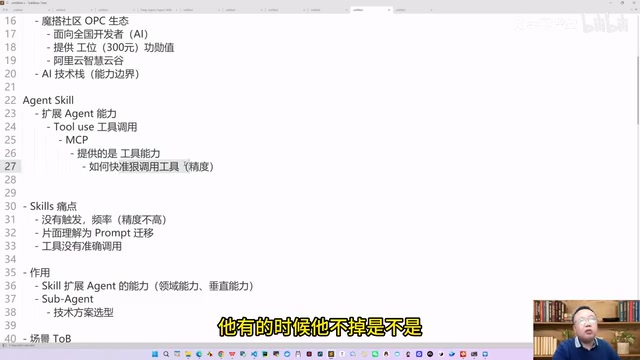
The technical implementation of Tool Calling (also known as Function Calling) typically follows a standard workflow: developers define the tool's name, description, parameter types, and required fields in JSON Schema format; the model determines during inference whether the user's intent matches a particular tool; if it does, the model generates a structured call instruction (rather than a natural language response); the application layer then executes the actual call and returns the result to the model. In this process, the model acts as a "dispatcher" rather than an "executor."
The model sometimes fails to call tools when it should, sometimes passes incorrect parameters, or provides ambiguous parameter values. The root cause of these issues often lies in poorly written tool descriptions. The deeper reason for accuracy problems is that models are fundamentally probabilistic generation systems — they determine tool match likelihood through statistical correlation rather than logical reasoning. When tool descriptions are vague or parameter boundaries are unclear, the model's tendency toward "hallucination" leads to incorrect calls. Common industry countermeasures include: writing detailed few-shot examples for tools, using Chain-of-Thought prompting to have the model analyze before calling, and implementing confirmation mechanisms for tool calls. To get the model to call tools "quickly, accurately, and decisively," developers need to write extensive trigger conditions, samples, and reasoning chains in their prompts, resulting in high engineering costs.
Stage 2: MCP (Model Context Protocol)
Subsequently, Anthropic introduced MCP (Model Context Protocol), standardizing how tool capabilities are integrated.
MCP was officially released by Anthropic in late 2024, inspired by the "USB interface" concept in software engineering — just as USB unified peripheral connection standards, MCP aims to unify the interaction protocol between large models and external tools/data sources. MCP uses a client-server architecture and defines three core primitives: Resources, Tools, and Prompts. Developers only need to implement an MCP Server according to the specification, and any MCP-compatible Client (such as Claude Desktop, Cursor, etc.) can use it in a plug-and-play fashion.
MCP solved the standardization problem for tool integration, but it has two critical shortcomings:
- Token consumption and context explosion: MCP's mechanism loads all tool descriptions into the context at once. When the number of integrated tools grows from a handful to hundreds or thousands, the tool descriptions alone consume massive amounts of tokens. Take GPT-4 Turbo as an example — its 128K context window seems generous, but when connecting 50 MCP tools with an average of 500 tokens per tool description, the descriptions alone consume 25K tokens, not counting conversation history and system prompts. The effective utilization rate of the context window drops significantly, directly impacting the model's ability to understand the user's true intent.
- Context pollution: A large model's context window is a precious resource that should remain precise and useful. The accumulation of tool descriptions pollutes the context, leading to a cascade of problems including increased inference latency and higher hallucination probability.
In other words, MCP defines the boundaries of "what tools can do," but doesn't solve the problems of "when to use a particular tool" and "how to load them efficiently."
Stage 3: Skills and the Progressive Disclosure Mechanism
To address the above limitations of MCP, Anthropic (the same company that introduced MCP) went a step further and introduced the Skills mechanism. Its core innovation lies in two aspects:
- Improved tool calling accuracy: Through more structured skill definitions, the model can more accurately determine when to use which capability.
- Progressive Disclosure: This is the most critical design feature of Skills. Instead of stuffing all tool descriptions into the context at once like MCP, it discloses information on-demand and in layers. The model first sees a high-level skill overview and only loads specific details when actually needed.
Progressive Disclosure is not an AI-original concept — it was first proposed by IBM researcher John Carroll in the 1980s and has been widely used in user interface design. The collapsible "Advanced Settings" panel in Windows is a classic example. In the Skills mechanism, this concept has been transplanted into AI system architecture: the model first receives a lightweight skill index (like a table of contents), where each skill is summarized in just one or two sentences describing its function. Only when the conversation context triggers the usage conditions for a particular skill does the system dynamically load that skill's complete instructions, parameter definitions, and examples. This "on-demand loading" design is analogous to "Lazy Loading" in computer science and the "virtual memory" mechanism in operating systems. Its engineering value is this: even if an Agent is equipped with hundreds of skills, its actual runtime context usage might be equivalent to an MCP solution using only 3-5 tools, achieving a balance between capability breadth and reasoning efficiency.
Progressive disclosure fundamentally alleviates the problems of context explosion and token waste. When the number of skills is large, the Agent can still maintain a "clean" context and efficient reasoning — this is crucial for building enterprise-grade, production-ready intelligent agents.
Practical Implications for AI Developers
From Tool Calling to MCP to Skills, the evolution of Agent capability extension clearly points in one direction: how to maintain context precision and efficiency even as capabilities become increasingly rich. This is the core challenge of engineering-oriented deployment.
Combined with the industry signals mentioned earlier — 80% of positions at major tech companies shifting toward AI, and Agents becoming the dominant form for application deployment — it's clear that mastering cutting-edge Agent development technologies like Skills is becoming a core competitive advantage for AI developers. For practitioners looking to enter or transition into AI roles, understanding the design philosophy behind these mechanisms (rather than just API calls) is the real key to establishing a lasting "capability edge."
Note: The source material for this article primarily comes from a single content creator's livestream. Specific data points such as Alibaba's hiring ratios and ACP certification requirements are based on that individual's personal research observations — readers are encouraged to verify through official channels. The technical analysis of MCP's limitations and Skills' progressive disclosure mechanism, however, aligns with the publicly documented design principles in Anthropic's official documentation.
Key Takeaways
Related articles

Python 3.15 New Feature: Is the sentinel Type Better Than None?
Python 3.15 adds the sentinel type, using named unique sentinel objects to replace None and bare object(), resolving confusion among missing values, explicit emptiness, and invalid input while avoiding type hint failures.

Deep Learning's Three Architectures and the Universal Approximation Theorem: A Complete Guide to MLPs, CNNs, and Transformers
Explaining the inductive bias differences among MLP, CNN, and Transformer, the existence meaning of the Universal Approximation Theorem (UAT), and the role of Taylor expansion in approximation analysis, while clearing up common misconceptions.

GitLab Emergency Patch Release: Analysis of Critical Security Fixes
GitLab releases critical patch 19.5.1, sparking 355 points of discussion on Hacker News. This article analyzes the background, upgrade steps for self-hosted instances, and verification points to help DevOps teams respond quickly to security updates.