Claude Sonnet 5.5 Cost Test: Only a Quarter of Opus 5.5?
Real tests show switching to Sonnet saves more tokens than plugins; rounds and model choice are the main cost levers.
The article documents a creator systematically testing the cost differences of various Claude Code configurations on the same 45-line to-do app task. The Opus 5.5 + Medium baseline averaged about 44 cents, but two runs varied by 16 cents, showing single results are unreliable. Logs revealed about 94% of tokens went to repeated file re-reads, with coding at just 2%, so reducing rounds is the key to savings. Switching to Sonnet 5.5 cost only 11 cents and passed all checks; low effort saved money but introduced visual issues missed by automated checks, while high effort cost 39% more with no benefit; popular minimalist prompt plugins saved only about 12%, lost in noise; splitting into new sessions doubled costs. The conclusion: the most effective strategies are plain and reliable—Sonnet for clear tasks, Medium/Low effort, give all requirements at once, stay in one session.
Introduction: Plenty of Token-Saving Tips, But Where Are the Numbers?
Lately there's been an avalanche of advice on how to save Claude usage quota—from Anthropic's official model selection guide to all sorts of videos claiming you'll "never hit the token limit again." But most of these tips either don't give concrete numbers or are based on a single run. So one YouTube creator decided to roll up their sleeves and test the cost differences of various configurations using the same real-world task.
The test task was ordinary: a 45-line JavaScript to-do app that needed to support due dates, highlight overdue tasks in red, and include an overdue filter that remembers its selected state. The baseline configuration was Claude Code's default model and effort level—Opus 5.5 with Medium effort, which is also the starting point Anthropic's official guide recommends for most work.
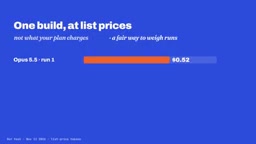
At Anthropic's listed pricing, this build consumed 52 cents worth of tokens. But running the same task again only cost 36 cents, so the average cost of the default configuration was about 44 cents. That variance itself is an important signal: single-run results just aren't reliable.
Where Does the Cost Go? Re-reading Files Is the Big Ticket
Analyzing the log from the first run revealed that about 94% of token consumption went to the agent repeatedly re-reading the same files in the conversation. The code actually written—the artifact at the top of the page—accounted for only about 2%, even though write operations have the highest per-token cost. Re-reads are cheaper per token thanks to caching, but they get re-executed every round, and a bit more content gets written each time.
So what really drives up total cost is the number of rounds. All the genuinely effective money-saving tricks essentially boil down to reducing rounds. This also explains why simply compressing output text yields so little—most of the money is spent on redundant input-side reads.
The Agent's "Re-read" Mechanism and Cache Pricing
Agent tools (like Claude Code) resend the current conversation history along with file contents read by tools to the model every round of interaction. To reduce the cost of this repeated input, Anthropic offers prompt caching: repeated prefix portions are billed at the cache-read price, typically far below the first-time input price. But caching only lowers the unit price, not the volume sent—the more rounds, the more the total volume of resent tokens still grows linearly. This is why the article observes that re-reads account for 94% of consumption: cheap per unit, but too many times. Understanding this is crucial—it means the optimization direction should be "send fewer rounds" (shorten tasks, reduce unnecessary tool calls), rather than simply compressing single-round text.
Switching Models: The Biggest Single Saving
The first variable tested was the model. Sonnet 5.5 costs half as much per token as Opus, and it completed the task in fewer rounds. The same feature cost only 11 cents, roughly a quarter of the default configuration, and it passed all nine checks with an output that looked basically identical.
Anthropic's cost page mentions that Sonnet handles most coding tasks well and is cheaper than Opus, while its model video is a bit more cautious, recommending Sonnet for well-scoped tasks and emphasizing its halved per-token price. But neither says exactly how much you'll save on a real task—and in this test, it was roughly four builds for the price of one.
If you can only change one thing, switching models offers the highest return.
Positioning Difference Between Opus and Sonnet
In Anthropic's Claude model family, Opus is the most capable, highest-priced flagship tier; Sonnet is positioned as the middle tier balancing capability and cost; Haiku is the fastest, cheapest small model. The input/output prices per million tokens typically differ by multiples between the three, and Sonnet is often reliable enough for coding tasks that are "well-scoped and clearly specified." This explains the test results: for the same task, Sonnet not only halved the unit price but also completed it in fewer rounds, creating a double saving. The trade-off is that for highly ambiguous tasks requiring extensive exploratory reasoning, Sonnet may not be as robust as Opus—so "switching models" isn't unconditionally applicable; it depends on how describable the task is.
Effort Level: Low Saves Money But Costs You, High Costs More With No Benefit
Effort level was the second variable. According to a public coding benchmark Anthropic released, low effort costs about a third of high effort with a score about eight points lower. In the actual test, low effort did save money—less than half the default configuration—making it worth using for small, clearly describable tasks.
But this was also the only run where the result looked visibly worse: the title drifted to the middle of each row, and all nine automated checks missed the problem. Only human eyes could catch it.
Adjusting in the opposite direction was completely uneconomical: high effort cost 61 cents, 39% more than default, and the app looked exactly the same. On a task of this scale, the extra "thinking" brought no visible benefit. Claude Code's own usage interface even suggests dropping from Max to High, and another line prompts you to trim your instruction files—the latter also proved effective in the test.
What Is Effort Level?
Effort level is a reasoning budget switch that tools like Claude Code expose to users, typically divided into Low, Medium, High, Max, etc. It doesn't change the model itself but controls how deeply the model performs internal reasoning (extended thinking) before responding and how aggressively it makes tool calls. Higher levels make the model spend more tokens deliberating and trying more approaches, so both unit price and rounds may increase; lower levels are faster and cheaper but more likely to "cut corners" on details. The phenomena in the article—low effort saving money but producing title misalignment, high effort costing 39% more with no visible improvement—are typical manifestations of this mechanism: the benefit depends on whether the task truly needs deep reasoning, and simple CRUD-style tasks often don't.
Third-Party Plugins and "Minimalist Prompts": Effects Are Overstated
Various add-on plugins are popular in the community; the hottest one has about 120,000 GitHub stars and claims to cut tokens by 65% by making Claude talk like a caveman. Related videos and posts even claim savings of 90% or half.
The tester didn't install anyone's code but tried the underlying idea: adding a line to the project's instruction file asking Claude to stay concise. The two runs averaged about 12% cheaper. Sounds good, but the default configuration itself varied by a third between two identical runs—the error bars overlap.

Independent verification mostly points to the same conclusion. Tests compiled by tech news site Implicator show such tools actually cut output by about 20%, not 65%. A benchmark run by a company selling a competing product did find a 19% bill reduction. And a research paper analyzing thousands of Claude Code runs found that compression tools feeding content back to Claude actually made bills about 7% higher, because the main cost there was in caching.
In other words, compressing text is at best a small saving—in this test it was even drowned out by noise.
The Principle and Limits of "Caveman-Style" Prompts and Output Compression
The idea behind such tools is to modify the system prompt or instruction file to require the model to answer in a minimal style that drops articles and conjunctions, thereby reducing output tokens. The problem is that, as the earlier cost analysis showed, output typically accounts for only a tiny fraction of total consumption—most of the overhead is in input-side repeated reads and rounds. So even if output is compressed by 60%, the reduction in the total bill is far smaller than advertised; and when shorter instructions cause the model to misunderstand and require more rounds of clarification, the savings may be offset or even reversed. Independent tests generally show actual reductions around 20%, masked by natural run-to-run variance—consistent with the article's conclusion.
Starting New Sessions: The Most Counterintuitive Conclusion
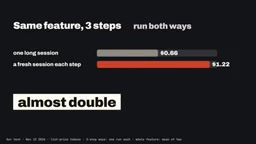
"Start a new session for every new task" is one of the most widely circulated recommendations. Anthropic's docs do say clearing a session costs nothing. But the tester split the same feature into three steps and ran it two ways:
- One long session completing all three steps: 66 cents
- A new session for each step: $1.22, nearly double
The long-session version was even more expensive than asking for the complete feature all at once. The reason lay in the tester's own instruction file—accidentally read—which required Claude to verify work using screenshots, but the test environment blocked screenshots, and Opus's reply even said it couldn't run the app and told the user to try it themselves. Each new session retried these blocked checks, and the final step spent 33 rounds just to add one filter.
The Strategies That Actually Work: Boring But Reliable
Combining all the tests, the cheapest combination is actually quite plain:
- For tasks you can describe in one sentence, switch to Sonnet—this is the highest-return single change.
- Keep effort level at Medium or Low, provided you check the screen yourself.
- Ask for the complete feature at once, rather than splitting into multiple steps.
- Stay in one session, since Anthropic's docs say clearing sessions is for unrelated work.
The tester concluded that of all the apps built, the 11-cent Sonnet version was the one they'd want to keep. If they were about to hit the quota limit tomorrow, they'd switch models first, not install plugins.
The Quota Pool Itself Is Shrinking
There's another easily overlooked variable: the quota limit itself isn't stable. According to the tester, Anthropic announced a 25% increase to Claude Code's weekly limit, but a temporary 50% boost ended the same day, so an officially confirmed reader's note described it as a 17% cut. Even if these habits save you something, the pool itself may be shrinking.
This means the value of money-saving strategies lies not just in the absolute amount but in the buffer they give you against rule changes.
Conclusion
The core takeaway from this test: when it comes to token costs, the biggest lever comes from architectural choices (which model, how many rounds), not from installing various plugins that claim to "halve" your bill. Single-run data varies enormously, and any advice without multiple repetitions deserves skepticism. Sonnet 5.5 did indeed achieve about a quarter of the default Opus configuration's cost on this real task, with no visible quality degradation—this may be the most reliable cost-saving method available right now.
Related articles

Gemini 4 Hydrogen vs Sonnet Comparison Test: Uses Only 1% of Weekly Quota, Performance on Par
Hands-on test: Gemini 4 Hydrogen vs Sonnet on the same CRUD task—Hydrogen used only 1% weekly quota with comparable performance and better UI details, while Anthropic's model used 7%. Developer says daily tasks don't require expensive models.

Gemini 4 Neon Released: Beats Opus 5.5 on Multiple Benchmarks, Google Returns to the Top Tier
Google DeepMind releases Gemini 4 Neon: 61 on the Artificial Analysis intelligence index (3rd) and 1st on the coding index, beating Opus 5.5 on multiple benchmarks. $3/$15 per million tokens; available in the Gemini API and AI Studio.

Gemini 4 Neon Review: Benchmark Scores Rival Carbon, API Cost-Performance Analysis
Full review of Google Gemini 4 Neon: benchmark scores rival Carbon, API priced at 2x Hydrogen, yet Antigravity quota consumption is only 1x (vs Carbon's 3x). Real tests show it replaces 90% of Carbon use cases. Includes channel restrictions, ban risks, and combination strategy analysis.