Claude Sonnet 5.5 Outage: What It Reveals About AI Service Stability

Claude Sonnet 5.5 had a brief error rate spike, fixed by the official team in under an hour—a reminder for developers to prioritize service resilience.
Based on the official status page RSS feed, the article reviews a service incident on Claude Sonnet 5.5 with elevated request error rates: investigation began at 09:14 UTC, a fix was deployed with monitoring at 09:38 UTC, and it was resolved at 09:56 UTC—all within an hour. The response pace is commendable—monitoring first, decisive diagnosis, and an observation window before closure. But the status page didn't disclose the root cause, making targeted fault-tolerance adjustments hard for developers. Three takeaways: make retry and fallback standard, use status page RSS for low-cost early warning, and distinguish transient errors from sustained failures in observability. Conclusion: AI service stability is a composite of compute, gateways, rate limiting, and authentication—engineering resilience remains the foundation of product reliability.
Incident Recap: Claude Sonnet 5.5 Hit by a Brief Service Disruption
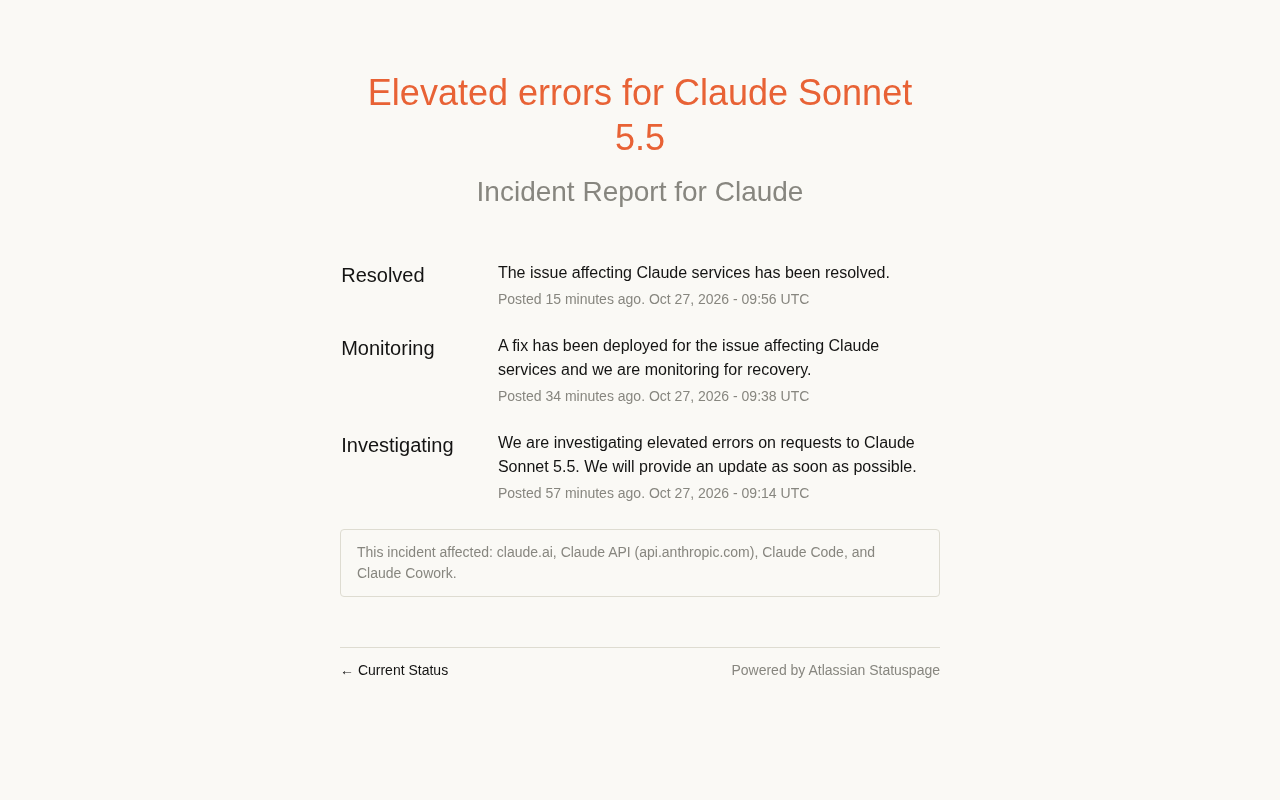
According to the RSS feed from the official status page, Claude Sonnet 5.5 recently experienced a service incident involving elevated request error rates. The status page timeline clearly documented the full handling process: at 09:14 UTC the team began investigating "elevated errors on requests to Claude Sonnet 5.5"; at 09:38 UTC the fix had been deployed and the team entered the monitoring and recovery phase; at 09:56 UTC the issue was marked as resolved.
From the start of the investigation to confirmed resolution, the whole process took less than an hour. For developers relying on LLM APIs, this level of brief fluctuation is not unusual—but it serves as another reminder: even the most mature AI services still run on engineering systems that require continuous operations and maintenance.
Breaking Down the Incident Timeline: What the Response Speed Tells Us
Looking at these three timestamps together reveals some noteworthy details.
Fast investigation start. The problem was publicly confirmed as early as 09:14, indicating that the monitoring and alerting system caught the anomalous metrics before large-scale user feedback. For API products, real-time error rate monitoring is a fundamental requirement, and this response avoided the lag of "users blowing up first, officials finding out later."
Decisive fix deployment. Entering the monitoring phase just 24 minutes later means the team pinpointed the root cause and pushed a fix, rather than repeatedly trial-and-erroring through the investigation. This pace is relatively efficient compared to incident handling at similar services.
Restrained closure. The resolution was only announced at 09:56, leaving over ten minutes of observation to confirm stable recovery—rather than immediately "declaring victory" after deployment. This caution is commendable—prematurely announcing recovery only to have the problem recur is the most awkward scenario in operations incidents.
It's worth noting that the status page wording was quite restrained: it only stated that "the issue affecting Claude services has been resolved," without disclosing whether the problem was in the model inference layer, the gateway layer, or the quota system. For external developers, the lack of root cause information means it's difficult to adjust their own fault-tolerance strategies in a targeted way.
Takeaways for Developers: Treat "Services Will Go Down" as a Default Assumption
This incident itself wasn't severe, but it provides an opportunity to re-examine architectural resilience.
Retry and Fallback Should Be Standard
Since request error rates can spike briefly, clients must have exponential backoff retry mechanisms. More critically, the fallback path: when the primary model is unavailable, can the system automatically switch to a backup model or return cached results? Designs that hardcode Sonnet 5.5 with no fallback whatsoever are fragile in real production environments.
Exponential backoff retry is a strategy of repeatedly attempting a request after failure with progressively increasing intervals, rather than immediately resending at a fixed frequency. A common implementation waits approximately base × 2^n for the nth retry, with added random jitter to avoid a "thundering herd" secondary impact from many clients retrying simultaneously. For LLM APIs, it's also necessary to distinguish retryable errors (429 rate limiting, 500/503 and other 5xx errors, connection timeouts) from non-retryable errors (400 parameter errors, 401 authentication failures). Retry counts should be capped and paired with an overall timeout budget, otherwise during sustained outages they will amplify latency and cost.
Fallback refers to switching to pre-defined alternatives when the primary path is unavailable—for example, calling a backup model, reducing parameter scale, returning cached or historical results, or showing users a clear service-busy message. The key to fallback design is defining trigger conditions and fallback levels in advance, and validating them through drills during non-incident periods, because hastily assembled fallbacks often reveal incompatible interfaces or inconsistent output formats only when things actually go wrong.
Monitor the Official Status Page
The status page RSS is an extremely low-cost early warning channel. Connecting status page updates to the team's alerting system means on-call engineers know as soon as the official "Investigating" notice is posted, rather than reacting only after user complaints. The integration effort for this kind of information source is minimal, but the benefit is direct.
Status page RSS is a standardized subscription feed where service providers publish incident timelines (Investigating / Identified / Monitoring / Resolved and other status phases), typically pollable without authentication. Compared to manually refreshing the web page, connecting it to an alerting system (e.g., scheduled polling, change-triggered notifications) can convert the "official confirmation of anomaly" signal into actionable events for the team. Two limitations to note: status page posts usually lag behind the actual failure time, and the wording may be vague without disclosing root causes—so it's better suited as an auxiliary signal rather than the sole availability criterion. A more robust approach is to cross-validate status page signals with self-built black-box probes (periodic real requests measuring error rates and latency).
Distinguish "Transient Errors" from "Sustained Failures"
Short-term error rate spikes and prolonged outages require different response strategies. The former suits retry with backoff, while the latter requires rapid traffic switching and external communication. Developers need to distinguish these two situations in their own observability systems, to avoid drowning genuinely serious problems in the same alert noise.
What a Single Incident Reveals About AI Service Operational Maturity
LLM service stability is a composite proposition: it depends both on the health of underlying compute and inference clusters, and on the reliability of peripheral components like API gateways, rate-limiting systems, and authentication chains. A fluctuation lasting less than an hour often exposes transient overload or configuration errors in a specific link, rather than a collapse of the overall architecture.
For Anthropic, transparent status page updates are a way to build trust; for developers, incorporating the provider's status page into their own operational awareness while maintaining a clear understanding that "any external dependency can fail" is the more pragmatic stance. No matter how powerful AI capabilities become, engineering resilience remains the foundation of product reliability.
One-line Summary
Claude Sonnet 5.5 experienced a brief spike in error rates, which the official team resolved in under an hour—a reminder for developers to prioritize service resilience.
Paragraph Summary
Based on the official status page RSS feed, the article reviews a service incident involving elevated request error rates on Claude Sonnet 5.5: investigation began at 09:14 UTC, a fix was deployed with monitoring at 09:38 UTC, and the issue was marked resolved at 09:56 UTC—all in under an hour. The author considers the response pace commendable—monitoring first, decisive diagnosis, and an observation window before closure, avoiding the awkwardness of premature recovery announcements. However, the status page only stated the issue was resolved without disclosing root cause, making it hard for external developers to adjust fault-tolerance strategies accordingly. The article then offers three developer takeaways: make retry and fallback standard practice, establish low-cost early warning via status page RSS, and distinguish transient errors from sustained failures in observability systems. The ultimate conclusion: AI service stability is a composite proposition spanning compute, gateways, rate limiting, authentication, and more—engineering resilience remains the foundation of product reliability.
Related articles

T3 Code: The Open-Source AI Coding Assistant's Comeback Story
T3 Code is an open-source AI coding assistant that unifies subscriptions like Codex and Claude, with powerful remote control and parallel task management.

Never Elected, Yet Ruled New York for 30 Years: The Ultimate Case Study in the Mechanics of Power
Robert Caro's biographies reveal how unelected Robert Moses ruled New York for 30 years through legal drafting and public authorities, and how Lyndon Johnson built leverage as a "powerless" Senate Majority Leader. Unpacking the underlying logic of accumulating and sustaining power.

The CPython 3.10 Recursion Trap and Synthetic Recovery in TokenGuard, an LLM Circuit Breaker
TokenGuard's author recounts a recursion crash caused by OrderedDict.pop in CPython 3.10 and introduces v0.3.0's Loop Nudge synthetic recovery, inline DLP scanning, and other new LLM agent circuit-breaker capabilities.