Claude Sonnet 5 Imminent, GPT-4.6 This Week? A Wave of Frontier Model Updates

Claude Sonnet 5, GPT-4.6 Pro, and a secret Opus 6 headline a packed week of frontier AI model releases.
This week sees an unprecedented wave of frontier AI model updates. Anthropic's Claude Sonnet 5 appears imminent with potential 2M token context and stunning SVG generation, while a mysterious model stronger than Opus 5 has been trained internally. OpenAI's GPT-4.6 Pro is expected Thursday with remarkable code generation capabilities, alongside a new real-time voice model BDI-1. Japanese lab Sakana enters with Fugu Ultra, an orchestration system offering 80% cost reduction over Opus 4.
This week the AI world is seeing a flurry of major announcements: Anthropic's Claude Sonnet 5 appears to be on the verge of release, a mysterious model stronger than Opus has surfaced, OpenAI's GPT-4.6 Pro may launch this week, and Japanese lab Sakana is entering the arena with new models. Let's break down each of these exciting developments.
Claude Sonnet 5: A Major Upgrade to Anthropic's Workhorse Model
According to the latest leaked information, Claude Sonnet 5 (codenamed CodeSonic v5) has appeared as a Model Slug on Anthropic's partner provider platforms. A Model Slug is the unique identifier assigned to each model in an AI provider's API system (e.g., claude-3-sonnet-20240229). Its appearance on partner platforms means the model has completed internal red-team testing, safety evaluations, and API integration testing, and is now in the final deployment verification stage. Based on past experience, when a model identifier starts appearing in partner projects, it typically signals 5 to 7 days before official release—suggesting Sonnet 5 could be available to the public this week.
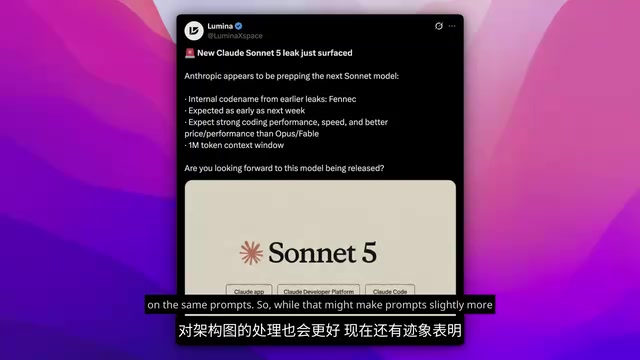
As Anthropic's primary everyday model, Sonnet is the core tool most users actually rely on for coding, writing, agents, and various workflows. This upgrade to version 5 is expected to bring the following key improvements:
- Larger context window: Potentially expanding to 1 million to 2 million tokens. The context window refers to the maximum number of tokens a model can process in a single conversation. From the 4K tokens of the early GPT-3 era to today's million-level capacity, this means the model can read an entire book, analyze a complete codebase, or process hours of meeting transcripts in one go. However, expanding the context window faces the "Lost in the Middle" problem—the model's attention to the middle portions of very long inputs tends to drop. Solving this requires improvements to positional encoding (such as RoPE extensions) and attention mechanism architectures.
- Stronger vision capabilities: Better understanding of UI mockups and improved architecture diagram processing
- Significantly improved reasoning: At the cost of roughly 30% more token consumption for the same prompt
- Enhanced multimodal understanding: A major leap in overall experience compared to the current Sonnet
Sonnet 5's SVG Generation Is Stunning
Early testing shows that Sonnet 5's SVG generation capabilities are remarkable—without any reference images provided, it can generate device SVG graphics approaching photorealistic quality, such as a high-quality Nintendo Switch 2 render.
SVG (Scalable Vector Graphics) is an XML-based vector graphics format composed of mathematical paths rather than pixels. The difficulty of AI-generated SVG lies in the model needing to understand spatial geometric relationships, color gradients, Bézier curve paths, and other abstract concepts, then translate visual cognition into precise coordinates and path code. Traditionally this requires professional design software like Illustrator and manual work. A model generating high-quality SVG directly from text descriptions means it has established a strong mapping from semantic space to geometric space. This improvement in design output capability is hugely significant for frontend developers and designers.
The Mysterious Opus 6: A Model Stronger Than Opus 5 Already Exists
Even more shocking is news from reliable leak sources that Anthropic has internally trained a new version stronger than Opus 5 (the previously restricted model). It's unclear whether it will be named Opus 5.1, Opus 6, or something else, but performance has indeed taken another step forward.

There's an important mental model update here: Even if a model hasn't been released to the public, that doesn't mean R&D has stalled. In fact, when a model is restricted from public use, the compute and resources originally dedicated to serving users can be redirected back into training, testing, and next-generation model development—potentially accelerating progress.
This new model is expected to be stronger in the following areas:
- Long-horizon reasoning and reinforcement learning: Reinforcement learning in large model training is primarily implemented through RLHF (Reinforcement Learning from Human Feedback) and RLVR (Reinforcement Learning from Verifiable Rewards). The former uses human preference data to train reward models that guide policy optimization, while the latter leverages automatically verifiable tasks like mathematical proofs and code execution to provide precise feedback signals. DeepSeekAd-R1 and OpenAI's o-series models have already demonstrated that large-scale RL training can significantly improve the quality of a model's reasoning chains, especially on complex tasks requiring multi-step planning.
- Further improvements in coding ability
- Enhanced planning capabilities
- Reliable execution of large-scale tasks
The real question is how Anthropic will release it—through limited access via Project Last Think, as a future public model, or kept behind the scenes to accelerate development of next-generation systems.
GPT-4.6 Pro: OpenAI's Big Release This Week
On the OpenAI side, GPT-4.6 Pro is expected to launch this week, possibly as early as Thursday. Based on leaked test results, this model shows significant improvements across multiple dimensions:
- Notably enhanced frontend capabilities: Improved design aesthetics, no longer just generating basic web pages
- Greater creativity: More creative completion of content based on prompts, with reduced "laziness"
- Stunning code generation: In testing, it generated a complete first-person playable indoor house in a ~700KB HTML file in about 40 minutes, including multiple rooms, a coherent floor plan, and a smooth movement system
Based on leaked test results, GPT-4.6 Pro will most likely be discussed in the same tier as Opus 5.
New Voice Model: GPT BDI-1
OpenAI is also preparing a new voice model called BDI (with a knowledge cutoff of August 2025), representing the first major voice upgrade since GPT-4o.

The core feature of this model is real-time interaction—it no longer waits for you to finish speaking before responding. Instead, it can naturally interrupt, count along with you as you speak, keep up with an entire conversation, and even correct you mid-sentence when you make a mistake.
Traditional voice AI uses a cascaded architecture: ASR (speech recognition) → LLM (language processing) → TTS (speech synthesis), with each stage introducing latency. The end-to-end multimodal approach pioneered by GPT-4o treats speech directly as an input/output modality of the model, eliminating intermediate conversion delays. Real-time interruption (barge-in) capability requires the model to perform full-duplex processing of "listening" and "speaking" simultaneously, demanding extremely low inference latency (typically first-token latency below 300ms). This architecture evolves AI conversation from "turn-based" to truly natural dialogue. Think of it as Gemini's Live Mode, but without as many modalities yet. It has already started rolling out to some ChatGPT App users.
Sakana AI: A Japanese Lab's New Approach to Orchestration
Finally, there's a new player—Japanese AI lab Sakana has released two models: Fugu and Fugu Ultra. Interestingly, they're not ordinary natural language models.

Fugu is more of an orchestration system, specifically trained to operate and coordinate other large language models. It can route tasks, combine different models, and use multiple systems in concert to achieve better results.
An Orchestration System represents a "meta-AI" approach: rather than training one omnipotent model, train a system that excels at dispatching and combining other models. This is similar to an API gateway or workflow engine in microservices architecture. Specific implementations include: intelligent routing (selecting the optimal model based on task type), result fusion (synthesizing outputs from multiple models), and cost optimization (balancing quality and expense). The core assumption is that different models have different strengths, and intelligent combination outperforms any single model. This approach is similar to OpenRouter's Fusion API and represents an important direction in AI development.
Fugu Ultra vs. Claude Opus 4: Real-World Comparison
Sakana claims Fugu Ultra is on par with Claude Opus 5 across seven benchmarks, but actual testing suggests these claims are overly optimistic. A comparison using a Crossy Road-style game generation test is illustrative:
| Metric | Claude Opus 4 | Fugu Ultra |
|---|---|---|
| Time | 79 minutes | 22 minutes |
| Token consumption | ~940K | ~90K |
| Cost | ~$37.85 | ~$7.32 |
| Quality | Better (but got stuck twice) | Flawed (inverted controls, etc.) |
Fugu Ultra's advantage lies in speed and cost efficiency—token consumption is only one-tenth of Opus 4's, cost is reduced by about 80%, and time is cut to one-quarter. But there's still a gap in final quality. However, as an orchestration system concept, it represents a technical approach worth watching: the future of AI competition may not just be about individual model capabilities, but about system-level architectural design.
This Week's AI Model Update Summary and Outlook
This week may be the most packed week for AI model releases in recent memory. Anthropic and OpenAI are rolling out major updates almost simultaneously, while new entrants like Sakana are making the competitive landscape more diverse.
The capability boundaries of frontier models are being pushed forward rapidly—from code generation to voice interaction, from visual understanding to task orchestration, AI's practical utility is undergoing a qualitative leap. Notably, the current competition is no longer just about parameter scale, but encompasses a full-spectrum contest across training methods (RL vs. pure pretraining), system architecture (single model vs. orchestration systems), and interaction paradigms (text vs. real-time multimodal). For developers and users alike, closely following this week's official release announcements will be crucial.
Related articles
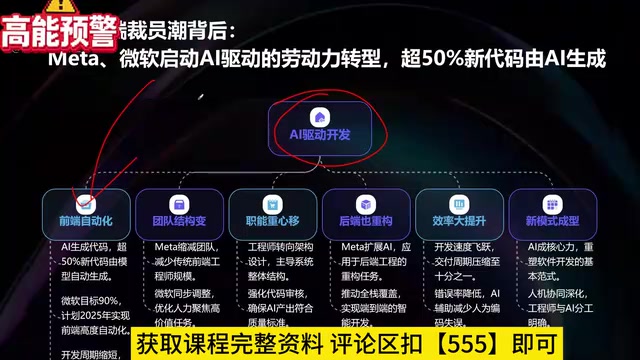
What Is Vibe Coding? The AI Programming Skill Every Developer Needs
What is Vibe Coding? Learn how AI programming is reshaping dev teams, why traditional programmers face displacement, and why Cursor & Claude Code matter.
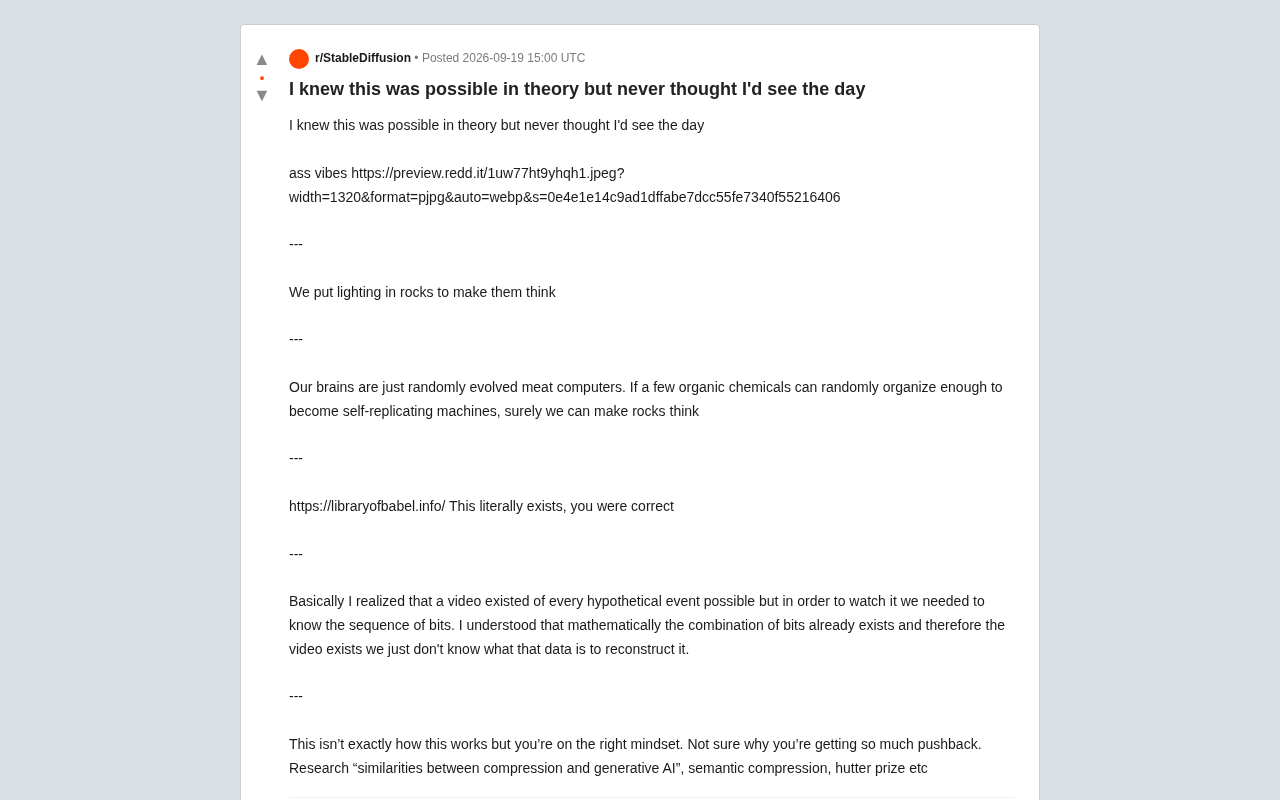
Making Rocks Think: A Philosophical Exploration of Generative AI and Information Compression
From a viral Reddit post to deep AI theory: why compression equals understanding, the Library of Babel thought experiment, semantic compression, and the Hutter Prize.

Irregular Warns: Four AI Lab Security Breaches Traced to the Same Root Cause
Irregular reveals four AI lab security breaches share a single root cause, exposing systemic risks from technology stack homogeneity across the AI industry.