Claude Sonnet 5 Leaked, Zhipu Hits HK$1 Trillion Market Cap: AI Industry Roundup for June 23

Claude Sonnet 5 leaks, Zhipu crosses HK$1T, and AI orchestration heats up on a packed June 23.
On June 23, the AI industry saw Claude Sonnet 5 leaked with a 1M-token context window, Zhipu's market cap surpassing HK$1 trillion after a 2000%+ post-IPO surge, Alibaba releasing Happy Horse 1.1 for video generation, and Sakana AI unveiling a multi-model orchestration system. OpenAI also upgraded real-time voice chat while Doubao gray-tested ride-hailing via AI agents.
June 23 brought a packed day for the AI industry: new model leaks from overseas, a domestic player's market cap crossing the trillion mark, continued iteration on video generation and multi-model orchestration — the competitive pace is clearly accelerating. Here's a breakdown of the day's key events.
Claude Sonnet 5 Leaked: 1M Context Window Takes Center Stage
According to overseas tech outlet Nomina, details about Anthropic's next-generation model Claude Sonnet 5 have surfaced. The model's internal codename is "Fennec," and it has reportedly appeared in the backend systems of select partner companies — typically a sign that an official launch is imminent.
The two most notable features from the leak: a 1-million-token context window, and better overall value than the existing Opus and Sonnet lines. If accurate, this means Anthropic is bringing long-context capabilities — previously reserved for the high-end Opus line — down to its mainstream Sonnet series, while further optimizing cost structure.
The context window refers to the maximum amount of text a model can process in a single inference pass. Early GPT-3 had a context window of just 4K tokens, where 1 token roughly corresponds to 0.75 English words or 1.5 Chinese characters. From an architectural standpoint, achieving very long contexts requires solving the quadratic complexity problem in Transformer attention mechanisms — as sequence length grows, compute and memory usage scale quadratically. Anthropic reached 200K tokens in the Claude 3 series through improved positional encoding and sparse attention techniques. A 1M token window means the model could process roughly 750,000 English words in one pass — equivalent to a full-length novel or a mid-sized codebase.
The combination of long context and competitive pricing addresses the two dimensions enterprise customers care about most: the former determines whether a model can handle complete documents, codebases, or extended conversations; the latter determines whether large-scale deployment is economically viable. The Sonnet line has always been Anthropic's highest-volume product, making this upgrade strategically significant.
Zhipu Crosses HK$1 Trillion: Stock Up Over 20x Since IPO
Domestic large model company Zhipu (GLM) had a landmark moment in the capital markets. Following the release of GLM 5.2, its stock has been climbing steadily. On June 23, it approached HK$3,000 per share intraday, with market cap briefly crossing HK$1 trillion — reaching HK$1.08 trillion by 4 PM.
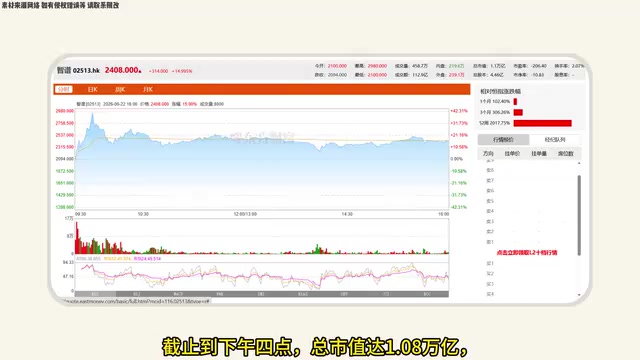
Even more striking is the magnitude of the gain: since its Hong Kong listing in January, Zhipu's stock has risen more than 2,000%. For comparison, MiniMax — which went public around the same time — currently sits at roughly HK$200 billion, a stark contrast.
Zhipu's surge reflects both investor optimism about the commercialization of domestic large models and genuine recognition of the GLM series' capability improvements and real-world deployments. That said, a run-up this steep in such a short time warrants caution about sentiment-driven premiums — whether fundamentals can sustain these levels remains to be seen.
Alibaba Releases Video Model Happy Horse 1.1
Alibaba officially launched Happy Horse 1.1, a video generation model, alongside the "Happy Horse Global AI Image Competition." As an iteration of version 1.0, the upgrade focuses on:
- Noticeably improved subject consistency and expressiveness;
- Enhanced instruction-following, with systematic improvements to visual quality;
- Support for 720p to 1080p resolution output;
- Video generation up to 15 seconds in length.

The latest version is now live on the Happy Horse website and the Bailian platform. Competition in the video generation space is fierce — subject consistency and longer durations have long been recognized as industry-wide pain points, and the targeted improvements in 1.1 show Alibaba continuing to push toward the top tier. Launching a global creative competition simultaneously is a familiar playbook for expanding model reach through the creator ecosystem.
Separately, Qwen officially announced that the Qwen 3.7 Max promotional period would end at 11 PM that night, with a new product teased for 10 PM the following evening. Based on the cadence of Qwen 3.5, 3.6, and 3.7 releases, the new product is likely Qwen 3.8 Max — worth watching.
Sakana AI Launches Multi-Model Orchestration System
Japanese AI lab Sakana AI released two products — Sata Fugu and Fugu Ultra — positioned as "multi-model orchestration systems": models specifically designed to schedule and coordinate other large language models.

Multi-model orchestration draws from microservices architecture thinking applied to AI. Different LLMs have meaningfully different strengths across tasks: some excel at mathematical reasoning, others at code generation or creative writing. The core of an orchestration system is the "routing decision" — determining which model is best suited for a given task and managing context passing across multiple model calls. Key technical challenges include latency accumulation (multiple API calls increasing response time), context synchronization (maintaining conversational coherence across models), and cost control. Sakana AI's approach is to train a dedicated "orchestration model" for routing decisions rather than relying on hard-coded rules.
According to the announcement, the system performs close to flagship models like Claude on multiple benchmarks covering code, reasoning, and other tasks. Many in the industry believe multi-model orchestration is an important direction for the future: rather than relying on a single model for everything, a "conductor" model dynamically routes tasks to the most suitable specialist.
This approach shares a common thread with OpenRouter's recently launched Fusion API. As the number of available models explodes and each excels at different tasks, "which model to use" is itself becoming a decision that requires intelligent handling. Sakana AI currently offers the system via API.
OpenAI Upgrades Voice Chat; Doubao Gray-Tests Ride-Hailing
On the application side, OpenAI rolled out a new voice conversation mode to select mobile ChatGPT users. The key breakthrough in this update is bidirectional real-time AI interaction — the ability to listen and respond simultaneously, breaking free from the stop-and-go feel of traditional voice Q&A and significantly improving conversational naturalness. The feature is still in limited testing.

On the domestic front, Doubao is reportedly gray-testing a ride-hailing feature: users simply tell Doubao their destination and can book a ride directly, with the service powered by Caocao Mobility. The feature is currently only available in select cities including Beijing and Hangzhou.
AI Agents are AI systems that can perceive their environment, plan autonomously, and execute multi-step tasks — distinct from traditional question-and-answer AI assistants. Doubao's ride-hailing integration is a textbook example of the agentic architecture: intent understanding (recognizing the user wants a ride) → parameter extraction (destination, time) → tool call (invoking the Caocao Mobility API) → result feedback. This architecture relies on Function Calling or Tool Use capabilities, enabling the model to translate natural language intent into structured API requests. The main challenge for real-world agent deployment remains reliability — errors in multi-step tasks compound, and ensuring accuracy in actual transactional scenarios is the core engineering challenge.
Doubao's ride-hailing integration is another concrete example of AI assistants evolving toward full agent behavior — no longer just answering questions, but completing full task loops by calling external services. These scenario-specific deployments are becoming the new battleground for domestic large model applications.
Summary
From Claude Sonnet 5's long-context upgrade to Zhipu's trillion-dollar capital moment, to ongoing iteration across video generation, multi-model orchestration, and voice interaction — June 23's industry news clearly traces several converging trends: model capabilities evolving toward longer context and better cost efficiency; domestic players accelerating their path to capital markets; and the application layer pushing deeper into agentic and multimodal deployments. The competition continues to accelerate — worth watching closely.
Key Takeaways
Related articles

uGAP: An AI Platform Unifying 100+ African Geospatial Datasets
uGAP is an African geospatial AI platform by a University of Cape Town team, unifying 120+ African datasets with a Python SDK for discovery, processing, and model training, already used in cyclone flood mapping.

Cursor Can Now Control Your Computer: AI Agents Can Drive Desktop Apps for Testing
Cursor adds desktop control: AI agents can drive desktop apps like the iOS Simulator to test their own features. We analyze the impact on dev workflows, possible technical approaches, and reliability concerns.

Vibecoding a Custom Inference Engine: High Hopes, Harsh Reality
A Reddit developer shares the real experience of vibecoding a custom inference engine: running GGUF Q4 models in the browser with WebGL2 and GLSL, only to fall into tokenizer debugging hell. This article analyzes the engineering challenges of browser-side LLM inference and why cloning llama.cpp is the more rational choice.