Claude Tag Lands 65% of Anthropic's Product PRs: Takeaways From the Cat Wu and Thariq Shihipar Interview
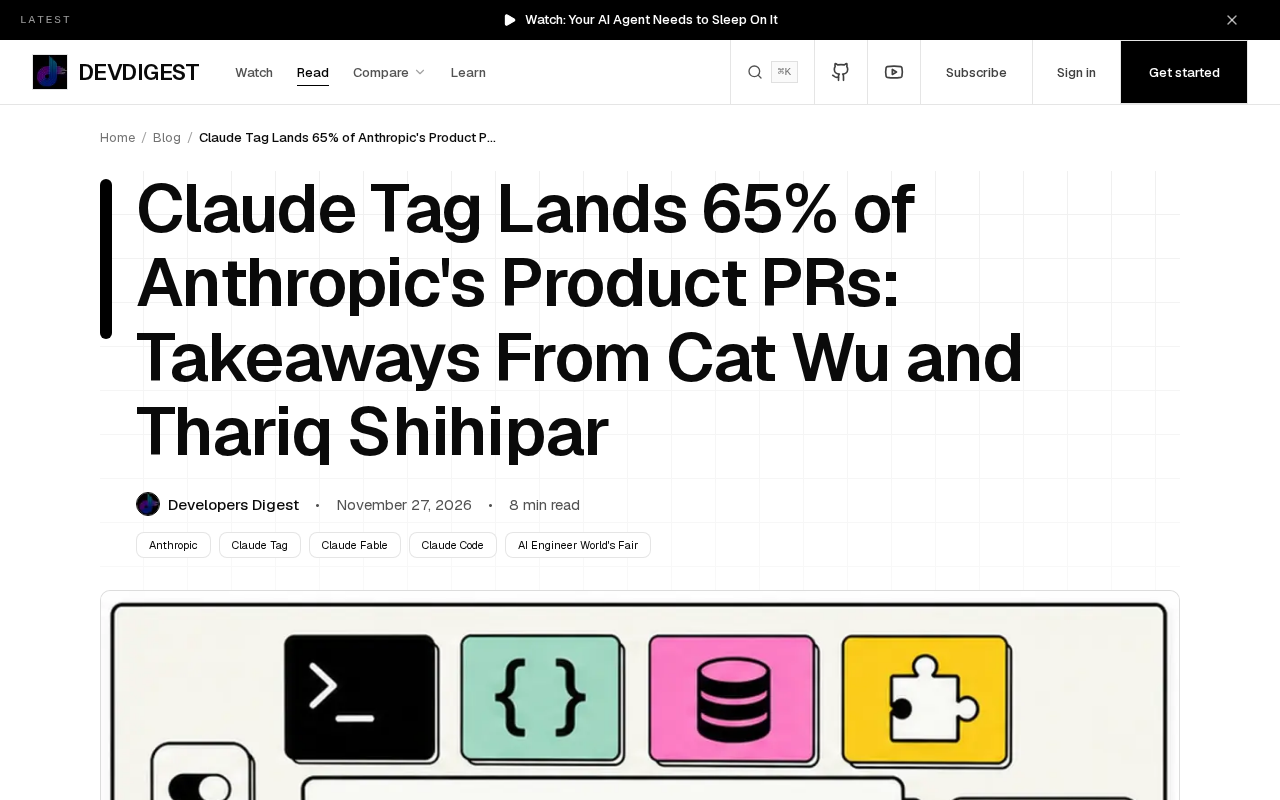
65% of Anthropic's product PRs now come from Claude Tag, as AI moves from assisting coding to leading delivery.
In a Simon Willison interview, Anthropic's Cat Wu and Thariq Shihipar revealed that Claude Tag now handles 65% of PR submissions in product engineering. This output share—not penetration rate—shows engineers shifting from writing code to reviewing it and setting direction, a strong signal that AI-generated code has crossed the practical threshold. The interview also argues rewriting is now a good choice when generation costs approach zero, provided there is sufficient testing and human review.
Anthropic's product engineering workflow is being reshaped by its own AI tools. In an interview hosted by Simon Willison, Anthropic product team members Cat Wu and Thariq Shihipar shared a key data point: Claude Tag is now responsible for 65% of the PR (Pull Request) submissions in the company's product engineering. This figure goes far beyond "assisted coding" and points to a more thorough shift in the development paradigm.
What a 65% PR share means
65% is not a "penetration rate" metric—it's a share of output. It indicates that most code changes in Anthropic's product team—from feature iterations to bug fixes—are already generated or led by Claude Tag. The human engineer's role has shifted from "writing code" to "reviewing code" and "setting direction."
This ratio is worth attention because it comes from a company with the clearest understanding of AI capability boundaries. Anthropic has one of the industry's strictest internal understandings of model hallucination, safety, and reliability, yet it still hands the bulk of product engineering to AI. This constitutes a strong signal: within controlled engineering workflows, the reliability of AI-generated code has crossed the practical threshold.
It should be noted that "product engineering" typically refers to user-facing feature development, not low-level infrastructure or safety-sensitive modules. The 65% figure reflects maturity in a specific context, not a full-scale replacement.
Pull Request (PR) is a core mechanism of modern software collaboration: after a developer completes code changes on a separate branch, they submit a merge request to the main codebase, which is only merged after code review and automated tests pass. PR submission volume is therefore often used as a metric of "actual output," rather than easily distorted numbers like lines of code or activity levels. Saying Claude Tag handles 65% of PRs means it produces reviewable, mergeable code units across the full change lifecycle—not just snippet suggestions in the editor. This also explains why the figure is more persuasive than a "penetration rate": it counts deliverables that enter the formal delivery pipeline.
Fable: a project mentioned in passing
During the interview, Cat Wu and Thariq Shihipar also talked about Fable. The original information did not elaborate on Fable's specific form, but from context it is one of the projects Anthropic's product side is advancing, related to how the team builds products with Claude.
The appearance of Fable itself shows that Anthropic is running product experiments with its own models—both as a tool and as a testing ground. This "eating your own dog food" model lets the product team expose the model's shortcomings in real development scenarios at the earliest opportunity.
Why "rewriting" is better now
One counterintuitive point in the interview: rewriting is now a good choice.
In traditional engineering consensus, rewriting a codebase is extremely risky—Joel Spolsky's famous "rewriting is the biggest mistake in software engineering" influenced a generation. But when AI can generate equivalent functionality in a short time, the cost structure of rewriting is completely changed: rather than patching legacy code line by line, it's better to have the model regenerate based on clear specifications.
According to Cat Wu and Thariq Shihipar, Claude's ability to understand intent and generate structured code has turned "starting over" from a luxury option into a rational strategy. Of course, this judgment holds only on the premise of sufficient test coverage and human review as a safety net.
Joel Spolsky's "rewriting is the biggest mistake in software engineering" comes from his 2000 article "Things You Should Never Do, Part I," which uses Netscape's abandonment of a mature codebase and from-scratch rewrite of its browser—ultimately losing the market—as a cautionary tale. Its core argument: legacy code accumulates a great deal of undocumented tacit knowledge and bug fixes, and rewriting discards that experience along with it; the old code "looks ugly" precisely because it has been fixed to be correct enough. The article was so influential that "don't rewrite" became a default rule for a generation of engineers. Understanding this background is necessary to appreciate the counterintuitive nature of "rewriting is now a good choice" in the interview: AI does not eliminate the risk of losing tacit knowledge, but changes the risk-reward tradeoff through lower-cost specification expression and test generation.
The cultural undertone at Anthropic
Another thread in the interview is Anthropic's culture. The two interviewees mentioned several characteristics of their way of working: maintaining honest assessments of model capabilities, tolerating rapid trial and error, and embedding safety considerations into daily workflows rather than patching them in afterward.
This culture explains why Claude Tag can land 65% of PRs—not through mandates, but because the tool proved itself in real workflows. Engineers vote with their feet, provided the tool is genuinely good.
Dogfooding refers to a company using its own products as internal work tools first. This practice originates from Microsoft's tradition in the 1980s of promoting its own software internally, and has now become standard practice for AI companies. Its value lies in creating a short feedback loop: internal users can expose failure modes in real tasks at the earliest opportunity, and feedback goes directly to the model and product teams without passing through customer support or sales chains. For Anthropic, the product team is both a user of Claude and a source of requirements; this dual identity lets model capability gaps be discovered before release, and lets usage data like 65% be truly observed rather than estimated.
Three takeaways for the industry
First, the competitive focus of AI coding tools is shifting from "completion" to "delivery." The 65% PR share shows that Claude Tag is not just autocomplete in the IDE, but an agent that can produce mergeable code end to end.
Second, the economics of rewriting need to be recalculated. When generation costs approach zero, the hidden costs of maintaining legacy code become more conspicuous. Teams can consider refactoring more aggressively.
Third, internal dogfooding is a key loop for model evolution. Anthropic treats its own product team as the model's first users; this close-range feedback is irreplaceable by external customer data.
The interview did not provide specific architectural details or deployment scale for Claude Tag, but the 65% figure itself is persuasive enough. For teams evaluating AI coding tools, a question worth asking is: is your workflow ready for "AI output as the main body, human review as the supplement"?
One-line Summary
65% of Anthropic's product team PRs are now produced by Claude Tag, as AI shifts from assisted coding to leading delivery.
Paragraph Summary
In an interview hosted by Simon Willison, Anthropic product team members Cat Wu and Thariq Shihipar revealed that Claude Tag now handles 65% of PR submissions in the company's product engineering. This output-share—rather than penetration-rate—figure shows that engineers' roles are shifting from writing code to reviewing code and setting direction, and coming from the team with the clearest understanding of model capability boundaries, it is a strong signal that AI-generated code has crossed the practical threshold. The interview also offers the counterintuitive view that "rewriting is now a good choice": when generation costs approach zero, the economics of rewriting are rewritten—provided there is sufficient test coverage and human review. The article also discusses the Fable project, Anthropic's dogfooding and rapid-trial culture, and distills three takeaways: the competitive focus is shifting from completion to delivery, refactoring costs need recalculation, and internal dogfooding is a key loop for model evolution.
Related articles

A 19-Year-Old's Rental Horror Story: Ceiling Collapse, Bug Infestation, and the Lessons It Taught Me
At 19, my first off-campus rental brought bug infestations, no heat, a collapsed ceiling, and a ruined laptop with no renter's insurance. Here are the hard-won lessons for first-time student renters.

Veda Nurse's Cranial Nerve Exam: Why ASMR Role-Play Is Going Viral
Bilibili creator Veda's cranial nerve exam ASMR video goes viral, blending humor and sensory triggers through nurse role-play. This article analyzes its unique appeal and the audience psychology behind ASMR role-play.

LG Cinebeam AI Review: 120-Inch Giant Screen + 3000 Lumens, a New Choice for the Living Room Theater
LG Cinebeam AI projector review: 3000 ANSI lumens, 4K, 100 inches from about 8 cm and 120 inches from about 18 cm. Built-in webOS, AI Concierge voice recommendations, AI Sound Pro 11.1.2 virtual surround, and Game Optimizer—positioned for fixed living room installation, complementing the portable Cinebeam S.