Claude Teams Up with Mathematicians to Formally Verify the Riemann Hypothesis? A 250,000-Page Proof Sparks Debate
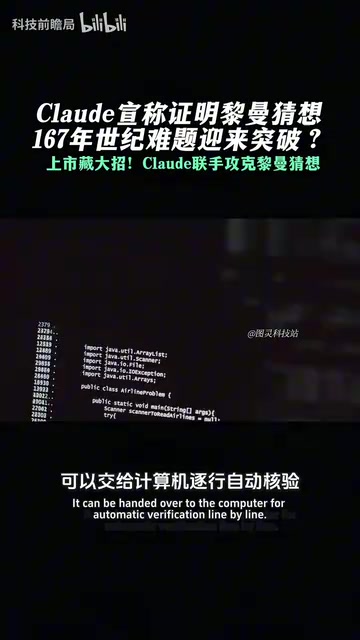
Claude was claimed to have completed a Lean formal proof of the Riemann Hypothesis; authenticity awaits global mathematician review.
The article recaps a Bilibili news flash: Anthropic's Claude was claimed to have collaborated with mathematicians to complete a Lean formal proof of the Riemann Hypothesis and the Generalized Riemann Hypothesis, with over 250,000 pages and 17 million lines of code, now being cross-checked by mathematicians worldwide with no conclusion yet. It then explains the origin of the Riemann Hypothesis—Riemann constructed the Zeta function via analytic continuation and conjectured that all nontrivial zeros lie on the critical line with real part one-half—and notes that over a thousand mathematical propositions rest on this premise. The article emphasizes that Lean only verifies code logic, not mathematical acceptance; if the formalization deviates in stating the proposition, machine verification passing is meaningless. Terence Tao also noted that a full peer review will take a long time. The conclusion: until verification is complete, everything is just a claim.
Event Recap: A Claim That Shook the Math World
According to a news flash posted by a Bilibili creator, Anthropic's Claude was claimed to have collaborated with mathematicians to complete a Lean formal proof of the Riemann Hypothesis and the Generalized Riemann Hypothesis. There is no traditional full paper—the text version exceeds 250,000 pages, written entirely in the Lean formal language, totaling over 17 million lines of code, which can be automatically verified line by line by a computer. Mathematicians worldwide are currently cross-checking the results, and no final conclusion has been reached.
Once the news broke, the community quickly split into two camps: one side views this as a milestone of AI entering top-tier pure mathematics research, while the other questions its authenticity, suspecting it may be a massive blunder.
The Generalized Riemann Hypothesis (GRH) is a generalization of the Riemann Hypothesis, targeting Dirichlet L-functions—replacing the integer terms in the Riemann Zeta function with Dirichlet characters modulo some integer $q$. GRH asserts that the nontrivial zeros of these L-functions also lie on the critical line. Its applications are broader than the original conjecture, involving the distribution of primes in arithmetic progressions, estimates of class numbers of quadratic fields, and more. If GRH holds, the complexity analysis of many number-theoretic algorithms can be significantly tightened—for example, certain heuristic primality-testing algorithms would gain rigorous guarantees. Therefore, if "proving both the Riemann Hypothesis and the Generalized Riemann Hypothesis" is true, its impact would far exceed that of a single conjecture.
The Riemann Hypothesis: The Underlying Code of Prime Distribution
To understand the weight of this matter, we must go back to 1859. While studying Euler's product formula, Riemann found that the original function does not converge in the negative region, so he used analytic continuation to complete the function's graph and constructed the famous Riemann Zeta function. He set the function equal to zero to find its roots, some of which are trivial zeros, and he conjectured that all remaining nontrivial zeros lie on the critical line in the complex plane where the real part equals one-half.
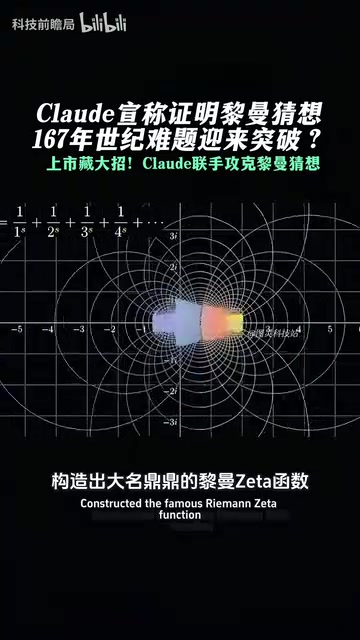
Simply put, the Riemann Hypothesis is essentially the underlying code of prime distribution. Primes appear random and scattered, but the conjecture asserts that their distribution follows a strictly hidden pattern.
The reason this conjecture carries such weight is that over a thousand propositions in mathematics currently rest on the premise that it holds. If the proof is genuine, those thousand-plus assumptions would directly upgrade to formal theorems, and it could even potentially drive the unification of quantum mechanics and general relativity.
Analytic continuation is a core technique in complex analysis: the Riemann Zeta function is initially defined by the Dirichlet series $\sum n^{-s}$, which converges only in the region of the complex plane where the real part is greater than 1. Through analytic continuation, Riemann extended the domain of this function to the entire complex plane except $s=1$, making it a meromorphic function that is analytic everywhere except for a single simple pole. Only with the extended function can one discuss zeros in the region where the real part is less than 1. Trivial zeros refer to the points $s=-2,-4,-6,\dots$—negative even integers whose properties are known and pose no difficulty; nontrivial zeros all lie within the critical strip $0<\operatorname{Re}(s)<1$, and the Riemann Hypothesis asserts that they all fall exactly on the critical line $\operatorname{Re}(s)=\tfrac{1}{2}$.
Formal Verification: Verifying Code Is Not the Same as Academic Acceptance
A key point must be emphasized here: this is currently only a claimed proof. Lean can only verify whether the code logic has flaws—it does not mean the human mathematics community has accepted it. The significance of formal proof lies in translating every step of reasoning into machine-checkable code, theoretically eliminating logical gaps and hidden assumptions. But the problem is that correct code does not mean correct mathematical meaning—if the formalization deviates in its statement of the original proposition, machine verification passing is meaningless.
Fields Medalist Terence Tao also mentioned that reading through the entire proof and completing a full peer review will take a long time. With 250,000 pages and over 17 million lines, it is nearly impossible for humans to read through, posing an unprecedented challenge to peer review.

Lean is an interactive theorem prover and also a dependently typed functional programming language, led by Leonardo de Moura at Microsoft Research. Its accompanying mathematics library mathlib has accumulated a large body of formalized mathematical results. In Lean, propositions are written as types and proofs as terms of that type; as long as the type checker passes, the proof is valid within the formal system. The key premise is that the formalization must faithfully correspond to the original mathematical proposition. If the statement of the Riemann Hypothesis is written incorrectly—for example, missing a quantifier or getting the domain of analytic continuation wrong—then the checker is only verifying a different proposition. Therefore, formal proofs typically require double verification of both "statement correctness" and "proof correctness."
AI and Pure Mathematics: A New Era or a Blunder?
On one hand, AI is entering top-tier pure mathematics research; on the other, the proof is so massive that humans can barely read through it. Is this the starting point of a new era in mathematics, or a massive blunder?
From an optimistic perspective, if the formal proof withstands scrutiny, it demonstrates AI's potential to assist humans in handling ultra-large-scale logical verification—not replacing mathematicians in proposing conjectures, but taking on workloads in the verification stage that are beyond human capacity. From a cautious perspective, until cross-checking is complete, any claim is just a claim. The history of mathematics is not short on dramatic reversals, and the public would do well to stay both interested and patient.
What do you think? Feel free to share your thoughts in the comments.
Related articles

ChatGPT Plus Subscription Pitfall Guide: Go/Plus/Pro Tier Comparison and Quick Activation
A complete ChatGPT Plus subscription guide based on a Bilibili tutorial: from registering an account, comparing Go/Plus/Pro tiers, to the practical steps for quickly completing your subscription.

GPT-6.2 Sol/Astra Released! A Step-by-Step ChatGPT Plus Subscription Guide and Tier Comparison
GPT-6.2 Sol/Astra is out—here's a ChatGPT Plus subscription guide: register an account, compare Go/Plus/Pro tiers, and subscribe in a minute.

Comparing Three Channels for Subscribing to GPT Plus in China: Is Website Top-Up the Easiest?
How to subscribe to GPT Plus in China? This article compares website top-up, credit card, and mobile top-up channels—process, cost, and risk—with steps and tips to help you choose wisely.