Cleverly Using the H3 Video Model to Generate 360° Character Reference Sheets: Solving the AI Character Consistency Challenge

Leveraging H3 video model's frame coherence to generate consistent 360° character reference sheets for AI art.
A creative workflow uses Tencent's H3 video model to generate 360° character reference sheets by exploiting the model's natural inter-frame coherence. Instead of struggling with character consistency across independent image generations, this approach generates a slow-rotation video and extracts consistent multi-angle views. Available in 4-panel and 6-panel versions, the workflow accepts up to 9 reference images and includes an Anime2Real variant, though it faces tradeoffs in speed, quality, and resolution.
Introduction: From Video Models to Character Consistency Tools
In the field of AI image generation, character consistency has always been one of the biggest challenges creators face. Whether it's comic creation, game concept art, or animation production, keeping the same character visually unified across different scenes and angles remains a persistent technical hurdle.
The root cause lies in the random sampling mechanism of Diffusion Models. Each time an image is generated, the model progressively denoises starting from Gaussian noise. Even with identical text prompts, different random seeds lead to entirely different sampling paths, producing outputs with significant visual differences. Current industry solutions include IP-Adapter (injecting reference features via image encoders), LoRA fine-tuning (training low-rank adapters for specific characters), and ControlNet guidance. However, each has its limitations: IP-Adapter tends to lose details at extreme angle changes, LoRA requires collecting training data and consumes training time, and ControlNet needs pre-prepared skeleton or depth maps.
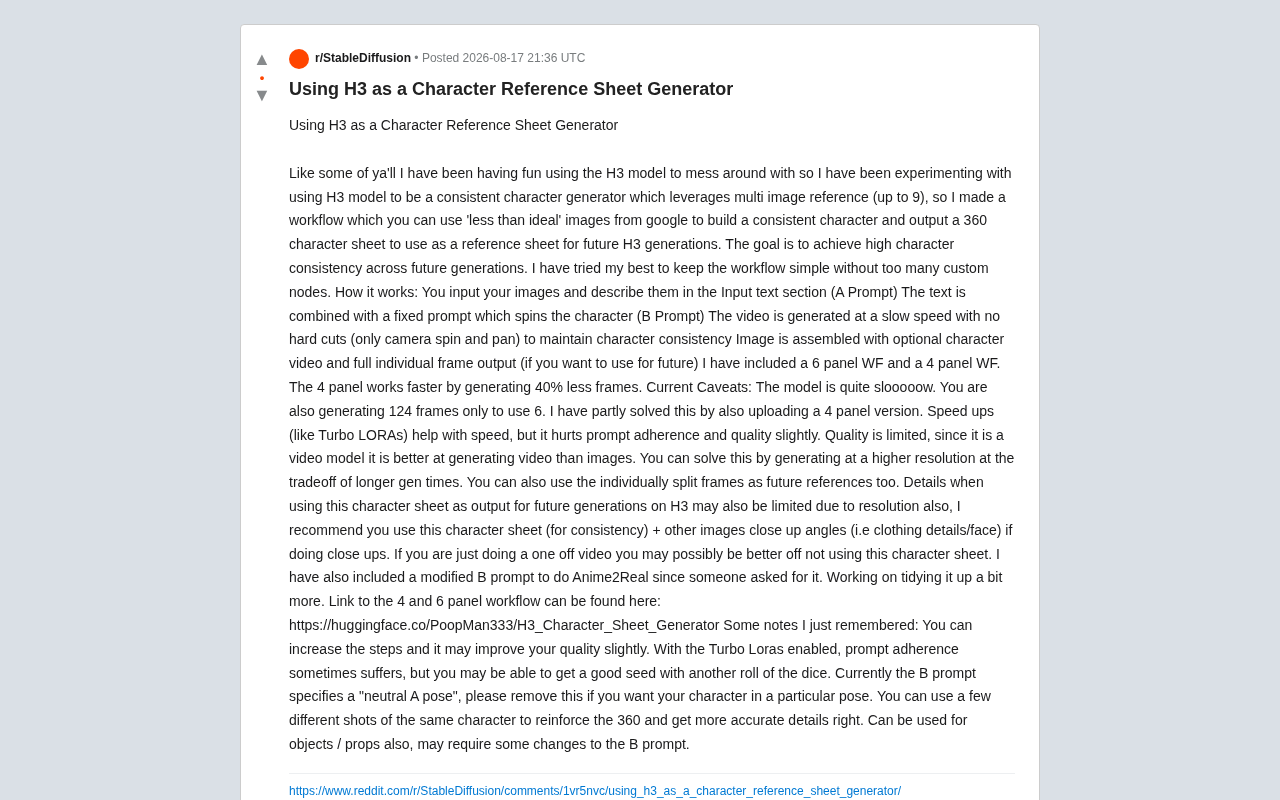
Recently, a Reddit user (PoopMan333) shared a creative workflow: instead of using traditional image generation models, he cleverly leveraged the H3 video model to generate 360° character reference sheets. The core logic is brilliant—exploiting the natural inter-frame coherence of video models to solve the character consistency problem in image generation.
Core Concept: Trading Video Coherence for Character Consistency
The ingenuity of this workflow lies in its reverse utilization of video model characteristics. Traditional image models sample independently each time, making it difficult to ensure character details remain consistent across multiple images. Video models, however, need to output continuous frames and naturally possess high coherence between frames.
This inter-frame coherence stems from the training objective and architectural design of video diffusion models. During training, the model learns the joint distribution P(x₁, x₂, ..., xₙ) of video data, rather than the marginal distribution of independent frames. This means that during the denoising process, the generation of each frame references the state of adjacent frames, forming implicit temporal constraints. Temporal Attention layers enable features across different time steps to communicate with each other, while motion compensation modules learn optical flow relationships between frames. This ensures that even for slow rotations, the model maintains continuity in surface textures, colors, and geometric structures.
The author exploits exactly this point: by having the H3 model generate a video of a "character slowly rotating" (with only camera rotation and translation, no hard cuts), multiple angle views of the same character are obtained in a single generation. These views are then stitched together into a 360° Character Reference Sheet that can be used as a consistency reference for subsequent generations.
About the H3 Video Model
H3 (HunyuanVideo 3) is an open-source video generation model developed by Tencent's Hunyuan team, built on the Diffusion Transformer (DiT) architecture. Unlike traditional U-Net architectures, DiT introduces the Transformer's self-attention mechanism into the diffusion process, enabling better modeling of long-range spatiotemporal dependencies. H3 supports high-resolution video generation, with its core advantage being temporal consistency—through Full 3D Attention, the model can simultaneously attend to token relationships in both spatial and temporal dimensions, ensuring visual elements remain highly consistent across consecutive frames. This architectural characteristic is the key technical foundation exploited by this workflow.
Multi-Image Reference Input Enhances Character Details
The workflow supports up to 9 reference image inputs, meaning you can even grab some "less-than-ideal" images from Google as source material, and the model will synthesize this multi-angle information to construct a coherent character appearance. The author specifically noted that using several different shots of the same character can "enhance the 360° rotation effect and achieve more accurate details."
Workflow Design: Prompt Structure and Two Versions
From a technical implementation perspective, the author deliberately kept the workflow simple, minimizing the use of Custom Nodes to lower the barrier to entry. The entire pipeline's prompt design is split into two parts:
- A Prompt (Input Description): Where users describe the content of their input reference images.
- B Prompt (Fixed Rotation Prompt): A fixed prompt designed to drive the character's rotation display.
When combined, the video generates at a slower pace, avoiding any hard cuts to maximize character consistency. The final output can be either a stitched character video or frame-by-frame split individual images for convenient reuse.
Industry Background on Character Reference Sheets
Character Reference Sheets (also called Turnaround Sheets) are part of the standard production pipeline in animation and game industries. Traditionally, concept designers manually draw a character's front, side, back, and 3/4 views, annotating scale, color schemes, and costume details. This documentation guides 3D modelers, animators, and other downstream production staff to maintain consistent character appearance. A complete character reference sheet typically includes 5-8 viewpoints and may require a professional artist 1-3 days to produce. While AI-generated character reference sheets don't yet match the refinement of hand-drawn versions, they offer significant efficiency advantages during rapid iteration and prototype validation phases.
4-Panel and 6-Panel Dual Version Options
To balance quality and speed, the author provides two versions:
- 6-Panel Workflow: Richer in detail but slower to generate.
- 4-Panel Workflow: Noticeably faster due to approximately 40% fewer generated frames.
Notably, the author also provides a modified B Prompt for achieving an "Anime to Real" (Anime2Real) effect, added in response to community user requests.
The complete 4-panel and 6-panel workflows have been uploaded to HuggingFace: https://huggingface.co/PoopMan333/H3_Character_Sheet_Generator
Practical Limitations: Balancing Speed, Quality, and Resolution
The author very honestly lists several clear shortcomings of the current approach, reflecting a pragmatic attitude.
Generation Speed Bottleneck
The biggest issue is that the model is relatively slow. To obtain 6 useful images, the model actually needs to generate 124 frames, resulting in obvious inefficiency. The author tried acceleration solutions like Turbo LORA to alleviate this, but it comes with side effects—prompt adherence and image quality decline slightly. This is a classic speed-versus-quality tradeoff.
Turbo LORA is an acceleration approach that uses distillation techniques to reduce the inference steps of diffusion models. Standard diffusion models typically require 20-50 denoising steps to generate high-quality output, while Turbo LORA compresses this process to 4-8 steps through Adversarial Distillation. The principle involves training a student model that can achieve the teacher model's multi-step inference results in fewer steps. However, reducing steps inevitably sacrifices fine-grained detail control—because each denoising step needs to cover a larger noise-to-signal conversion range, the model's ability to respond to subtle semantics in prompts decreases. This is the technical root cause of reduced prompt adherence.
Image Quality Ceiling
Since H3 is fundamentally a video model rather than an image model, it performs better at generating video but falls short in static image refinement. The author suggests improving quality by increasing generation resolution, but the tradeoff is again longer generation times.
Practical Optimization Tips
Regarding applying the reference sheet in subsequent generations, the author offers several practical suggestions:
- Due to resolution limitations, details may be limited when using the reference sheet for subsequent generation. It's recommended to combine the reference sheet (for overall consistency) with other close-up angle images (such as costume details, facial close-ups).
- If you're only doing a one-off single video, you might not need this reference sheet at all—direct generation may be more efficient.
- The B Prompt specifies a "neutral A pose" by default. If you want the character in a specific pose, you'll need to manually remove that setting.
- Increasing generation Steps can slightly improve quality.
- If you encounter prompt adherence issues when using Turbo LORA, try switching to different random seeds.
Extended Applications: Beyond Character References
The scope of this workflow actually extends beyond characters themselves. The author notes it can equally be used to generate 360° reference images of objects and props, though the B Prompt may need corresponding adjustments. This means whether you're designing a game character, a weapon, or an architectural model, you can leverage this "video-to-reference-sheet" approach to obtain multi-angle consistent visual assets.
Conclusion: A New Paradigm—Using Video Models to Solve Image Consistency
While this H3 character reference sheet generation workflow is still in the optimization stage with practical issues like slow speed and limited image quality, its core concept of "using video model coherence to solve image consistency" is highly inspiring.
Cross-modal capability reuse is one of the important trends in current AI. Beyond the "video model generating consistent images" introduced in this article, similar approaches include: using 3D generation models (such as Zero123++, SV3D) to infer multi-view from a single image, leveraging video interpolation models to achieve smooth transitions between images, and harnessing the planning capabilities of large language models to drive image generation workflows. The underlying logic of this cross-modal thinking is that generative models of different modalities each learn different structural priors from data, and through creative combination, they can compensate for the inherent limitations of single-modality models. Stability AI's SV3D and Google's CAT3D also adopt similar video-to-multi-view conversion approaches, further validating the viability of this technical direction.
It reveals a valuable direction: as video generation model capabilities rapidly improve, we can absolutely reuse these capabilities cross-modally to solve problems that traditional image workflows struggle to address. For AI creators, rather than waiting for perfect dedicated tools, learning to creatively combine existing models may be the greatest value this workflow offers us.
Related articles

Claude Autonomously Designs Proteins with 35% Success Rate, Far Exceeding Human Expert Performance
Anthropic's Claude achieves 35% wet-lab success rate in autonomous protein design, far surpassing the 10-15% human expert average, signaling AI's move toward real scientific productivity.

Perplexity Discover's Multilingual Support Suddenly Disappears — Why Are International Users Upset?
Perplexity Discover's multilingual news feature suddenly dropped non-English support, frustrating international users. We analyze possible causes and the broader challenges of AI product internationalization.

GitHub Daily · August 20: Mojo Tops the Charts & The Local-First Open Source Rebellion
GitHub Trending Aug 20: Mojo tops charts for AI compute stack ambitions, OpenLogi surges 1225 stars with local-first philosophy, and privacy rebellion dominates.