Cline Agents SDK Releases Version 0.2.1: The Evolution of AI Coding Tools Behind a Minor Update

Cline Agents SDK releases patch 0.2.1, with automated releases reflecting its engineering and SDK-driven cadence.
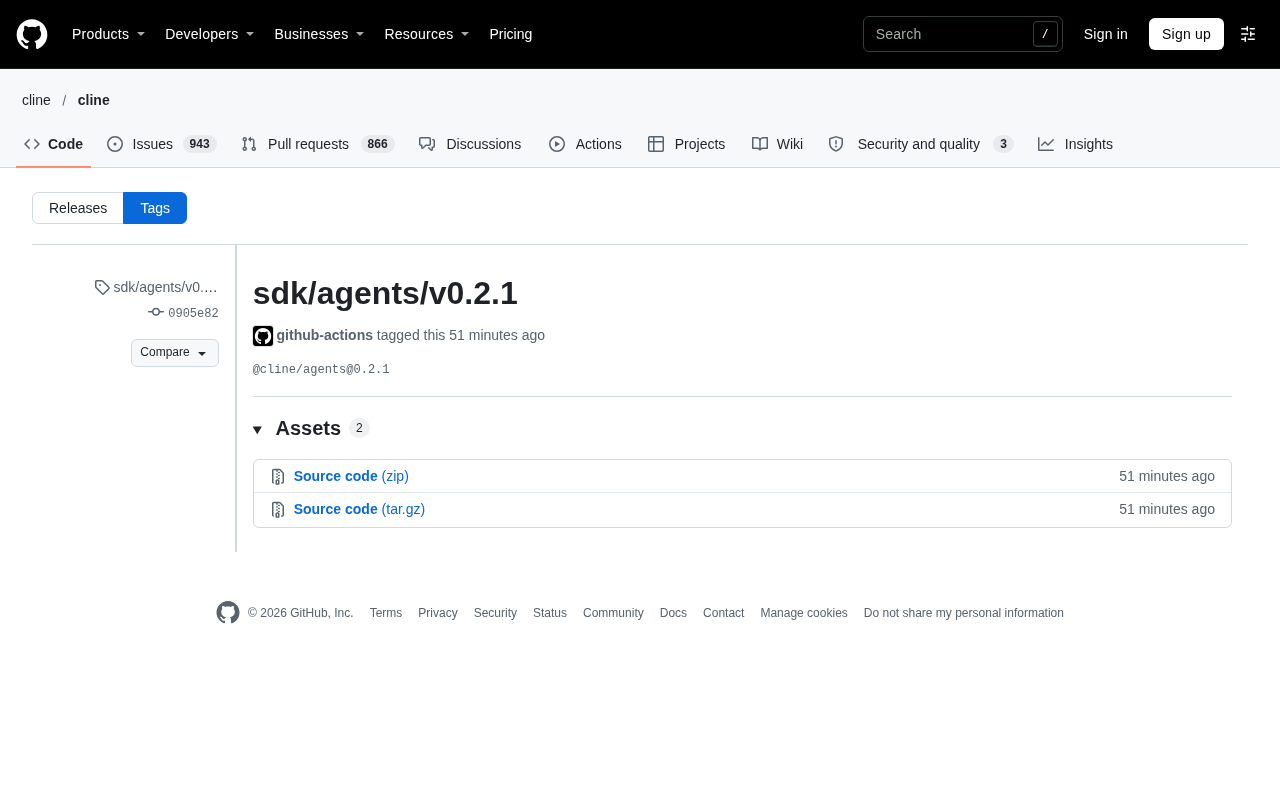
Cline's Agents SDK has released patch version 0.2.1, corresponding to commit 0905e82, auto-tagged by GitHub Actions and published on November 21. As a patch update in semantic versioning, it typically covers bug fixes and detail optimizations that users can upgrade to smoothly, but the release page discloses no specific changelog, so developers must check commit history or diff to learn the actual changes. The article notes that auto-tagging shows Cline has integrated its release process into CI/CD, while independent versioning of the Agents SDK reflects the team's effort to extract Agent orchestration, tool invocation, and other capabilities from a single product into a development kit for third-party integration. Given that 0.2.x is still early and the API may change, regression testing before upgrading—or trying it first in experimental projects—is recommended.
The AI coding tools space has seen another version iteration. Cline's Agents SDK has released version 0.2.1, with the version tag sdk/agents/v0.2.1 corresponding to commit 0905e82. Judging by the version number, this is a patch-level release, but against the backdrop of rapidly evolving AI coding assistants, it's still worth examining the product cadence and ecosystem significance behind it.
Basic release information
According to the release record on GitHub, sdk/agents/v0.2.1 was auto-tagged by github-actions, published on November 21 at 05:19, with the package name labeled @cline/agents@0.2.1. The release page includes 2 asset files for developers to download.
The auto-tagging detail shows that the Cline team has integrated its release process into a CI/CD pipeline, with version releases completed automatically by GitHub Actions. This kind of engineering practice is especially important for SDK-type products that require frequent iteration—it reduces errors caused by manual operations and makes the release cadence more controllable.
What a patch version means
0.2.1 is a patch version in semantic versioning, typically used to fix defects and optimize details rather than introduce breaking changes or large-scale new features. For developers already using @cline/agents, such versions can generally be upgraded smoothly without worrying about interface incompatibilities.
However, the release page itself does not show a detailed changelog—it only provides the version tag, commit hash, and asset download entry. This means that to understand exactly what 0.2.1 fixed and which modules were changed, developers need to further check the repository's commit history or compare the diff.
Semantic Versioning (SemVer) is a version numbering convention widely adopted in software development today, formatted as "MAJOR.MINOR.PATCH." A major version change indicates incompatible API modifications; a minor version change indicates backward-compatible new features; and a patch version change indicates backward-compatible bug fixes. Under this convention, the "1" in 0.2.1 is the patch number, meaning this release mainly addresses known defects or optimizes details without breaking interface adjustments, so developers on 0.2.0 can typically upgrade smoothly. It's also worth noting that when the major version is 0 (i.e., 0.y.z), the SemVer spec explicitly states that the public API is not yet stable and any version may change—this is the basis for the article's reminder that "0.2.x is in an early stage and the API may still be adjusted."
Cline and the AI coding tools ecosystem
Cline is an AI coding assistant project that has gained attention in recent years, focusing on completing tasks such as code writing, file operations, and terminal command execution within the editor in an Agent fashion. The independent versioning of the Agents SDK indicates that the team is extracting Agent capabilities from a single product and packaging them as a development kit for other tools to integrate.
This SDK-oriented approach is not uncommon in the AI coding arena. Once the underlying Agent orchestration, tool invocation, and context management mature, encapsulating them as an SDK can expand the technology's applicability, enabling third-party developers to build their own coding assistance tools on the same set of capabilities. The 0.2.x series is still in an early stage, and the version number itself suggests the API may still change.
CI/CD (Continuous Integration / Continuous Delivery) is a set of automated software delivery practices. Continuous integration requires developers to frequently merge code into the main branch and catch integration issues early through automated builds and tests; continuous delivery, building on this, connects build, test, packaging, and release into an automatically executable pipeline. The GitHub Actions mentioned in the article is a CI/CD service provided by GitHub, where developers can define workflows in configuration files that automatically execute tasks when triggered by events such as code commits, merges, or tag creation. The Cline team uses github-actions to auto-tag release versions, indicating that version releases have become an automated step in the pipeline, which helps reduce human error, ensure release consistency, and make the high-frequency iteration cadence more controllable.
How developers should follow up
For projects that have already integrated @cline/agents, it's recommended to follow the official repository's release page and commit history, and decide on upgrade timing after confirming the specific changes in 0.2.1. Since the release information does not disclose detailed change notes, running regression tests before upgrading in a production environment is the prudent approach.
For developers who haven't yet used it but are interested in evaluating it, 0.2.1 is a reasonable version to start understanding the SDK's capability boundaries. Early versions iterate quickly and are suitable for trial use in experimental projects first, building up an understanding of Agent workflows.
Summary
sdk/agents/v0.2.1 is a routine patch release with limited public information, but it reflects Cline's continued investment in AI coding Agent infrastructure. The automated release process and independent SDK versioning are both signals that this project is maturing. What's more worth looking forward to is whether 0.3 or higher versions will bring substantive capability-level expansions.
Related articles

ChatGPT Plus Subscription Pitfall Guide: Go/Plus/Pro Tier Comparison and Quick Activation
A complete ChatGPT Plus subscription guide based on a Bilibili tutorial: from registering an account, comparing Go/Plus/Pro tiers, to the practical steps for quickly completing your subscription.

GPT-6.2 Sol/Astra Released! A Step-by-Step ChatGPT Plus Subscription Guide and Tier Comparison
GPT-6.2 Sol/Astra is out—here's a ChatGPT Plus subscription guide: register an account, compare Go/Plus/Pro tiers, and subscribe in a minute.

Comparing Three Channels for Subscribing to GPT Plus in China: Is Website Top-Up the Easiest?
How to subscribe to GPT Plus in China? This article compares website top-up, credit card, and mobile top-up channels—process, cost, and risk—with steps and tips to help you choose wisely.