Cline Agents SDK v0.0.94 Released: Plugin SDK Update Analysis

Cline Agents SDK releases v0.0.94, still in the early 0.0.x stage, but its release process has already achieved CI/CD automation.
Cline's Agents SDK has released version v0.0.94, corresponding to commit 2bbaa7a, automatically released by github-actions on October 16. This reflects that the SDK has established a standardized CI/CD release pipeline, ensuring traceability and consistency of releases while iterating rapidly. The version number remains at 0.0.x, meaning the SDK has not yet entered a stable API commitment period; interfaces may be adjusted at any time, and breaking changes are not strictly constrained by semantic versioning rules, so developers building production-grade applications on it need to factor this into their evaluation. The article also points out that some dynamic areas on the Release page have loading errors, and Assets need to be obtained by directly visiting the repository. For developers, a pragmatic approach is to follow the changelog and commit diff rather than blindly upgrading with every update; and when the SDK reaches version 1.0 will be an important signal for observing its API stability commitment and the starting point of ecosystem building.
Another High-Frequency SDK Version
Cline's Agents SDK has released version v0.0.94. This version was published with the tag @cline/agents@0.0.94, corresponding to commit 2bbaa7a. From the GitHub Release page, we can see that this release was completed through the github-actions automation workflow, with a release time of 16 Oct 03:50.
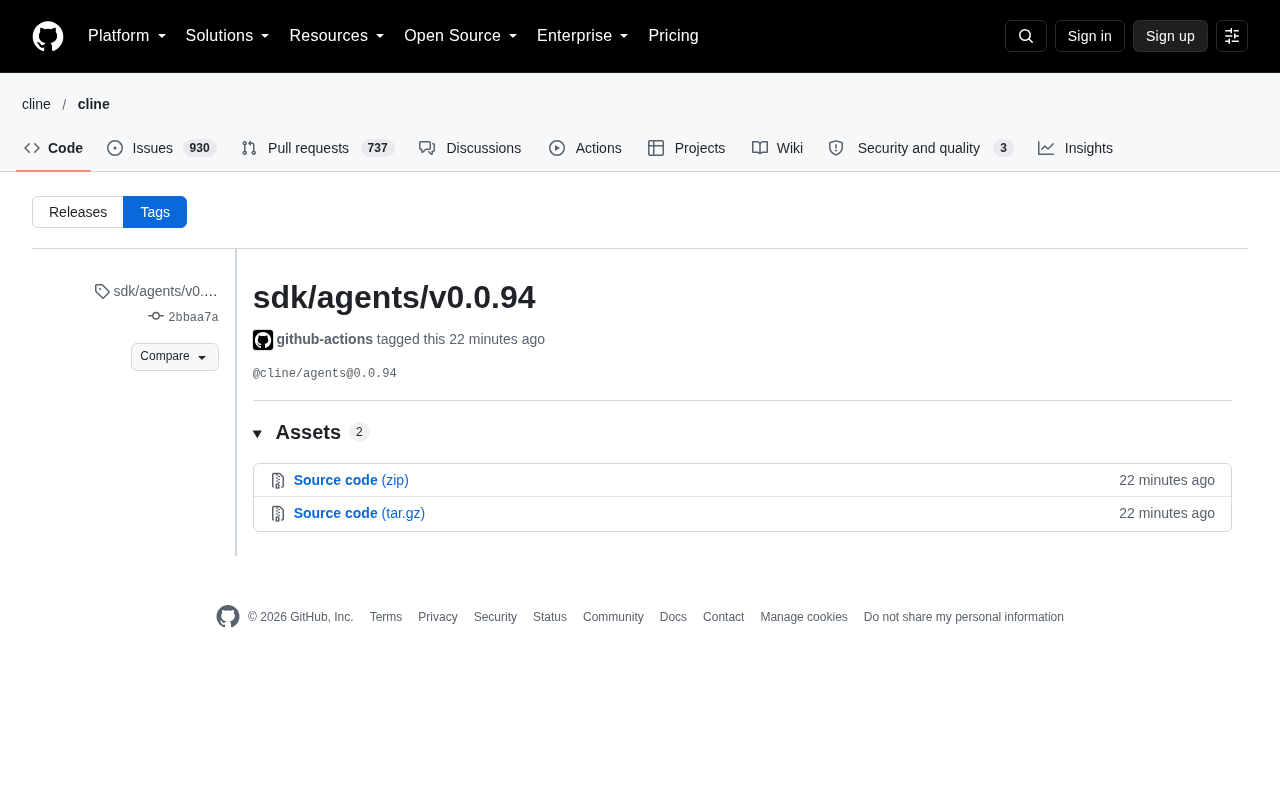
For developers who have been following the Cline ecosystem, this kind of high-frequency minor version iteration is nothing new. As a tool that emphasizes agent capabilities and deep editor integration, Cline's SDK version cadence often adjusts in step with the rapid evolution of its upper-layer product features.
What We Can Read from the Release Information
The Automated Release Pipeline Is Already Mature
This release was tagged by the github-actions bot account, indicating that Cline Agents SDK has established a standardized CI/CD release pipeline. For an SDK still in the 0.0.x stage, the maturity of this infrastructure is worth noting—it means the team maintains traceability and consistency in the release process while iterating rapidly.
GitHub Actions is a continuous integration and continuous delivery (CI/CD) platform provided by GitHub, allowing developers to define automated workflows in a repository via YAML configuration files. Triggers can include code pushes, pull requests, scheduled tasks, or manual invocation. In the context of SDK releases, a common approach is to configure a release workflow: when code is merged into the main branch or a specific tag is applied, it automatically executes a series of steps including build, test, version number writing, npm publishing, and GitHub Release creation. The account performing these operations typically appears as the github-actions bot, which explains why the tag operation for this release was not done manually. This mechanism can significantly reduce human error, ensure consistency of artifacts for each release, and make release records strictly correspond to specific commits for easy traceability.
The Version Number Is Still in an Early Stage
The version number 0.0.94 itself conveys a signal: this SDK has not yet entered a stable API commitment period. The 0.0.x stage typically means interfaces may be adjusted at any time, and breaking changes do not follow strict semantic versioning rules. For developers planning to build production-grade applications based on this SDK, this is a factor that needs to be included in the evaluation.
Semantic Versioning (SemVer) is a widely adopted version numbering convention with the format MAJOR.MINOR.PATCH. The MAJOR version number is incremented when incompatible API changes occur, MINOR is incremented when backward-compatible functionality is added, and PATCH is incremented when backward-compatible bug fixes are made. When the major version number is 0 (i.e., 0.y.z), the specification explicitly states that this is an initial development stage where anything may change at any time, and the public API should not be considered stable. Therefore, for versions like 0.0.94, an incremented PATCH digit does not necessarily represent only bug fixes; it may also include interface adjustments or even breaking changes. Developers cannot rely on the conventional SemVer conventions to judge upgrade risks.
Practical Impact on Developers
Who Should Pay Attention to This Version
If you are developing with Cline's agent capabilities, or building a toolchain that integrates with the Cline editor extension, then every SDK update is worth noting. Iterations in the 0.0.x stage typically include bug fixes, small feature enhancements, and interface fine-tuning—changes that may directly affect your existing code.
Starting from the Usability of the Release Page
Interestingly, some dynamically loaded areas on the current Release page (such as the tag filter and Assets section) show loading error prompts. This could be a temporary rendering issue on GitHub's page, or it could be a loading failure caused by the network environment. In any case, the actual Assets content needs to be obtained by developers directly visiting the repository page.
The Assets section on a GitHub Release page is used to attach downloadable artifact files for that release, such as packaged tarballs, compiled outputs, or checksum files, while the tag filter is used to switch between different version tags for viewing. These two sections are typically rendered by frontend JavaScript dynamically requesting APIs, so when network access is restricted, APIs are rate-limited, or page scripts fail to load, loading errors or blank prompts will appear—not because the version has no published artifacts. To confirm the actual content of a version, a more reliable approach is to directly visit the repository's Releases or Tags page, or check the corresponding version's metadata through a package manager (such as npm), or directly consult the source code and change records corresponding to that commit.
How to View This Kind of High-Frequency Minor Version Release
In the field of AI programming tools, rapid SDK iteration has become the norm. Cline's choice to continuously advance the evolution of its Agents SDK through the 0.0.x series reflects the product team's strategy of rapidly responding to market feedback.
For the developer community, this pace is both an opportunity and a challenge. The opportunity is that you can use new capabilities and fixes as soon as they are available; the challenge is that you need to invest extra effort in tracking changes and verifying compatibility. A pragmatic approach is: pay attention to the changelog and commit diff, rather than blindly upgrading with every version update.
From a longer-term perspective, when Cline Agents SDK moves from 0.0.x to version 1.0 will be a signal worth continuous observation—it means a formal commitment to API stability and the true starting point of ecosystem building.
One-line Summary
Cline Agents SDK releases v0.0.94, still in the early 0.0.x stage, but its release process has already achieved CI/CD automation.
Paragraph Summary
Cline's Agents SDK has released version v0.0.94, corresponding to commit 2bbaa7a, automatically released by github-actions on October 16. This reflects that the SDK has established a standardized CI/CD release pipeline, ensuring traceability and consistency of releases while iterating rapidly. The version number remains at 0.0.x, meaning the SDK has not yet entered a stable API commitment period; interfaces may be adjusted at any time, and breaking changes are not strictly constrained by semantic versioning rules, so developers building production-grade applications on it need to factor this into their evaluation. The article also points out that some dynamic areas on the Release page have loading errors, and Assets need to be obtained by directly visiting the repository. For developers, a pragmatic approach is to follow the changelog and commit diff rather than blindly upgrading with every update; and when the SDK reaches version 1.0 will be an important signal for observing its API stability commitment and the starting point of ecosystem building.
Related articles

Random Pruning of the DPO Computation Graph: 1.4x Training Speedup and Lower Peak Memory
DPO training too slow and memory-hungry? This paper proposes a random pruning framework for the DPO computation graph, sampling independently across position, sequence, and branch dimensions; branch pruning achieves a 1.426x step-time speedup and cuts training time by about 30%, with in-depth attribution of memory and time gains.

Why Does JEPA Underperform MLM in Longitudinal EHR Representation Learning?
New study compares JEPA and MLM for longitudinal EHR representation learning on MIMIC-IV: three JEPA variants train stably without collapse but underperform MLM; target size, not heterogeneity, drives prediction error.

Transfer Learning + Visible Light Communication: A New Approach to Energy-Efficient Indoor Positioning
A study proposes a transfer learning-based visible light communication indoor positioning method, achieving 47% accuracy improvement on the BOSCH factory dataset, 67.5% model efficiency under high noise, and introducing the ME composite metric for energy-efficient positioning in energy-constrained industrial IoT scenarios.