Cline CLI v3.0.68 Update: Agent Team Performance Fixes and Model Catalog Refresh

Cline CLI v3.0.68 fixes Agent team long-session slowdowns and database bloat, and updates default models for five providers.
Cline CLI v3.0.68 is a stability-focused maintenance release. A previous design flaw caused every streamed chunk to trigger a full Agent team state save, leading to progressive performance degradation and a `teams.db` database that could grow to several gigabytes. The fix introduces automatic one-time compaction of historical team data on upgrade — no manual steps needed. The update also refreshes default model configurations for DigitalOcean, GMI Cloud, NanoGPT, Nvidia, and Ofox, with multiple providers opting for lightweight "Flash" models suited to CLI low-latency use cases.
The open-source AI coding assistant Cline has released CLI version v3.0.68. While a modest update, it addresses critical performance bottlenecks in long-running sessions and refreshes default model configurations across several providers. For developers relying on Agent team collaboration features, this is a version worth upgrading to promptly.
Agent Team Performance Fix for Long Sessions
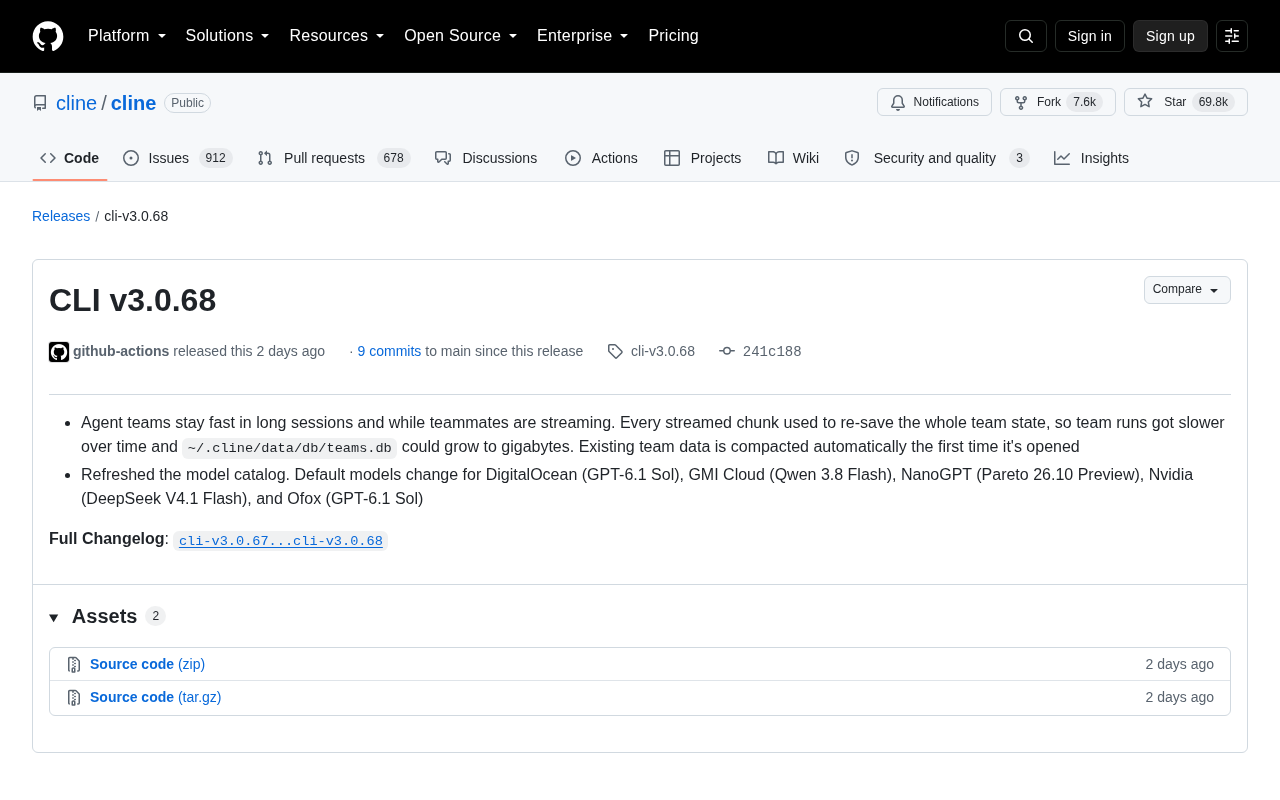
The most significant change in this update is a fix for the gradual slowdown experienced by Agent teams during extended runs and multi-member streaming output.
According to the release notes, the previous implementation had a notable design flaw: every streamed chunk triggered a full re-save of the entire team state. This meant that as sessions grew longer and interactions increased, the overhead from write operations kept accumulating, causing team performance to degrade over time.
The storage-level side effect was even more serious — the local database file ~/.cline/data/db/teams.db could balloon to several gigabytes due to repeated full-state writes. For users who rely heavily on Cline for multi-Agent collaboration, this growth not only consumed disk space but also created a feedback loop that further degraded read/write performance.
With the fix in place, existing team data will be automatically compacted the first time it is opened after upgrading — no manual intervention required. This means not only do new sessions benefit, but the bloated historical data accumulated over time gets cleaned up in one pass, restoring the database to a reasonable size.
Background: Agent teams in Cline are a multi-agent collaboration mechanism that allows multiple AI Agents to work in parallel or divide tasks — for example, one Agent handles code generation while another writes test cases. Streaming refers to the model returning responses in real time, token by token or chunk by chunk, rather than waiting for a complete response before sending it back. This significantly reduces perceived latency, but it also means a single AI response is split into dozens or even hundreds of small chunks arriving in sequence. When the system triggers a full state save for every chunk, the overhead accumulates linearly — or faster — over a long session, eventually causing noticeable performance degradation.
Model Catalog Refresh and Default Model Updates
Beyond the performance fix, v3.0.68 also refreshes the model catalog and adjusts default model configurations for several providers. The specific changes include:
- DigitalOcean: Default model switched to GPT-6.1 Sol
- GMI Cloud: Default model switched to Qwen 3.8 Flash
- NanoGPT: Default model switched to Pareto 26.10 Preview
- Nvidia: Default model switched to DeepSeekAd V4.1 Flash
- Ofox: Default model switched to GPT-6.1 Sol
These default model updates reflect Cline's effort to keep pace with the rapid iteration of mainstream provider models. For users on these platforms, new sessions created after upgrading will automatically use the updated defaults — though you can still manually specify other available models in your configuration. Notably, multiple providers have independently opted for lightweight, high-speed models with the "Flash" label as their defaults, which aligns well with the CLI tool's emphasis on responsiveness and low latency.
Background: "Flash" series models in the AI space typically refer to lightweight or inference-optimized variants that trade some complex reasoning capability for lower latency and higher throughput compared to flagship models in the same family — similar in positioning to Google's Gemini Flash or Anthropic's Haiku. In CLI tool scenarios, developers frequently send short, rapid requests for code completion, command explanation, and similar tasks, where model response speed often matters more than deep reasoning. This makes lightweight, fast models a sensible engineering default.
Practical Impact for Developers
Cline is an open-source project with nearly 70,000 GitHub stars and over 7,600 forks. Its CLI tool serves as a key entry point for developers invoking AI coding capabilities from the terminal. While this is a minor version bump (v3.0.67 to v3.0.68), the performance issues it resolves have a meaningful impact on the experience of heavy users.
If you've previously noticed team sessions becoming sluggish after running for a while, or spotted the teams.db file growing abnormally large, this upgrade should provide immediate relief. The automatic compaction mechanism lowers the cost of upgrading — there's no need to worry about data migration or manual maintenance.
From an engineering perspective, "saving full state on every streamed chunk" is a classic performance anti-pattern, and fixing it reflects the project's attention to detail in real-world long-session scenarios. As multi-Agent collaboration becomes an increasingly standard feature of AI coding tools, the efficiency of state persistence will only grow more critical — making optimizations like this increasingly valuable.
Summary
Cline CLI v3.0.68 is a stability- and performance-focused maintenance update. The headline fix addresses Agent team performance degradation and database bloat during long sessions, with automatic compaction smoothing over historical data; the update also refreshes default models across five providers. Developers using Agent team features are encouraged to upgrade promptly for a more stable and fluid multi-Agent collaboration experience.
Related articles

Random Pruning of the DPO Computation Graph: 1.4x Training Speedup and Lower Peak Memory
DPO training too slow and memory-hungry? This paper proposes a random pruning framework for the DPO computation graph, sampling independently across position, sequence, and branch dimensions; branch pruning achieves a 1.426x step-time speedup and cuts training time by about 30%, with in-depth attribution of memory and time gains.

Why Does JEPA Underperform MLM in Longitudinal EHR Representation Learning?
New study compares JEPA and MLM for longitudinal EHR representation learning on MIMIC-IV: three JEPA variants train stably without collapse but underperform MLM; target size, not heterogeneity, drives prediction error.

Transfer Learning + Visible Light Communication: A New Approach to Energy-Efficient Indoor Positioning
A study proposes a transfer learning-based visible light communication indoor positioning method, achieving 47% accuracy improvement on the BOSCH factory dataset, 67.5% model efficiency under high noise, and introducing the ME composite metric for energy-efficient positioning in energy-constrained industrial IoT scenarios.