Cline Core SDK Releases Version 0.2.0: The AI Coding Toolchain Takes Another Step Forward

Cline Core SDK releases 0.2.0, auto-tagged but with no detailed changelog yet; upgrade with careful compatibility checks.
Cline Core SDK has been updated to version 0.2.0. The tag was created by a GitHub Actions automated process, and no detailed changelog has been published yet. The jump from 0.1.x to 0.2.0 typically signals backward-compatible new features or significant internal refactoring, though API stability in the 0.x phase remains uncertain. The article suggests that independent SDK versioning shows Cline is modularizing its core capabilities, offering a clearer integration path for third-party tools. Developers are advised to verify compatibility in a test environment and watch for breaking changes before upgrading.
Version Release Overview
The core SDK of the AI coding assistant Cline has received a 0.2.0 version update. Although the official detailed changelog has not yet been published, judging from the version number jump and Cline's recent product developments, this update is likely to bring developers a more stable integration experience and new capability extensions.
Version Release Overview
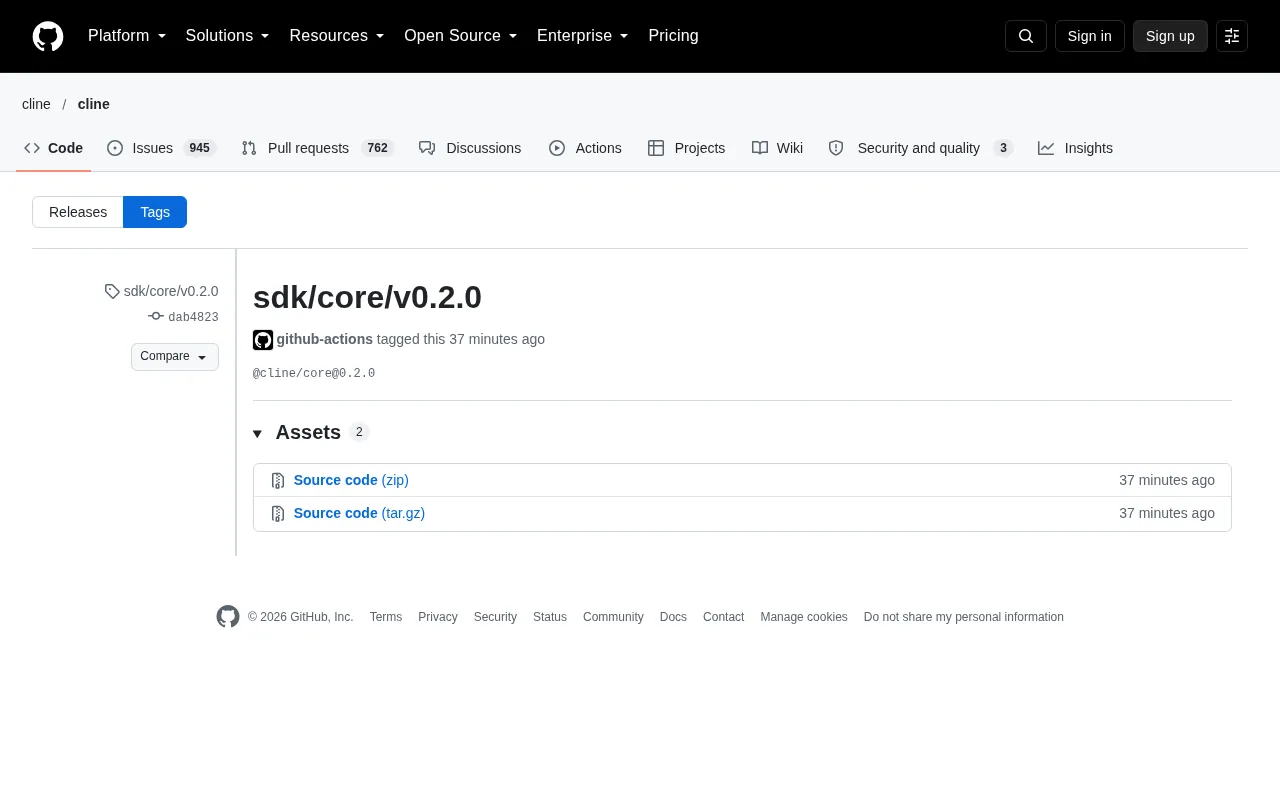
According to the tag information on GitHub, @cline/core@0.2.0 was recently tagged by an automated process. The version number jumping from 0.1.x to 0.2.0, under semantic versioning conventions, typically means the introduction of backward-compatible new features or significant internal refactoring. For developers who rely on the Cline SDK to build custom AI coding workflows, this is a signal worth paying attention to.
The official repository's Release page has not yet attached detailed change notes, which to some extent increases the uncertainty of upgrade decisions. However, given the Cline project's consistent iteration pace, core SDK version updates often stay in sync with feature enhancements in the main product.
Semantic Versioning (SemVer) is a widely adopted versioning convention with the format MAJOR.MINOR.PATCH. Under the specification, an increment to the major version indicates backward-incompatible breaking changes; an increment to the minor version indicates new features added in a backward-compatible manner; and an increment to the patch version indicates backward-compatible bug fixes. The article's description of moving from 0.1.x to 0.2.0 is a minor version jump, which in projects that strictly follow SemVer means backward-compatible feature additions. However, note that SemVer specifies that public APIs during the 0.y.z phase (major version zero) are considered unstable, and any version may introduce breaking changes. Therefore, for the Cline SDK, which is still in the 0.x phase, although 0.2.0 is nominally a minor version update, interface adjustments cannot be ruled out, and compatibility verification before upgrading is particularly necessary.
GitHub Actions is a continuous integration and continuous delivery (CI/CD) platform provided by GitHub. Developers can define automated tasks through YAML workflow files, such as code testing, building, packaging, and publishing. The "automatic tagging" mentioned in the article is typically triggered by a release workflow: when code is merged or a release is manually triggered, Actions automatically creates a Git tag (such as @cline/core@0.2.0) based on the version number in package.json and pushes it to the repository. This automated process ensures that tags strictly match code versions and reduces human error, but it also means that the tag itself does not come with change notes—Release Notes often need to be written separately or generated by tools based on commit records. This precisely explains why the version has been tagged but there is currently no detailed changelog.
Potential Impact on AI Coding Workflows
As an open-source AI coding assistant, Cline's core value lies in enabling developers to directly call large models within the IDE to complete code generation, refactoring, and debugging. The independent version management of the SDK means that third-party tools can integrate Cline's capabilities more flexibly without having to bind to the complete plugin ecosystem.
The emergence of version 0.2.0 suggests that the Cline team is modularizing and interfacing its core capabilities. For teams that want to build custom AI coding agents, this means a clearer integration path and a more controllable upgrade strategy. Developers can expect improvements in task orchestration, context management, or tool invocation protocols—although specific details still await supplementation in official documentation.
How Developers Should Respond
In the face of a version update that lacks detailed Release Notes, caution is necessary. Developers currently using the Cline SDK are advised to first verify the compatibility of 0.2.0 in a test environment, focusing on whether there are breaking changes in interface integration with existing workflows.
At the same time, they can follow subsequent developments in the official Cline repository. Usually the community will gradually supplement usage feedback and migration guides after a version release. For teams that have not yet integrated the SDK, this update is also an opportunity to re-evaluate Cline as AI coding infrastructure—its open-source nature and active iteration pace keep it quite competitive among AI-assisted development tools.
Overall, Cline Core SDK 0.2.0 is a version evolution worth noting, but the realization of its specific value still requires further verification through official documentation and community practice.
One-line Summary
Cline Core SDK releases version 0.2.0, automatically tagged but with no detailed changelog yet; upgrades require careful compatibility verification.
Paragraph Summary
Cline Core SDK has received a 0.2.0 version update. The tag was produced by a GitHub Actions automated process, and the official detailed changelog has not yet been published. The version number jumped from 0.1.x to 0.2.0, which under semantic versioning conventions usually means backward-compatible new features or significant internal refactoring, but API stability during the 0.x phase remains to be seen. The article argues that the SDK's independent version management reflects Cline's ongoing effort to modularize and interface its core capabilities, providing a clearer path for third-party tools to integrate AI coding capabilities. Developers can expect improvements in task orchestration, context management, and tool invocation protocols. In the face of an update lacking Release Notes, developers are advised to first verify compatibility in a test environment, focus on breaking changes, and keep following the official repository and community feedback before deciding whether to upgrade or integrate.
Related articles

Qwen4 Architecture Preview Open-Sourced: 125B Parameters, 512 Experts, Designed for VRAM-Constrained Hardware
Qwen4 isn't released yet, but its architecture is previewed via open-source Qwen3.8 Flash Next: 125B params, 6B activated per token, 512 experts, 262K context, built for VRAM-limited hardware. This article covers official confirmations, key config.json metrics, and local deployment tests on 24G memory.

Run 8K Images on 6GB VRAM! Hands-On Test of Fudan's Open-Source MOSS-Image Model
Fudan OpenMouse team and Shanghai MOSS Intelligence open-source MOSS-Image, a 500M-parameter DT architecture text-to-image model that runs locally on 6GB VRAM with precise text rendering, structured layout control, and 4K Token prompt support—ideal for e-commerce posters and local deployment by individual creators.

Overseas Blogger Tests Local Deployment of 100B-Parameter MoE Model: Key Lessons on Quantization and Tool Calling
Overseas blogger tests local deployment of Alibaba's Qwen 3.8 Flash Next 100B MoE model on a Strix Halo mini PC and CUDA workstation, revealing how quantization precision affects tool-calling success and the real-world performance of the Strata and GUFO inference engines.