Cline Releases agents SDK v0.0.90: Open-Source AI Coding Assistant Keeps Evolving

Cline releases agents SDK v0.0.90, continuing its rapid iteration cadence for open-source AI coding agents.
Cline, the popular open-source AI coding agent with nearly 70,000 GitHub stars, has released agents SDK v0.0.90 (npm: `@cline/[email protected]`) via automated GitHub Actions. The `0.0.x` version prefix signals the SDK is still in early stages with evolving interfaces, but reaching patch version 90 shows extensive iteration and growing maturity. The SDK gives developers a programmatic interface to build or integrate AI coding agent capabilities into their own tools and workflows — without starting from scratch. In a competitive open-source AI coding tools market, Cline stands out for its transparency, local deployment support, and flexible LLM backend options.
Cline's agents SDK Reaches v0.0.90
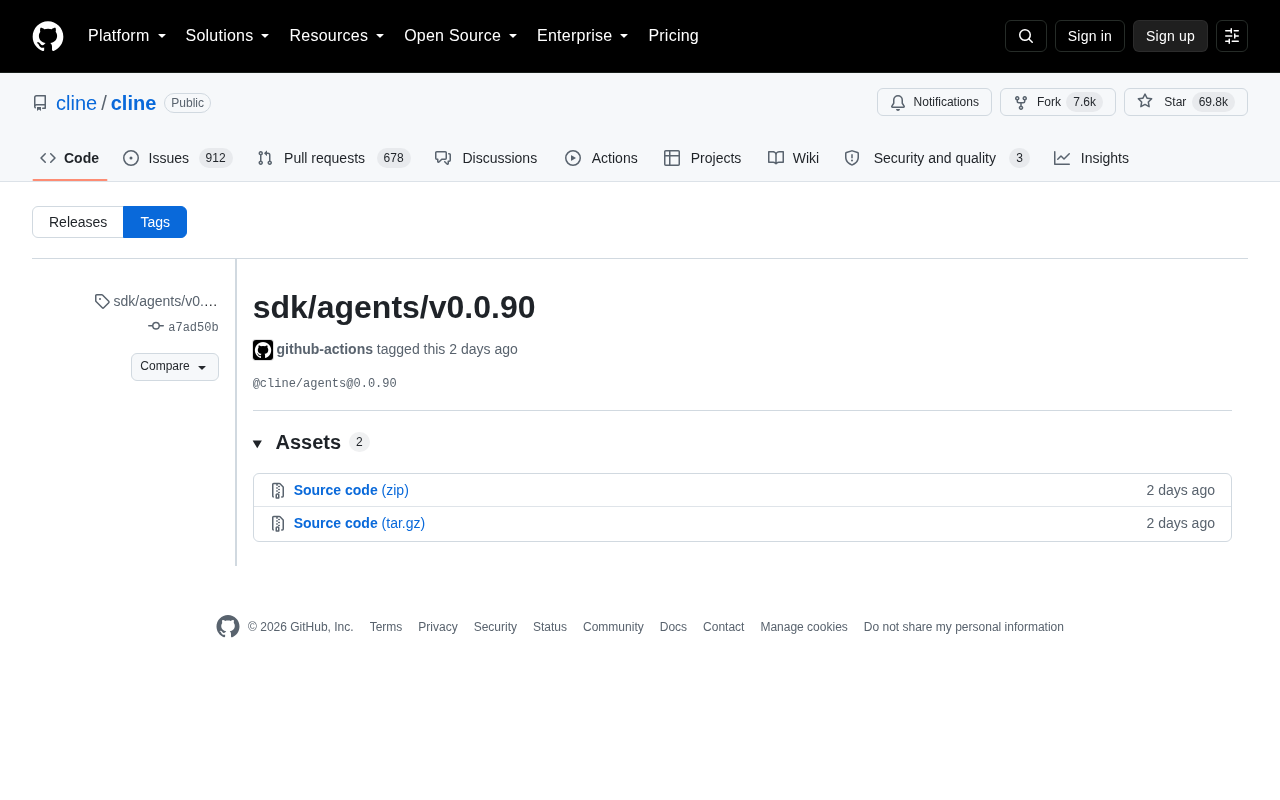
Cline, a popular open-source project on GitHub with nearly 70,000 stars and over 7,600 forks, has just released v0.0.90 of its agents SDK (published to npm as @cline/[email protected]). The release was tagged automatically via GitHub Actions from commit hash a7ad50b.
For developers tracking the AI coding tools ecosystem, Cline is a project worth following closely. It's positioned as an open-source AI coding agent capable of autonomously performing code writing, debugging, file operations, and other tasks within a development environment. This minor SDK release continues the project's high-cadence update rhythm.
What the Version Number Tells Us About Iteration Strategy
The v0.0.90 version number is itself informative. The leading 0.0.x signals that the agents SDK is still in an early stage — interfaces and capabilities are likely to keep evolving. At the same time, reaching .90 in the patch version indicates the SDK has already gone through extensive iteration, with features gradually maturing and stabilizing.
This "fast, small steps" release strategy is quite common among active open-source AI tooling projects. By leveraging GitHub Actions for automated tagging and publishing, the Cline team can continuously ship updates with minimal manual overhead, getting fixes and improvements into the hands of community users as quickly as possible.
What the SDK Means for Developers
The existence of an agents SDK means Cline is more than just a standalone tool — it also provides a programmatic interface for secondary development and integration. Developers can build their own AI agent applications on top of the SDK, or embed Cline's agent capabilities into existing workflows. For teams that want to build a custom AI coding assistant without starting from scratch, this open-source foundation is a valuable reference point.
The core value of an AI agent SDK lies in encapsulating complex agent capabilities into callable programming interfaces. In Cline's case, the SDK typically exposes modules for task planning, tool invocation (e.g., file read/write, terminal execution, browser automation), and context management — so developers don't need to worry about the underlying communication with the LLM. They can instead focus on orchestrating multi-step automated tasks within their own applications. Compared to calling an LLM API directly, an agent SDK wraps the "think–act–observe" loop (the ReAct pattern) along with engineering-level features like error retry and tool permission control. Typical use cases for this kind of SDK include automated code review and repair in CI/CD pipelines, IDE plugin feature extension, and building customized internal coding assistants for enterprises.
The Competitive Landscape of Open-Source AI Coding Tools
Cline's nearly 70,000 stars reflect just how hot the open-source AI coding assistant space has become. In this arena, closed-source commercial products and open-source solutions are developing in parallel, each with their own following. The open-source approach has clear advantages: transparency, auditability, and the ability to deploy locally. Users can choose their own underlying LLM and control where their data goes — which matters greatly to developers who prioritize privacy and cost.
Frequent version releases are one signal of an open-source project's health. Continuous commit activity and an automated release pipeline indicate that Cline has an active maintainer team and engaged community. For teams considering adopting an AI coding agent in a production environment, a project's iteration velocity is an important evaluation criterion.
Key competitors in the open-source AI coding agent space include Aider (focused on command-line interactive programming), Continue (available as a VS Code/JetBrains plugin), and OpenHands (formerly OpenDevin, targeting complex software engineering tasks). Cline differentiates itself through deep integration with the VS Code extension ecosystem, while also supporting user-configurable backend models — including Claude, GPT-4, and locally hosted Ollama models — balancing flexibility with ease of use. Competition in this space is also driving rapid feature iteration across all players: from single-file editing at the start, to multi-file refactoring, browser automation, MCP (Model Context Protocol) tool integration, and other increasingly sophisticated agent capabilities. Release cadences are typically measured in days or weeks.
How to Get It and Get Started
Developers who want to try the latest version can install it via npm as @cline/[email protected], or head to Cline's GitHub repository to review the release notes and source code. Since this version is still in early stages, it's advisable to try it out in non-critical projects first, and keep an eye on subsequent changelogs for specific feature changes and any breaking updates.
It's worth noting that the publicly available information for this release is primarily the version tag and package identifier. For detailed information on what's changed functionally, you'll need to consult the project's release notes or commit history. Readers following Cline's development are encouraged to subscribe directly to its GitHub Releases for the most up-to-date information.
Related articles

How Big Can Stars Really Get? The Physical Limits of the Largest Stars
Red supergiants are the largest stars by volume, with radii up to 2,000 times the Sun, engulfing the inner solar system. But there is no precise upper limit on stellar size—models predict up to 15,000 solar radii. The most massive blue stars are far smaller than red supergiants—biggest and heaviest are two different things.

Apple HomeView Smart Display Full Feature Breakdown: Wall-Mount or Desktop, $299
Apple launches HomeView, a $299 smart display with wall-mount and desktop options, 12MP camera for facial recognition, smart home control, music playback, and recipe step-by-step cooking. Full breakdown of watch faces, apps, privacy, and cooking integration.

Where Did the Promised New Studio Go? Craft Computing Answers After Five Years
Craft Computing's host responds to viewer questions: the new studio promised five years ago was shelved as construction costs soared from $30,000 to $75,000, and was replaced by a 168-square-foot garage conversion.